


• Advertise
  • About us
  • Terms and Conditions
  • Contact us
Thursday, May 14, 2026
Australian Times News
  • News
    • Weather
    • Sport
    • Technology
    • Business & Finance
      • Currency Zone
    • Lotto Results
      • The Lott
  • Lifestyle
    • Entertainment
    • Horoscopes
    • Health & Wellness
    • Recipes
  • Travel
  • Expat Life
  • Move to Australia
No Result
View All Result
  • News
    • Weather
    • Sport
    • Technology
    • Business & Finance
      • Currency Zone
    • Lotto Results
      • The Lott
  • Lifestyle
    • Entertainment
    • Horoscopes
    • Health & Wellness
    • Recipes
  • Travel
  • Expat Life
  • Move to Australia
No Result
View All Result
Australian Times News
No Result
View All Result
Home News

Can I still be hacked with 2FA enabled?

Usernames and passwords were once good enough to keep an account secure. But before long, cybercriminals figured out how to get around this.

The Conversation by The Conversation
07-09-2020 06:21
in News
Can I still be hacked

Can I still be hacked Photo by Morning Brew on Unsplash

David Tuffley, Griffith University

Cybersecurity is like a game of whack-a-mole. As soon as the good guys put a stop to one type of attack, another pops up.
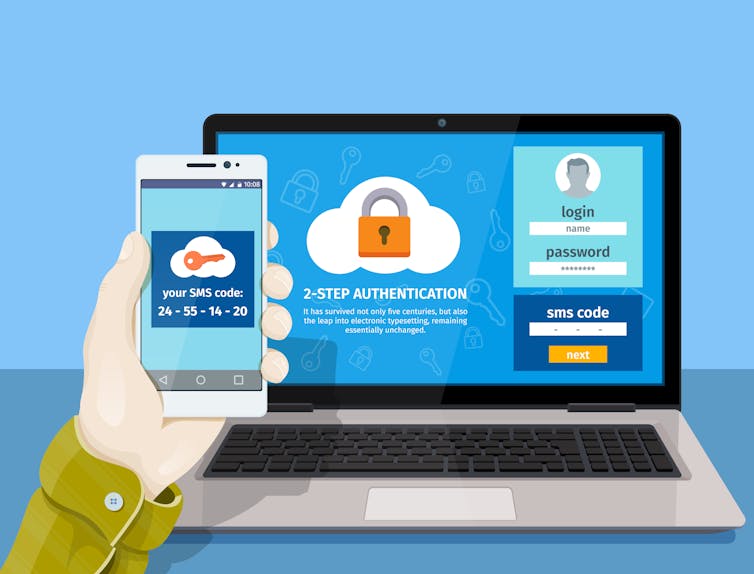
Shutterstock

Usernames and passwords were once good enough to keep an account secure. But before long, cybercriminals figured out how to get around this.

Often they’ll use “brute force attacks”, bombarding a user’s account with various password and login combinations in a bid to guess the correct one.

To deal with such attacks, a second layer of security was added in an approach known as two-factor authentication, or 2FA. It’s widespread now, but does 2FA also leave room for loopholes cybercriminals can exploit? https://giphy.com/embed/IgLIVXrBcID9cExa6r

2FA via text message

There are various types of 2FA. The most common method is to be sent a single-use code as an SMS message to your phone, which you then enter following a prompt from the website or service you’re trying to access.

Most of us are familiar with this method as it’s favoured by major social media platforms. However, while it may seem safe enough, it isn’t necessarily.


AlsoRead...

Svitla Systems

Svitla Systems acquires Australia’s Kiandra IT to expand Global Engineering Footprint and Accelerate AI-Driven delivery

11 May 2026
How Clevero is helping Australian Service Businesses compete with Enterprises on a Fraction of the Budget

How Clevero is helping Australian Service Businesses compete with Enterprises on a Fraction of the Budget

28 April 2026

Hackers have been known to trick mobile phone carriers (such as Telstra or Optus) into transferring a victim’s phone number to their own phone.

Pretending to be the intended victim, the hacker contacts the carrier with a story about losing their phone, requesting a new SIM with the victim’s number to be sent to them. Any authentication code sent to that number then goes directly to the hacker, granting them access to the victim’s accounts.
This method is called SIM swapping. It’s probably the easiest of several types of scams that can circumvent 2FA.

And while carriers’ verification processes for SIM requests are improving, a competent trickster can talk their way around them.

Authenticator apps

The authenticator method is more secure than 2FA via text message. It works on a principle known as TOTP, or “time-based one-time password”.

TOTP is more secure than SMS because a code is generated on your device rather than being sent across the network, where it might be intercepted.

The authenticator method uses apps such as Google Authenticator, LastPass, 1Password, Microsoft Authenticator, Authy and Yubico.

However, while it’s safer than 2FA via SMS, there have been reports of hackers stealing authentication codes from Android smartphones. They do this by tricking the user into installing malware (software designed to cause harm) that copies and sends the codes to the hacker.

The Android operating system is easier to hack than the iPhone iOS. Apple’s iOS is proprietary, while Android is open-source, making it easier to install malware on.

2FA using details unique to you

Biometric methods are another form of 2FA. These include fingerprint login, face recognition, retinal or iris scans, and voice recognition. Biometric identification is becoming popular for its ease of use.

Most smartphones today can be unlocked by placing a finger on the scanner or letting the camera scan your face – much quicker than entering a password or passcode.

However, biometric data can be hacked, too, either from the servers where they are stored or from the software that processes the data.

One case in point is last year’s Biostar 2 data breach in which nearly 28 million biometric records were hacked. BioStar 2 is a security system that uses facial recognition and fingerprinting technology to help organisations secure access to buildings.

There can also be false negatives and false positives in biometric recognition. Dirt on the fingerprint reader or on the person’s finger can lead to false negatives. Also, faces can sometimes be similar enough to fool facial recognition systems. https://giphy.com/embed/jnEQ1YoSLy9gSic7Qv

Another type of 2FA comes in the form of personal security questions such as “what city did your parents meet in?” or “what was your first pet’s name?”

Only the most determined and resourceful hacker will be able to find answers to these questions. It’s unlikely, but still possible, especially as more of us adopt public online profiles.
Person looks at a social media post from a woman, on their mobile.
Often when we share our lives on the internet, we fail to consider what kinds of people may be watching. Shutterstock

2FA remains best practice

Despite all of the above, the biggest vulnerability to being hacked is still the human factor. Successful hackers have a bewildering array of psychological tricks in their arsenal.

A cyber attack could come as a polite request, a scary warning, a message ostensibly from a friend or colleague, or an intriguing “clickbait” link in an email.

The best way to protect yourself from hackers is to develop a healthy amount of scepticism. If you carefully check websites and links before clicking through and also use 2FA, the chances of being hacked become vanishingly small.

The bottom line is that 2FA is effective at keeping your accounts safe. However, try to avoid the less secure SMS method when given the option.

Just as burglars in the real world focus on houses with poor security, hackers on the internet look for weaknesses.

And while any security measure can be overcome with enough effort, a hacker won’t make that investment unless they stand to gain something of greater value.

David Tuffley, Senior Lecturer in Applied Ethics & CyberSecurity, Griffith University

This article is republished from The Conversation under a Creative Commons license. Read the original article.


Tags: SB001
DMCA.com Protection Status

SUBSCRIBE to our NEWSLETTER

[mc4wp_form id=”2384248″]

Don't Miss

Svitla Systems acquires Australia’s Kiandra IT to expand Global Engineering Footprint and Accelerate AI-Driven delivery

by Pauline Torongo
11 May 2026
Svitla Systems
Business & Finance

Acquisition marks Svitla’s entry into the Australian market and strengthens capabilities in low-code, Microsoft technologies, and enterprise software engineering.

Read moreDetails

Residential Healthcare Practices: Revolution or Evolution?

by Pauline Torongo
11 May 2026
Residential Healthcare Practices: Revolution or Evolution?
Lifestyle

President Bill Lutz’s "revolution" was born from his background in fine dining, which instilled a disciplined, customer-focused approach.

Read moreDetails

Medicana Health Group launches HPV vaccination campaign to support cervical cancer prevention

by Pauline Torongo
28 April 2026
Medicana Health Group launches HPV vaccination campaign to support cervical cancer prevention
Health & Wellness

The Türkiye-based healthcare group has introduced a new awareness campaign focused on HPV vaccination, regular check-ups and early detection, with...

Read moreDetails

How Clevero is helping Australian Service Businesses compete with Enterprises on a Fraction of the Budget

by Pauline Torongo
28 April 2026
How Clevero is helping Australian Service Businesses compete with Enterprises on a Fraction of the Budget
Business & Finance

By consolidating CRM, scheduling, workflow automation, invoicing, reporting, and client communications into a single platform, Clevero gives smaller operators the...

Read moreDetails

How CJAM Group is building 1,100 homes across Southeast Queensland

by Pauline Torongo
24 March 2026
How CJAM Group is building 1,100 homes across Southeast Queensland
Lifestyle

The CJAM Group founder is quietly building a 1,100+ home pipeline, with projects in Hervey Bay and Toowoomba, using a...

Read moreDetails

Design Without Compromise: Where Gutter Protection Meets Modern Architecture

by Fazila Olla-Logday
20 March 2026
Design Without Compromise: Where Gutter Protection Meets Modern Architecture
Business & Finance

Design without compromise by integrating gutter protection seamlessly into modern architecture. Discover how innovative gutter systems enhance your home’s aesthetics...

Read moreDetails

How WageSafe Secured Australia’s Most Reputable Retail Business Among Its Premium Clients

by Fazila Olla-Logday
12 March 2026
How WageSafe Secured Australia’s Most Reputable Retail Business Among Its Premium Clients
at

Learn how WageSafe helps businesses stay compliant with payroll and wage regulations through reliable monitoring, risk management, and expert support—protecting...

Read moreDetails
Load More

Copyright © Blue Sky Publications Ltd. All Rights Reserved.
australiantimes.co.uk is a division of Blue Sky Publications Ltd. Reproduction without permission prohibited. DMCA.com Protection Status

  • About us
  • Write for Us
  • Advertise
  • Contact us
  • T&Cs, Privacy and GDPR
No Result
View All Result
  • News
    • Weather
    • Sport
    • Technology
    • Business & Finance
      • Currency Zone
    • Lotto Results
      • The Lott
  • Lifestyle
    • Entertainment
    • Horoscopes
    • Health & Wellness
    • Recipes
  • Travel
  • Expat Life
  • Move to Australia

Copyright © Blue Sky Publications Ltd. All Rights Reserved.
australiantimes.co.uk is a division of Blue Sky Publications Ltd. Reproduction without permission prohibited. DMCA.com Protection Status

No Result
View All Result
  • News
    • Weather
    • Sport
    • Technology
    • Business & Finance
      • Currency Zone
    • Lotto Results
      • The Lott
  • Lifestyle
    • Entertainment
    • Horoscopes
    • Health & Wellness
    • Recipes
  • Travel
  • Expat Life
  • Move to Australia

Copyright © Blue Sky Publications Ltd. All Rights Reserved.
australiantimes.co.uk is a division of Blue Sky Publications Ltd. Reproduction without permission prohibited. DMCA.com Protection Status





