

• Advertise
  • About us
  • Terms and Conditions
  • Contact us
Wednesday, September 30, 2026
Australian Times News
  • News
    • Weather
    • Sport
    • Technology
    • Business & Finance
      • Currency Zone
    • Lotto Results
      • The Lott
  • Lifestyle
    • Entertainment
    • Horoscopes
    • Health & Wellness
    • Recipes
  • Travel
  • Expat Life
  • Move to Australia
No Result
View All Result
  • News
    • Weather
    • Sport
    • Technology
    • Business & Finance
      • Currency Zone
    • Lotto Results
      • The Lott
  • Lifestyle
    • Entertainment
    • Horoscopes
    • Health & Wellness
    • Recipes
  • Travel
  • Expat Life
  • Move to Australia
No Result
View All Result
Australian Times News
No Result
View All Result
Home News

Virgin Orbit launched a rocket from a plane – here’s how

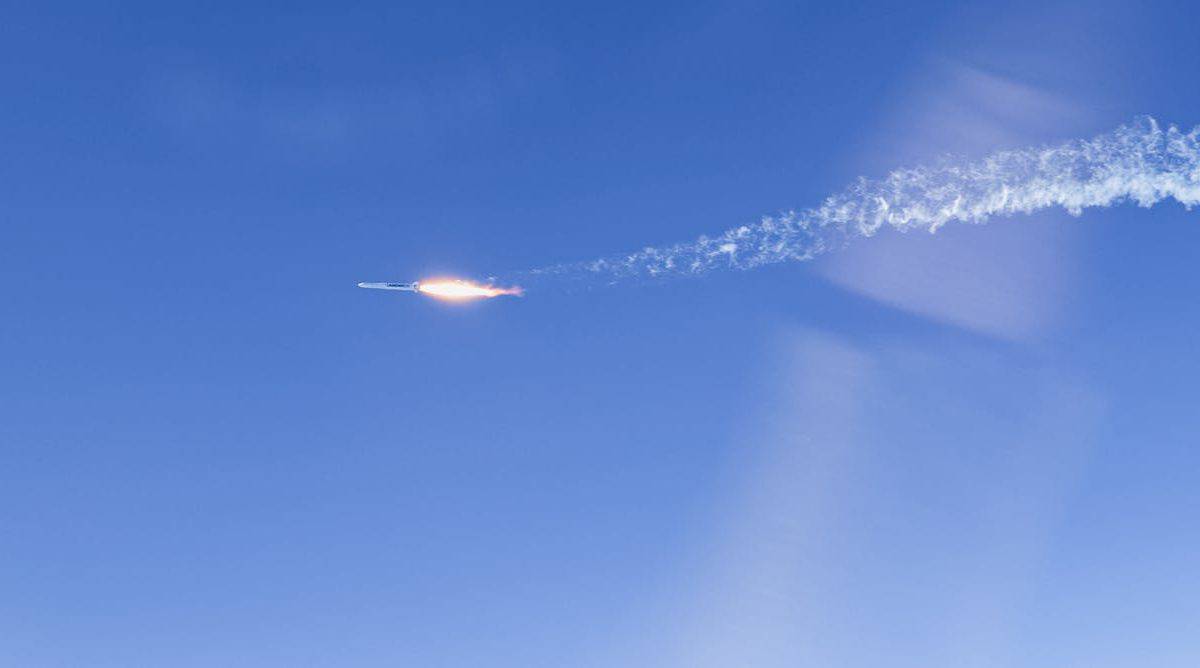
Earlier this month, ten cubesats – small, cheap satellites weighing about a kilogram each – were sent into orbit around Earth. With almost 1,500 of these small satellites launched so far, adding another ten might seem trivial. But this was no ordinary launch.

The Conversation by The Conversation
31-01-2021 06:25
in News
Lift off. Virgin Orbit/Greg Robinson, CC BY-SA

Lift off. Virgin Orbit/Greg Robinson, CC BY-SA

Simon Lindsay, University of Leicester

Earlier this month, ten cubesats – small, cheap satellites weighing about a kilogram each – were sent into orbit around Earth. With almost 1,500 of these small satellites launched so far, adding another ten might seem trivial. But this was no ordinary launch.

Instead of lifting off from the ground, the rocket carrying these Nasa satellites was slung under the wing of a modified Boeing 747, called Cosmic Girl. The plane carried them to a height of 11km (6.8 miles) before launching the rocket.

This was the first successful launch of Virgin Orbit’s LauncherOne rocket, marking the start of its commercial ventures. The company hopes to provide cheap, flexible satellite launching services, without the need to use sites on the ground.

But how does launching a rocket from a plane actually work?
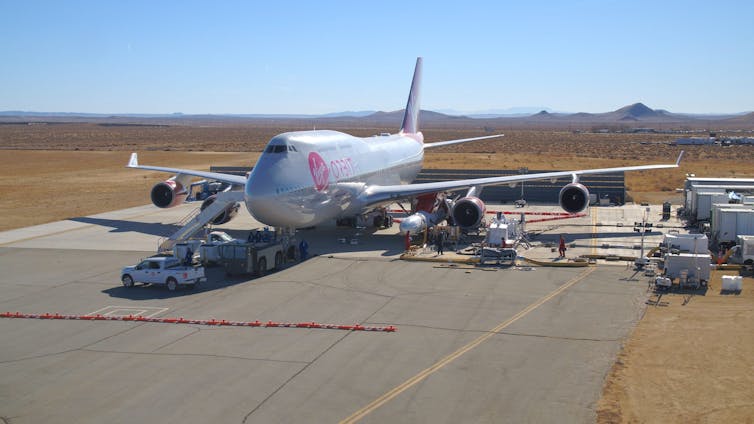
Virgin Orbit's plane on a runway.
She’s just a Cosmic Girl. Virgin Orbit/Greg Robinson, CC BY

Launching from a plane

Usually, a rocket launched from a launch site on the ground will have two or three stages, which allow the rocket to shed weight as it uses up fuel. The first stage is the part which ignites at launch, powering the rocket from the ground. When the rocket reaches a certain altitude, the first stage then separates, leaving the second to ignite. A third stage operates on the same principle and typically places the payload – the part we want to get into space – in its final orbit or interplanetary trajectory.

When satellites are launched from a plane, the carrier aircraft functions as both a launch site and a reusable first stage of the rocket.


AlsoRead...

Mark Levin and Yael Eckstein: Celebrating 250 Years - The Bond Between America and Israel

Mark Levin and Yael Eckstein: Celebrating 250 Years – The Bond Between America and Israel

30 September 2026
How supporting Australia’s Care Workforce could strengthen care in the community

How supporting Australia’s Care Workforce could strengthen care in the community

10 September 2026

Aircraft are more efficient than rockets at getting off the ground, but they cannot function without an atmosphere to generate aerodynamic lift. Air-launching takes advantage of this by attaching a rocket to an aircraft and releasing it at high altitude.

As well as saving fuel getting off the ground, aircraft launches offer other benefits. Traditional rocket launches are often repeatedly delayed by bad weather conditions. With an aircraft, it’s easy to change launch sites because it can take off from a commercial airport. Pesky weather conditions can simply be flown around, and different launch requirements for different spacecraft can easily be accommodated.
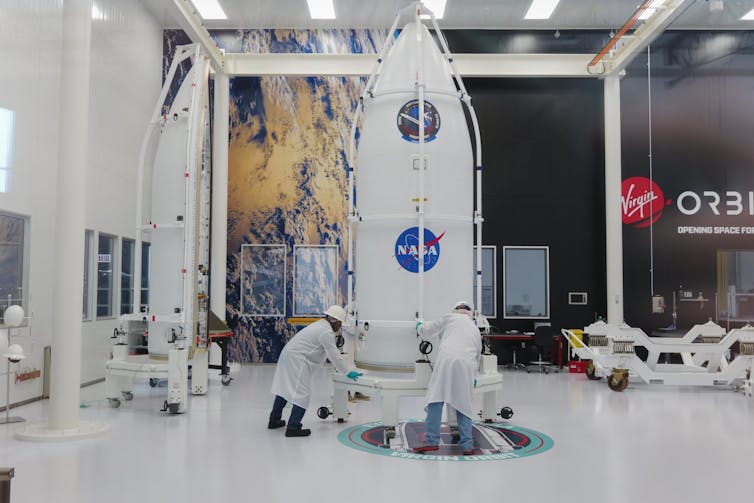
The NASA payload in a warehouse being inspected by two men.
The payload. Virgin Orbit/Greg Robinson, CC BY

There are limits

Of course, air-launching isn’t a perfect solution. The size of rocket is limited to the carrying capacity of the aircraft. A dedicated carrier aircraft may be able to carry much more, but for now there is not much scope for larger launchers.

Stratolaunch, the developers of the enormous carrier aircraft of the same name able to carry a rocket weighing 250 tons, abandoned its heavy-lift launch vehicle program in 2019. For comparison, LauncherOne weighs 30 tons, and will only be used to carry small satellites.

Launching a rocket 10km from the ground saves some fuel, but most of the fuel requirement to achieve orbit is not in gaining height, but getting it moving with enough speed so that it falls into orbit. While the flight speed of an aircraft can make a small contribution to this requirement, the fuel saving from air launch is not as large as it might first appear.

A relatively small launch vehicle, LauncherOne, has the capacity to launch 500kg into low earth orbit. Heavy-lift launchers like Ariane, Delta and Falcon can launch many times this weight, and will continue to be used for large satellites and interplanetary missions.

But large, expensive launches aren’t Virgin Orbit’s target audience. For small satellites, cubesats, micro-satellites and nano-satellites – all of which are being rapidly adopted by the space industry – air launches could represent a significant improvement in versatility and, crucially, cost.

What’s next?

The idea of air launching has been around for some time. Nasa launched a Pegasus rocket from a B-52 bomber as long ago as 1990. The Pegasus launch service is still operational, and has completed 39 successful flights, but its launches are expensive and only four have been made in the last ten years.

In the short term, several launch contracts are already in place. Longer term, there are plans to expand the LauncherOne rocket with a third stage, which may be able to place smaller satellites – 50kg or so – into much more distant orbits to fly past Mars or Venus.

There are not many other air launch programmes in development. SpaceX abandoned an air-launched Falcon variant way back in 2012. The Pegasus launch vehicle still exists but hasn’t launched since 2019.

British aerospace company Reaction Engines aims to fully combine aircraft and spacecraft with the SABRE engine which can function like a jet within the atmosphere and a chemical rocket in space. But this project has been delayed multiple times and may still be some distance from making its first commercial launch.

As the provision of launch services moves ever more into the private sector, LauncherOne must make an economic case to survive in an increasingly competitive market. There aren’t yet many direct competitors for small individual launches like those offered by Virgin Orbit, although heavier launchers from more established companies such as SpaceX can compete by launching several small payloads on the same rocket. It remains to be seen if the system’s versatility and relatively low cost will win out.

Simon Lindsay, Researcher in the School of Physics and Astronomy, University of Leicester

This article is republished from The Conversation under a Creative Commons license. Read the original article.


Tags: SB001
DMCA.com Protection Status

SUBSCRIBE to our NEWSLETTER

[mc4wp_form id=”2384248″]

Don't Miss

Mark Levin and Yael Eckstein: Celebrating 250 Years – The Bond Between America and Israel

by Pauline Torongo
30 September 2026
Mark Levin and Yael Eckstein: Celebrating 250 Years - The Bond Between America and Israel
News

As America marks 250 years since the Declaration of Independence, Yael Eckstein and Mark Levin explore the biblical values and...

Read moreDetails

How supporting Australia’s Care Workforce could strengthen care in the community

by Pauline Torongo
10 September 2026
How supporting Australia’s Care Workforce could strengthen care in the community
News

Australian care funding faces growing scrutiny after a 2025 ANAO report found NDIS losses from fraud, non-compliance, and payment errors...

Read moreDetails

The Future of Work Is Changing: What HR must champion next, according to Energy Collective Co

by Pauline Torongo
28 August 2026
What HR Must Champion Next, According to Energy Collective Co
Business & Finance

Energy Collective Co examines the root causes of performance by considering how work is designed, how leadership is enacted and...

Read moreDetails

From Empathy Burnout to Body-Led Recovery: What Heidi Jane of Intuition Co. learned by living through what she teaches

by Pauline Torongo
25 August 2026
What Heidi Jane of Intuition Co. learned by living through what she teaches
Lifestyle

Recognising emotional exhaustion is only the first step. While supportive habits such as rest, time in nature, hydration, and reduced...

Read moreDetails

Why Smarter Fleet Management Is For All Modern Business Options

by Fazila Olla-Logday
29 July 2026
Smarter Fleet Management
Motoring

Operating a business that relies on vehicles is harder than ever.

Read moreDetails

Animal Communication Goes Beyond What Science Can Currently Measure: Zoologist and Spiritual teacher Artemis, the heart whisperer on what the textbooks don’t teach

by Australian Times
7 July 2026
Animal Communication Goes Beyond What Science Can Currently Measure
Lifestyle

Animal communication classes and formal training can be valuable, providing tools, structure, and guidance.

Read moreDetails

Managing Aussie Share Portfolios Abroad: Tips for Growth

by Fazila Olla-Logday
2 July 2026
Managing Aussie Share Portfolios Abroad: Tips for Growth
at

Unlock the secrets to optimizing your Aussie share portfolios abroad. Discover essential tips for growth and navigate the global market...

Read moreDetails
Load More

Copyright © Blue Sky Publications Ltd. All Rights Reserved.
australiantimes.co.uk is a division of Blue Sky Publications Ltd. Reproduction without permission prohibited. DMCA.com Protection Status

  • About us
  • Write for Us
  • Advertise
  • Contact us
  • T&Cs, Privacy and GDPR
No Result
View All Result
  • News
    • Weather
    • Sport
    • Technology
    • Business & Finance
      • Currency Zone
    • Lotto Results
      • The Lott
  • Lifestyle
    • Entertainment
    • Horoscopes
    • Health & Wellness
    • Recipes
  • Travel
  • Expat Life
  • Move to Australia

Copyright © Blue Sky Publications Ltd. All Rights Reserved.
australiantimes.co.uk is a division of Blue Sky Publications Ltd. Reproduction without permission prohibited. DMCA.com Protection Status

No Result
View All Result
  • News
    • Weather
    • Sport
    • Technology
    • Business & Finance
      • Currency Zone
    • Lotto Results
      • The Lott
  • Lifestyle
    • Entertainment
    • Horoscopes
    • Health & Wellness
    • Recipes
  • Travel
  • Expat Life
  • Move to Australia

Copyright © Blue Sky Publications Ltd. All Rights Reserved.
australiantimes.co.uk is a division of Blue Sky Publications Ltd. Reproduction without permission prohibited. DMCA.com Protection Status





