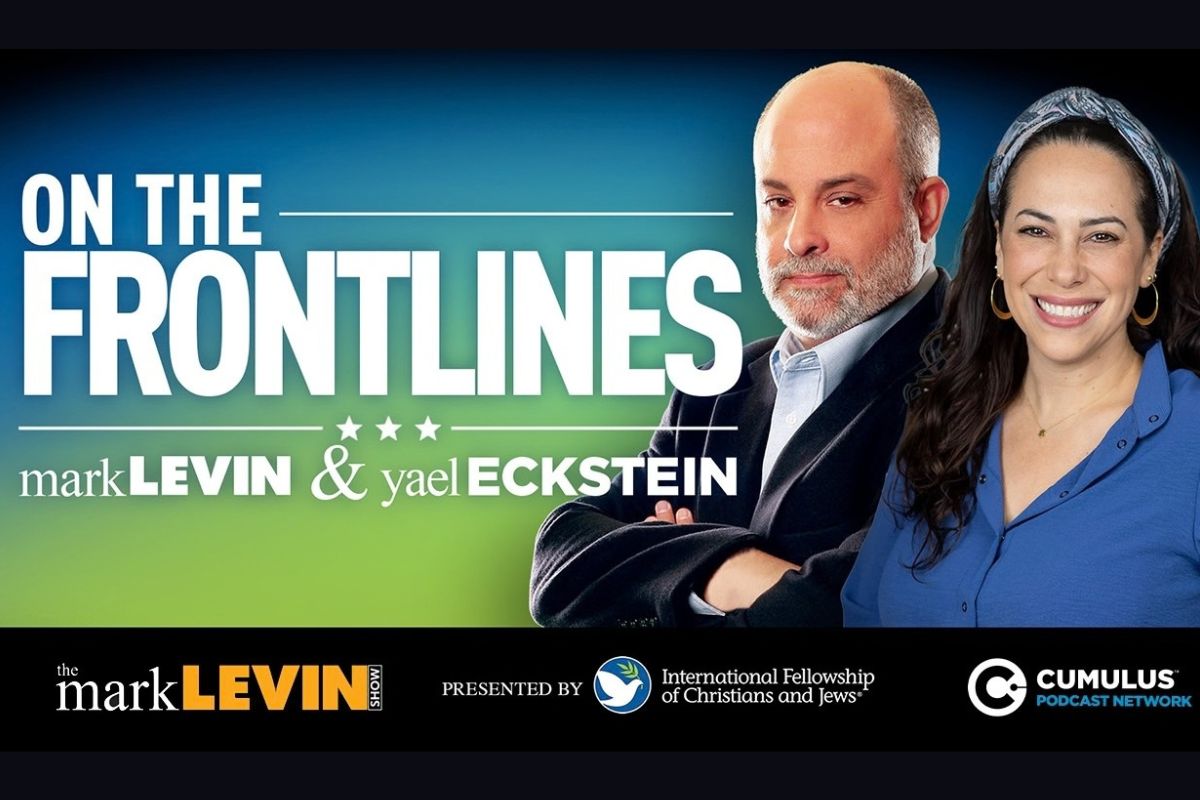
As the United States celebrates 250 years since the Declaration of Independence, Yael Eckstein and Mark Levin are looking beyond the anniversary itself to the biblical values, shared convictions, and history connecting America and Israel.
Eckstein is president and CEO of the International Fellowship of Christians and Jews, also known as IFCJ or The Fellowship. She oversees all ministry programs and serves as the organization’s international spokesperson. Before assuming her current role, Eckstein served as global executive vice president, senior vice president and director of program development and ministry outreach.
Based in Israel with her husband and four children, Eckstein is a published writer, social services professional and prominent voice on Jewish-Christian relations. She has contributed to The Jerusalem Post, The Times of Israel and other publications. She is also the author of three books: Generation to Generation: Passing on a Legacy of Faith to Our Children, Holy Land Reflections: A Collection of Inspirational Insights from Israel and Spiritual Cooking with Yael.
Eckstein has partnered with international organisations, appeared on national television and met with U.S. and world leaders on matters of shared concern. She has been a featured guest on CBN’s “The 700 Club” and served on a 2015 Religious Liberty Panel on Capitol Hill addressing persecution in the Middle East. Her honours include recognition in The Jerusalem Post’s lists of influential Jews, The Algemeiner’s Jewish 100, a 2022 CEO World Award and The Jerusalem Post’s 2023 Humanitarian Award.
Born in Evanston, Illinois, outside Chicago, Eckstein studied biblical texts at Torat Chesed Seminary in Israel, Jewish studies and sociology at Queens College in New York, and completed additional studies at Hebrew University in Jerusalem. She has also taught Hebrew and Jewish studies in the United States.
In this special episode, Eckstein joined Levin on his podcast called “On The Frontlines” to discuss the historical, spiritual and strategic bond between the United States and Israel. Levin, an American broadcaster and former Reagan administration official, reflects on the influence of Jewish teachings on America’s founding and why the alliance remains consequential 250 years later.
The following interview has been edited for brevity.


Mark Levin and Yael Eckstein in Conversation
ML: The connection between Jews and Christians and the American founding is quite profound, isn’t it?
YE: It’s incredible to be celebrating America’s 250th with you, Mark, because of all those things you said. Israel and America stand together in the most sacred values known to man: the freedom given to all, and the love and sanctity of life.
That may have sounded like a given for many decades: that everyone sanctifies life and everyone desires to live in freedom. But what we see more and more is that it’s not always the case. When we go back to the founding of America, the founders were working with a whole new concept: democracy, freedom, every voice being equal, every person created equal, and justice for everyone. These were new concepts, and they were found in the Bible.
So when we move forward today, 250 years later, we see how those values have flourished, how Jews and Christians set the foundation for this incredible country. And then we see how that led into the founding of the modern State of Israel after 2,000 years of exile. Those same founders were reading the words of the Bible, and now, generations later, Americans are part of helping Israel come to fruition and bring those words to life.
There’s nothing more sacred, as far as I see it, than this bond and brotherhood between America and Israel, and Christians and Jews. I believe God created us for this moment, to make sure it not only survives but strengthens.
There are many Americans who have made what’s called aliyah to Israel, moved there because of their faith, who remain deeply committed to the United States as well as Israel. So there’s a significant population of Americans there, is there not?
YE: There is. If you come to Israel, even the street signs are written in three languages: Hebrew, Arabic, and English. It’s in Arabic because we’re in the Middle East, and because 20% of our population is not Jewish. That population includes Arabs, Christians, Bedouins, and Druze, almost all native to the Middle East and Arabic-speaking.
But we also have English because Israel loves America and identifies with America. That’s why English is one of the most prominent languages you’ll hear on the street. What’s incredible is that you also hear Russian because so many Russian immigrants have come to Israel. You hear Amharic because of the Ethiopian Jewish community. You hear French because of the many Jews who’ve come from France. And you hear Spanish because of Jews from South America who have made aliyah.
That’s one of the main things I prioritise in leading The Fellowship. Scripture says the Jewish people will return home to Israel, the scattered people will be gathered in Jerusalem. That’s why, every single day, The Fellowship brings aliyah flights of Jews home to Israel from all four corners of the earth.
And it’s Christians who make this possible, standing together not just in studying and believing the Scriptures, but in taking action to bring them to life. I think that’s totally awesome.
Can you tell us about your father’s founding of The Fellowship?
YE: There’s a Hebrew verse that says the end result reflects the first thought. My father, Rabbi Yechiel Eckstein, of blessed memory, had that first thought 42 years ago, when he was in Chicago and realised that Israel and the Jewish people, maybe for the first time ever, actually had friends.
Christian leaders, Pat Boone, Pat Robertson and Jerry Falwell, came to him and said, “We pray for Israel and the Jewish people. We love Israel and the Jewish people. We want to stand with you.”
Through that, my father said we, together, Christians and Jews, can learn from heroes like Pastor Dietrich Bonhoeffer and Corrie ten Boom, and say we stand together to create a new reality instead of just what we know from the history books.
There’s a biblical word, Mark. In Hebrew it’s Hineni. It means “Here I am.” It’s what someone says when they hear God’s call and say, “I will do whatever is needed to carry it out.” It’s what Abraham said before God told him to leave everything behind and go to the Holy Land. I believe it’s what my father said 42 years ago when he heard this calling from God.
Today, 42 years later, thank God, The Fellowship is part of bringing biblical prophecy to fruition. We’re the largest philanthropic organisation in Israel, feeding the hungry, clothing the naked, sheltering the poor, and being the voice of Christians who love and stand with Israel, especially during times when they’re not heard or reflected in the mainstream media.
How do the people you help on the ground in Israel find the strength to carry on? You’re helping the neediest people, particularly after these battles. How is their spirit? What’s their thinking like?
YE: I love that question, because Israel is really the most resilient country in the world. We go from the bomb shelter to get ice cream. I think it’s deeply ingrained in people of faith. When you know you’re doing the right thing, you somehow have this supernatural resilience to get up even when things are hard.
That Hebrew word we talked about, Hineni, here I am, and being able to do the hard things because God’s spirit is inside you. There’s so much darkness, so much anger, so much hatred around us, but I also see these scriptural words come alive: Hunger will not be for bread, and thirst will not be for water, but for wanting to hear the word of God.
We see the fastest-growing Christian population in the world is actually in Iran. The fastest-growing evangelical population in the world is in Iran, which I believe is so symbolic of what’s happening.
I was recently in Nazareth, where The Fellowship dedicated a new hospital floor for the Christian population in Israel. I see Jews and Christians standing together everywhere I look, and it makes me believe there’s a silent majority.
I used to think they were silent, Mark, but I don’t think they’re silenced. I think their voices are being silenced. But nothing can silence the word of God, the spirit of God.
When I go and deliver food and medicine, visit the elderly and the orphans, feed the hungry, clothe the naked, shelter the poor, and tell them, “This is from Christians in America who love you,” that’s the greatest inspiration.
I believe people are still committed to do good, still committed to help one another and still committed to hear the voice of God, which doesn’t have to do with politics or policy, but is calling every person, in their own way, to say, “Here I am. I’m willing to do what’s hard in order to do what’s right.”
About Yael Eckstein and The Fellowship
Yael Eckstein leads the International Fellowship of Christians and Jews as president and Global CEO, overseeing its ministry programs and representing the organisation internationally. Her leadership continues the work begun by her father, Rabbi Yechiel Eckstein, who founded The Fellowship to create a new relationship between Christians and Jews rooted in shared faith, friendship and action.
Eckstein’s work spans humanitarian relief, support for vulnerable Jewish communities, aliyah, emergency assistance and advocacy for Israel. Through her books, radio programs, podcast, public appearances and meetings with leaders, she also helps audiences understand Jewish faith, life in Israel and the continuing importance of Jewish-Christian relations.
The conversation with Levin places that work within the larger story of America and Israel. Their discussion presents the alliance as more than a political or military arrangement. It is a relationship grounded in biblical ideas, mutual interests, common threats, and a shared commitment to freedom and the sanctity of life.
As America marks 250 years since the Declaration of Independence, Yael Eckstein delivers a powerful message that the bond must be understood, taught, and carried forward. Her work through IFCJ turns that conviction into practical help for people on the ground, connecting Christians who stand with Israel to immigrants, older adults, families and communities that need to know they are not alone.