• Advertise
  • About us
  • Terms and Conditions
  • Contact us
Friday, November 7, 2025
Australian Times News
  • News
    • Weather
    • Sport
    • Technology
    • Business & Finance
      • Currency Zone
    • Lotto Results
      • The Lott
  • Lifestyle
    • Entertainment
    • Horoscopes
    • Health & Wellness
    • Recipes
  • Travel
  • Expat Life
  • Move to Australia
No Result
View All Result
  • News
    • Weather
    • Sport
    • Technology
    • Business & Finance
      • Currency Zone
    • Lotto Results
      • The Lott
  • Lifestyle
    • Entertainment
    • Horoscopes
    • Health & Wellness
    • Recipes
  • Travel
  • Expat Life
  • Move to Australia
No Result
View All Result
Australian Times News
No Result
View All Result
Home News

The Reserve Bank thinks the recovery will look V-shaped. There are reasons to doubt it

Reserve Bank’s long-awaited two-year forecasts for jobs, wages and growth

The Conversation by The Conversation
10-05-2020 02:05
in News
The Reserve bank

Photo credit Shutterstock/RBA

Peter Martin, Crawford School of Public Policy, Australian National University

The Reserve Bank’s long-awaited two-year forecasts for jobs, wages and growth are frightening, but I fear they are not frightening enough.

The bank looks two years ahead every three months. The last set of forecasts, released at the start of February, mentioned coronavirus mainly as a source of “uncertainty”.

That’s how much things have changed.

Back then economic growth was going to climb over time, consumers were going to start opening their wallets again (household spending had been incredibly weak) and unemployment was going to plunge below 5%.

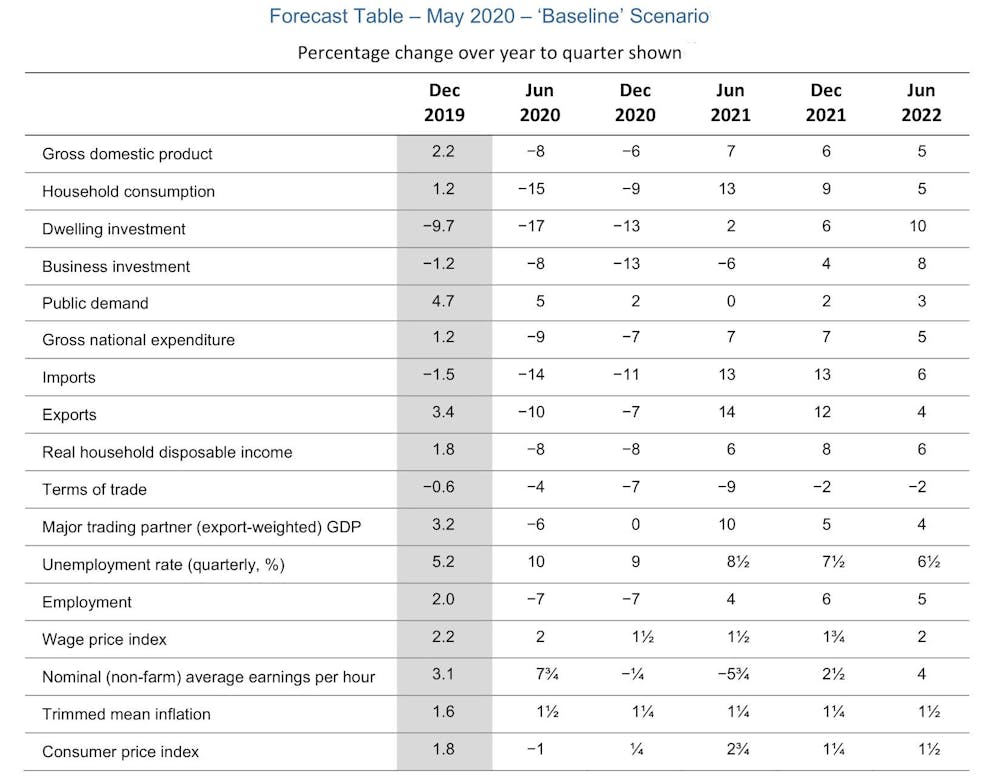
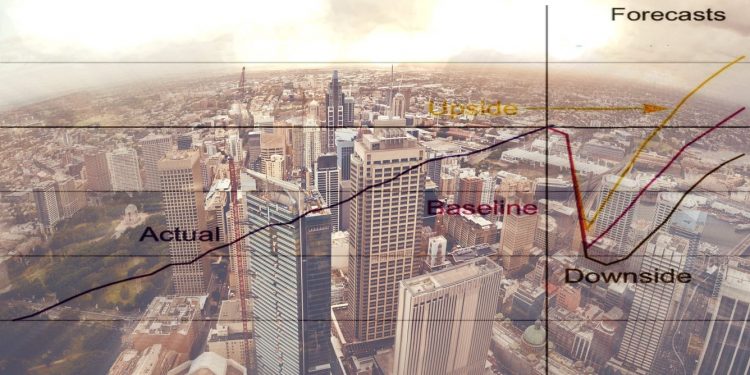
The forecasts released on Friday come in three sets – “baseline”, a quicker economic recovery, and a slower recovery.

“Baseline”, the central set with which we will concern ourselves here, is both shocking, and disconcertingly encouraging.


AlsoRead...

Welding Safety Gear in NZ: Helmets, Respirators, and Fume Control

Welding Safety Gear in NZ: Helmets, Respirators, and Fume Control

18 August 2025
Why the Greeff Brothers built Founders table as Australia's answer to Elite Business Communities that cost nothing

Why the Greeff Brothers built Founders table as Australia’s answer to Elite Business Communities that cost nothing

4 August 2025

Reserve Bank Statement on Monetary Policy, May 2020

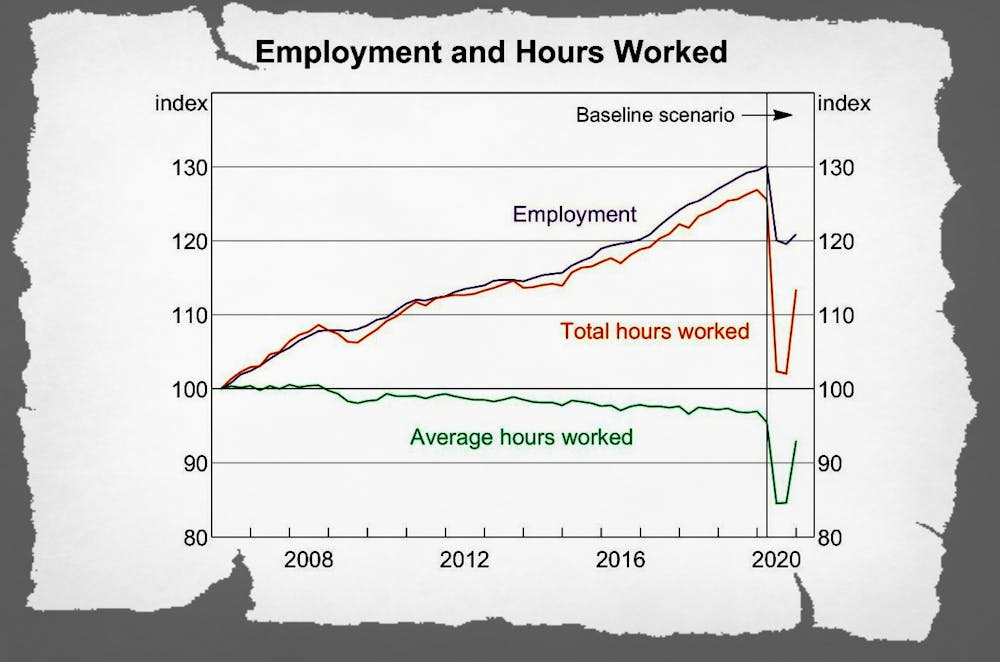
On employment, it predicts a drop of more than 7% in the first half of this year, most of it in the “June quarter”, the three months of April, May and June that we are in the middle of.

Thirteen million of us were employed in March, making a drop of 7%, a drop of 900,000. Put differently, one in every 13 of us will lose their jobs.

Harder to believe is that by December next year 6% of the workforce will have got them back.

It sounds like what the prime minister referred to earlier in the crisis as a “snapback”, the economy snapping back to where it was.

Except that it’s not.
Reserve Bank Statement on Monetary Policy, May 2020

Six per cent of a small number is a lot less than 7% of a big number.

The bank’s forecasts have far fewer people in work all the way out to mid 2022 (the limit of the published forecasts) and doubless well beyond.

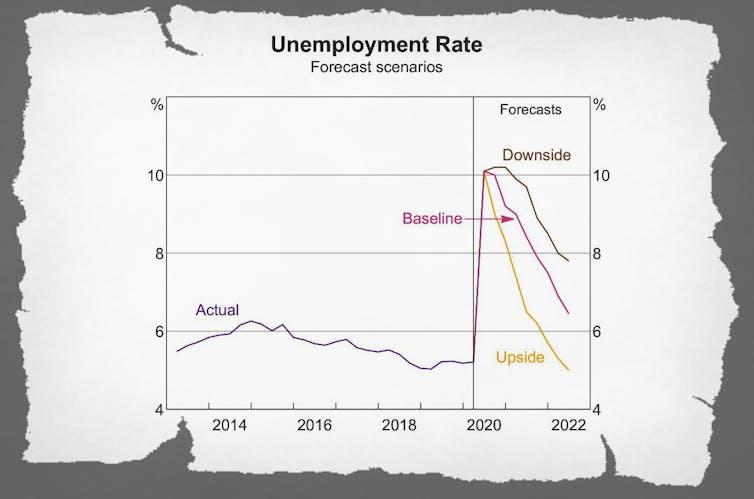
The unemployment rate would shoot up to 10% by June and take a long while to fall.
Reserve Bank Statement on Monetary Policy, May 2020

The baseline economic growth forecast is also drawn as a V.

After economic activity shrinks more than 8% in the June quarter, we are asked to believe it will bound back 7% in the year that follows.

But that will still leave us with much lower living standards than we would have had, missing the usual 2-3% per year increase.
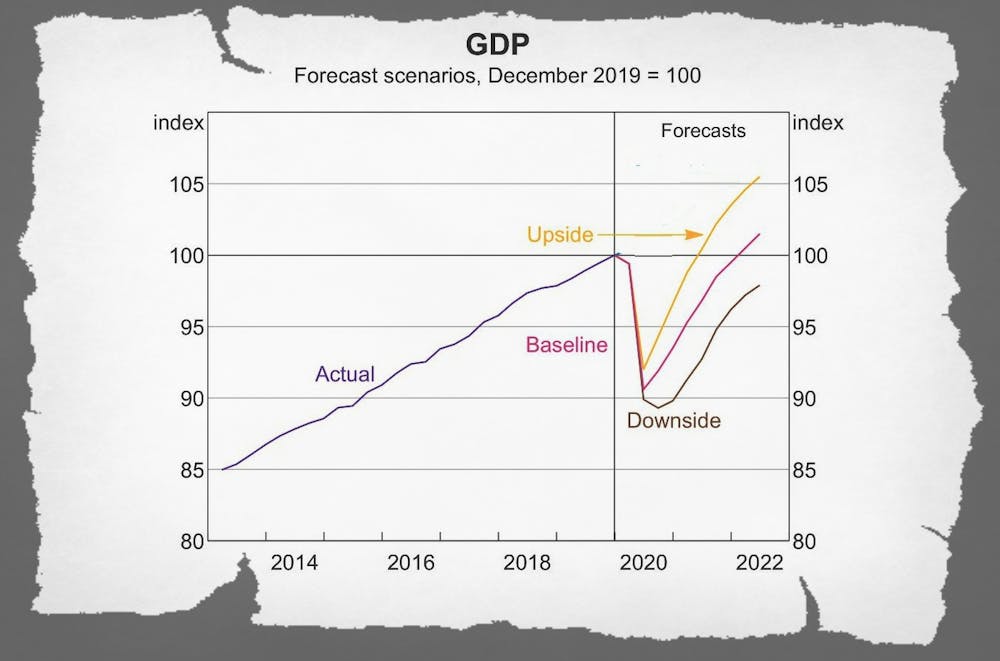
Reserve Bank Statement on Monetary Policy, May 2020

The reason I fear the baseline forecasts aren’t frightening enough is that they are partly built on a return to form for household spending, which accounts for 65% of gross domestic product.

After diving 15% mainly in this quarter we are asked to believe it will climb back 13% in the year that follows.

Maybe. But here’s another theory. While we’ve been restricted in movement or without jobs we’ve become used to spending less (and used to flying less, and used to hanging onto our cars for longer and hanging on to the money we’ve got).

My suspicion is that these behaviours can be learned, and we’ve been doing them long enough to learn them.

During the global financial crisis we tightened our belts and then kept them tight for years, saving far more than the offical forecasts expected, in part because we had been shocked and felt certain about the future.

A recovery that had been forecast to be V-shaped looked more like a flat-bottomed boat when graphed. It’s a picture I find more believable than a snapback.

We are unlikley to get back where we would have been for a very long time.

Peter Martin, Visiting Fellow, Crawford School of Public Policy, Australian National University

This article is republished from The Conversation under a Creative Commons license. Read the original article.


Tags: SB001
DMCA.com Protection Status

SUBSCRIBE to our NEWSLETTER

[mc4wp_form id=”2384248″]

Don't Miss

Where in Europe you should go for your next breakaway

by Fazila Olla-Logday
8 October 2025
Where in Europe you should go for your next breakaway
Travel

When it comes to travelling and going on holiday, you can’t really go wrong when booking a trip to Europe....

Read more

Why Fairness Matters in Today’s Online Gaming World

by Fazila Olla-Logday
17 September 2025
What Real Fairness in Online Gaming Looks Like
Gaming

Explore what makes gaming platforms trustworthy and fair. Learn what to look for and how fairness enhances your experience.

Read more

Dee Tozer reveals why criticism mutes lovingness in partnerships

by Pauline Torongo
12 September 2025
Dee Tozer reveals why criticism mutes lovingness in partnerships
Lifestyle

Criticism is often brushed off as “just being honest” or “trying to help.” Yet in practice, its impact on relationships...

Read more

Global Shifts: How Geopolitics and Economics Are Driving Private Jet Demand

by Fazila Olla-Logday
4 September 2025
How Geopolitics and Economics Are Driving Private Jet Demand
Travel

The rise in global wealth—particularly across emerging economies—is reshaping private jets from symbols of luxury into vital tools for business...

Read more

5 Things Australians Renting in the UK Need to Know About Possession Claims

by Fazila Olla-Logday
4 September 2025
5 Things Australians Renting in the UK Need to Know About Possession Claims
Expat Life

Facing a possession claim while renting in the UK? Here's what Australians need to know to protect their rights and...

Read more

How Charity Solicitors Help UK Organisations Stay Legally Compliant

by Fazila Olla-Logday
4 September 2025
How Charity Solicitors Help UK Organisations Stay Legally Compliant
Lifestyle

Charity solicitors help UK organisations stay legally compliant by advising on governance, regulatory duties, and Charity Commission requirements.

Read more

5 Ways a Power of Attorney Can Protect Your Wellbeing and Future

by Fazila Olla-Logday
4 September 2025
5 Ways a Power of Attorney Can Protect Your Wellbeing and Future
Expat Life

A Power of Attorney lets someone you trust make decisions if you're unable to. From managing money to making healthcare...

Read more
Load More

Copyright © Blue Sky Publications Ltd. All Rights Reserved.
australiantimes.co.uk is a division of Blue Sky Publications Ltd. Reproduction without permission prohibited. DMCA.com Protection Status

  • About us
  • Write for Us
  • Advertise
  • Contact us
  • T&Cs, Privacy and GDPR
No Result
View All Result
  • News
    • Weather
    • Sport
    • Technology
    • Business & Finance
      • Currency Zone
    • Lotto Results
      • The Lott
  • Lifestyle
    • Entertainment
    • Horoscopes
    • Health & Wellness
    • Recipes
  • Travel
  • Expat Life
  • Move to Australia

Copyright © Blue Sky Publications Ltd. All Rights Reserved.
australiantimes.co.uk is a division of Blue Sky Publications Ltd. Reproduction without permission prohibited. DMCA.com Protection Status