

• Advertise
  • About us
  • Terms and Conditions
  • Contact us
Tuesday, September 29, 2026
Australian Times News
  • News
    • Weather
    • Sport
    • Technology
    • Business & Finance
      • Currency Zone
    • Lotto Results
      • The Lott
  • Lifestyle
    • Entertainment
    • Horoscopes
    • Health & Wellness
    • Recipes
  • Travel
  • Expat Life
  • Move to Australia
No Result
View All Result
  • News
    • Weather
    • Sport
    • Technology
    • Business & Finance
      • Currency Zone
    • Lotto Results
      • The Lott
  • Lifestyle
    • Entertainment
    • Horoscopes
    • Health & Wellness
    • Recipes
  • Travel
  • Expat Life
  • Move to Australia
No Result
View All Result
Australian Times News
No Result
View All Result
Home News

The future of transport: how local people are helping to design new metro trains

The Tyne and Wear Metro train fleet has served the UK’s busiest light rail network outside London for over 40 years. Now, these trains are at the end of their working life – and people across the region have been contributing to the design for their replacement.

The Conversation by The Conversation
25-02-2021 22:19
in News
Electric Egg/Shutterstock

Electric Egg/Shutterstock

Simon Bowen, Newcastle University and Alexander Wilson, Newcastle University

The Tyne and Wear Metro train fleet has served the UK’s busiest light rail network outside London for over 40 years. Now, these trains are at the end of their working life – and people across the region have been contributing to the design for their replacement.

In 2016, Nexus, the public body running the publicly owned Tyne and Wear Metro, applied for the funds to replace the trains and commissioned a public consultation to understand what people across the region wanted from their new trains.

Nexus were aware of our work at Newcastle University in collaborative research and design and asked us to run a more exploratory part of the consultation to complement the questionnaires, interviews and focus groups used elsewhere.

Doing design with people – also known as co-design – has two benefits. It satisfies people’s democratic right to influence what affects them, and results in designs that better fit those people’s needs.

This is the case for the new Tyne and Wear Metro trains, which are set to be built by manufacturer Stadler. The design for the new trains was based on the concerns and ideas from the over 3,000 people who took part in the 2016 consultation. It includes more wheelchair spaces and CCTV cameras, information screens throughout, a sliding step between trains and platforms and multipurpose spaces for bikes, buggies and luggage.

Bringing people in

We began by running a series of co-design workshops with people who had a variety of needs – such as commuters, people with disabilities, and people travelling with bicycles. We also ran pop-up labs: drop-in activities in busy public locations spread across the region, such as shopping centres, travel interchanges, and a local market.


AlsoRead...

How supporting Australia’s Care Workforce could strengthen care in the community

How supporting Australia’s Care Workforce could strengthen care in the community

10 September 2026
What HR Must Champion Next, According to Energy Collective Co

The Future of Work Is Changing: What HR must champion next, according to Energy Collective Co

28 August 2026

We asked workshop participants to record their experiences of the metro trains. These video clips were shared between the workshop participants to work out common concerns with the current trains. The clips were also featured on our website and at pop-up labs to gather further comments and to generate discussion.
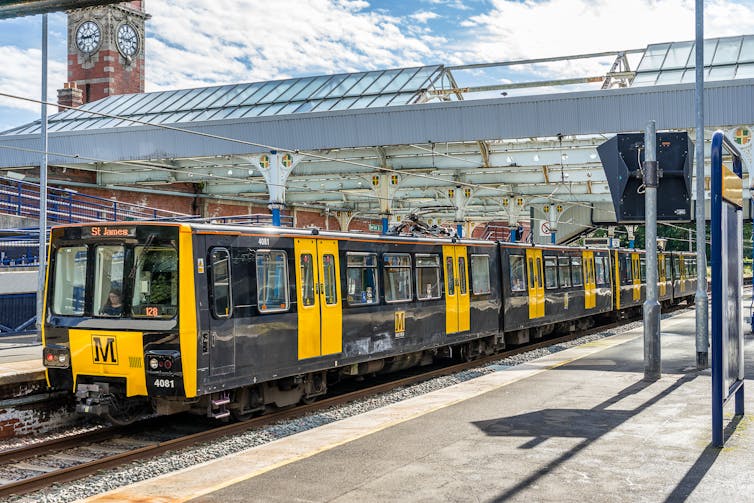
Yellow and black light rail train in station.
The current Metro trains. Gordon Bell/Shutterstock

We noticed that the participants’ ideas tended to focus on fixing concerns rather than exploring new design possibilities. So, we produced some imaginative design ideas that suggested alternative ways of dealing with concerns, such as tackling anti-social behaviour on trains by crowd-sourcing the monitoring of onboard CCTV cameras.

This enabled people to explore the implications of these ideas. For example, participants discussed how this management of onboard CCTV might be misused by some to show off to the cameras.

The pop-up labs were an opportunity to undertake quick, less detailed activities with more people across the region. The participants used technology we have developed, called JigsAudio, to share their experiences and ideas. People wrote and drew answers to a topic on wooden or card puzzle pieces. Each puzzle piece had its own unique electronic tag, and the participants held the piece to the JigsAudio device to record audio descriptions linked to their drawings.
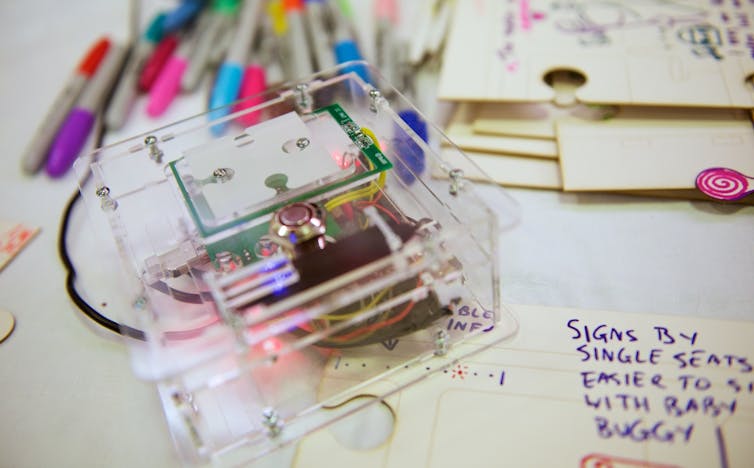
Photo showing pens, tech and paper puzzle pieces.
JigsAudio and puzzle pieces. Alexander Wilson, Author provided

This allowed people to share their ideas in ways they were used to (drawing, writing, and talking) rather than concentrating on how to use a new technology. This approach gave people more time to think about their answers.

We also produced videos that illustrated concerns with current trains and ideas for the new trains. Videos were shown to pop-up lab and website visitors, who fed back if they agreed or disagreed with them and left text or audio and video comments. This allowed our workshop findings to be developed further with more people across the region.
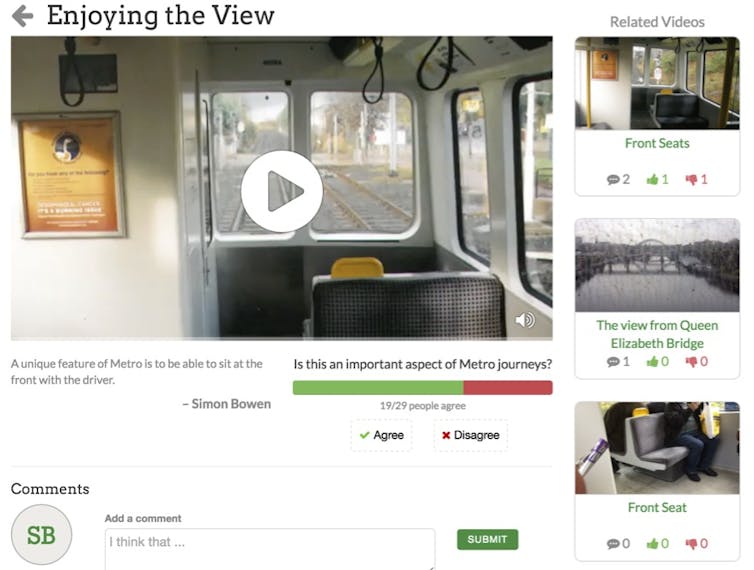
Screenshot of website with video and feedback options.
Metro Futures 2016 website, feeding back on a train feature. Simon Bowen, Author provided

New findings

Our findings complemented the other parts of the 2016 consultation. They reinforced common concerns and added participants’ descriptions of how these issues made them feel and their suggestions for dealing with these concerns. For instance, crowded trains made people feel claustrophobic, and they suggested train occupancy sensors as a solution.

Second, they showed how train designers needed to consider several viewpoints, not just the most popular. For example, sideways seating was preferred overall, but our participants found this suitable for shorter journeys and preferred front or back facing seating for longer journeys.

Third, having an open approach revealed new findings. For example, rather than focusing on the interior of the trains, as other parts of the consultation did, our workshop participants recorded getting on and off trains, and discussed safety concerns about the gaps between trains and platforms and ideas to reduce them. https://www.youtube.com/embed/8EAjwSKgxpo?wmode=transparent&start=0

In 2020, after Stadler’s proposed designs were received, Nexus asked us to run another public consultation to find whether the new design fitted public needs and help decide on interior design options. The 2020 consultation received an unprecedented 23,000 public responses.

The new Tyne and Wear Metro trains’ journey towards reality is a powerful example of the value of carrying out co-design, both at scale and online.

Simon Bowen, Senior Research Associate in the School of Computing, Newcastle University and Alexander Wilson, ESRC Postdoctoral Research Fellow in Architecture, Planning and Landscape, Newcastle University

This article is republished from The Conversation under a Creative Commons license. Read the original article.


Tags: SB001
DMCA.com Protection Status

SUBSCRIBE to our NEWSLETTER

[mc4wp_form id=”2384248″]

Don't Miss

How supporting Australia’s Care Workforce could strengthen care in the community

by Pauline Torongo
10 September 2026
How supporting Australia’s Care Workforce could strengthen care in the community
News

Australian care funding faces growing scrutiny after a 2025 ANAO report found NDIS losses from fraud, non-compliance, and payment errors...

Read moreDetails

The Future of Work Is Changing: What HR must champion next, according to Energy Collective Co

by Pauline Torongo
28 August 2026
What HR Must Champion Next, According to Energy Collective Co
Business & Finance

Energy Collective Co examines the root causes of performance by considering how work is designed, how leadership is enacted and...

Read moreDetails

From Empathy Burnout to Body-Led Recovery: What Heidi Jane of Intuition Co. learned by living through what she teaches

by Pauline Torongo
25 August 2026
What Heidi Jane of Intuition Co. learned by living through what she teaches
Lifestyle

Recognising emotional exhaustion is only the first step. While supportive habits such as rest, time in nature, hydration, and reduced...

Read moreDetails

Why Smarter Fleet Management Is For All Modern Business Options

by Fazila Olla-Logday
29 July 2026
Smarter Fleet Management
Motoring

Operating a business that relies on vehicles is harder than ever.

Read moreDetails

Animal Communication Goes Beyond What Science Can Currently Measure: Zoologist and Spiritual teacher Artemis, the heart whisperer on what the textbooks don’t teach

by Australian Times
7 July 2026
Animal Communication Goes Beyond What Science Can Currently Measure
Lifestyle

Animal communication classes and formal training can be valuable, providing tools, structure, and guidance.

Read moreDetails

Managing Aussie Share Portfolios Abroad: Tips for Growth

by Fazila Olla-Logday
2 July 2026
Managing Aussie Share Portfolios Abroad: Tips for Growth
at

Unlock the secrets to optimizing your Aussie share portfolios abroad. Discover essential tips for growth and navigate the global market...

Read moreDetails

The New Meaning of Luxury: Lessons from Entrepreneur Chloe Hardy

by Pauline Torongo
2 July 2026
The New Meaning of Luxury: Lessons from Entrepreneur Chloe Hardy
Business & Finance

Chloe Hardy, the founder and CEO of Dupes & Co established an Australian-made beauty brand focused on affordability and product...

Read moreDetails
Load More

Copyright © Blue Sky Publications Ltd. All Rights Reserved.
australiantimes.co.uk is a division of Blue Sky Publications Ltd. Reproduction without permission prohibited. DMCA.com Protection Status

  • About us
  • Write for Us
  • Advertise
  • Contact us
  • T&Cs, Privacy and GDPR
No Result
View All Result
  • News
    • Weather
    • Sport
    • Technology
    • Business & Finance
      • Currency Zone
    • Lotto Results
      • The Lott
  • Lifestyle
    • Entertainment
    • Horoscopes
    • Health & Wellness
    • Recipes
  • Travel
  • Expat Life
  • Move to Australia

Copyright © Blue Sky Publications Ltd. All Rights Reserved.
australiantimes.co.uk is a division of Blue Sky Publications Ltd. Reproduction without permission prohibited. DMCA.com Protection Status

No Result
View All Result
  • News
    • Weather
    • Sport
    • Technology
    • Business & Finance
      • Currency Zone
    • Lotto Results
      • The Lott
  • Lifestyle
    • Entertainment
    • Horoscopes
    • Health & Wellness
    • Recipes
  • Travel
  • Expat Life
  • Move to Australia

Copyright © Blue Sky Publications Ltd. All Rights Reserved.
australiantimes.co.uk is a division of Blue Sky Publications Ltd. Reproduction without permission prohibited. DMCA.com Protection Status





