

• Advertise
  • About us
  • Terms and Conditions
  • Contact us
Wednesday, May 13, 2026
Australian Times News
  • News
    • Weather
    • Sport
    • Technology
    • Business & Finance
      • Currency Zone
    • Lotto Results
      • The Lott
  • Lifestyle
    • Entertainment
    • Horoscopes
    • Health & Wellness
    • Recipes
  • Travel
  • Expat Life
  • Move to Australia
No Result
View All Result
  • News
    • Weather
    • Sport
    • Technology
    • Business & Finance
      • Currency Zone
    • Lotto Results
      • The Lott
  • Lifestyle
    • Entertainment
    • Horoscopes
    • Health & Wellness
    • Recipes
  • Travel
  • Expat Life
  • Move to Australia
No Result
View All Result
Australian Times News
No Result
View All Result
Home News

Climate explained: what is an ice age and how often do they happen?

Ice ages form during protracted periods of a relatively cooler Earth. A definition must include the condition that the Earth is sufficiently cool for permanent ice formation.

The Conversation by The Conversation
29-09-2021 06:11
in News
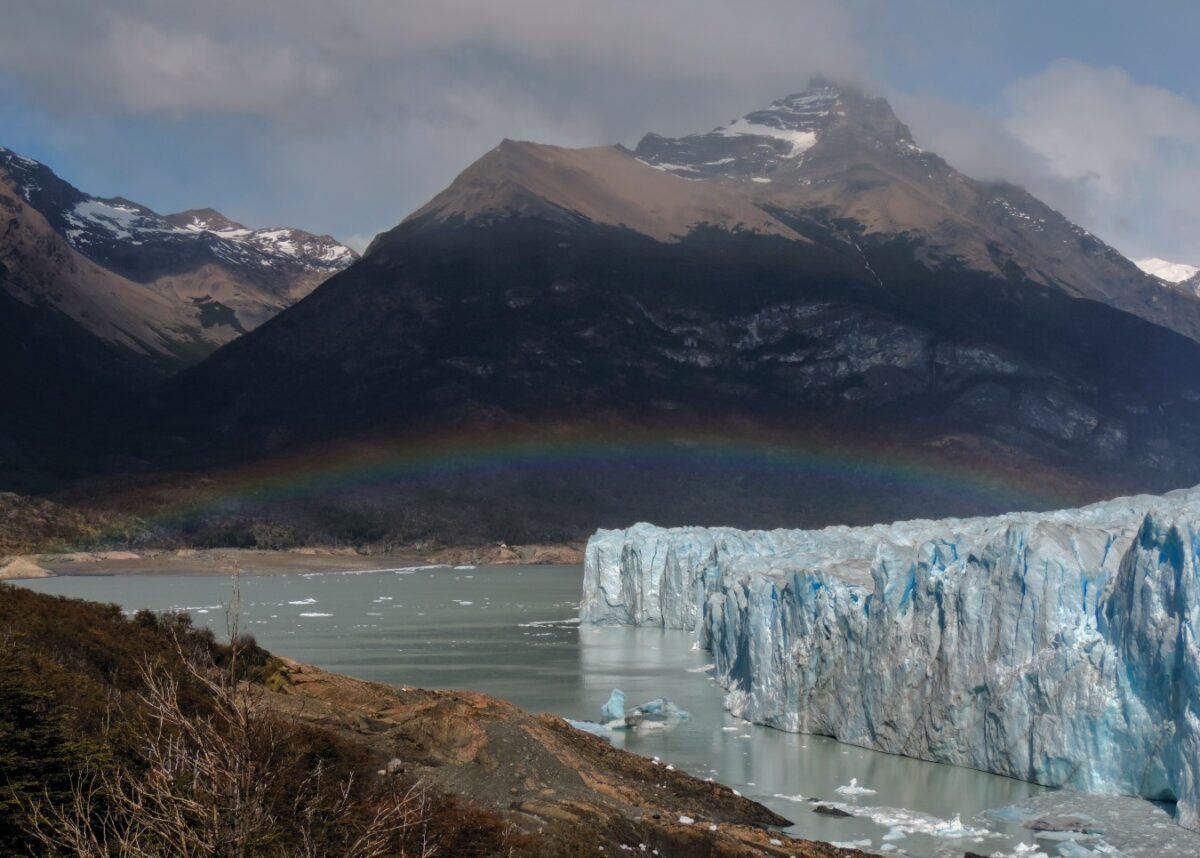
Photo by NOAA on Unsplash

Photo by NOAA on Unsplash

Michael Petterson, Auckland University of Technology

Climate explained is a collaboration between The Conversation, Stuff and the New Zealand Science Media Centre to answer your questions about climate change.

If you have a question you’d like an expert to answer, please send it to climate.change@stuff.co.nz


What is an ice age? Do they have to last a certain amount of time to count, how did they vary and how many ice ages has the Earth experienced?

As with many definitions of natural phenomena, a precise definition of an ice age isn’t straightforward.

Ice ages form during protracted periods of a relatively cooler Earth. A definition must include the condition that the Earth is sufficiently cool for permanent ice formation.

A second part of an ice age definition is the end result of protracted cooling. Ice ages lead to the development of continental ice sheets in the northern and southern hemispheres, and the growth of glaciers in mountainous parts of the world, such as the Himalayas, Alps, Southern Alps and Andes.

A third part of the definition involves time. For an ice age to be recorded as significant, it must last for a geologically significant amount of time.


AlsoRead...

Svitla Systems

Svitla Systems acquires Australia’s Kiandra IT to expand Global Engineering Footprint and Accelerate AI-Driven delivery

11 May 2026
How Clevero is helping Australian Service Businesses compete with Enterprises on a Fraction of the Budget

How Clevero is helping Australian Service Businesses compete with Enterprises on a Fraction of the Budget

28 April 2026

If we bring all these factors together, then an ice age occurs during times of protracted lower temperatures, resulting in significant areas covered in ice for millions to tens or even hundreds of millions of years.


Variations within an ice age

Ice ages are not uniformly cold. There can be colder and warmer periods during the overall ice-age period. Colder periods lead to more extensive areas of continental ice sheets, valley glaciers and sea ice, while warmer periods lead to reduced areas of ice.

Cold ice-age periods on Earth are called “stadials”, while warmer parts of an ice age are known as “inter-stadials”. An ice age ends when the Earth warms enough for the ice cover to recede, or disappear completely.

The regions on the fringes of extensive ice sheets and glaciers experience a cooling to the point that a consistently cold environment forms.
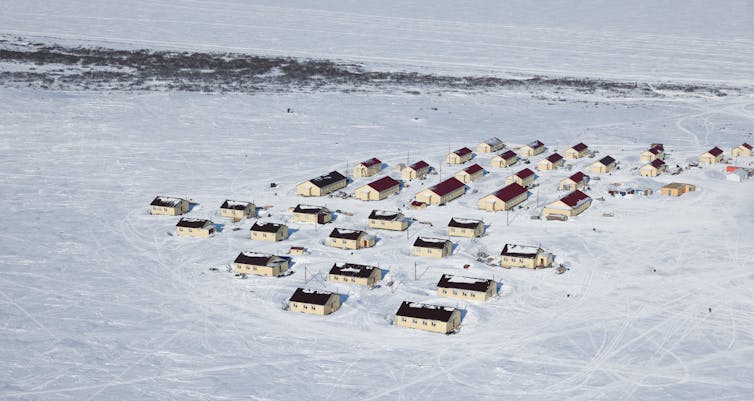
An aerial view of the village in a permafrost region of Russia.
In regions close to larger ice sheets, thr ground remains frozen for most of the year. Alexander Ryumin\TASS via Getty Images

Usually, the ground is frozen for much of the year, growing seasons are short, and only the hardiest of flora and fauna survive. The Russian tundra is an example of this landscape.

These environments are called “periglacial” and occupy areas between relatively warmer ice-free regions and permanent ice fields.

Ice ages and the Earth’s climate

Ice ages change the Earth’s climatic belts. Temperate and tropical zones become restricted to the lower equatorial latitudes.

A question that follows on from the definition of an ice age is: how cold does Earth have to become to produce one? Earth’s average global temperature today is around 16℃.

Analysis of proxy temperature data (e.g. from the modelling of deep-ocean sediment isotope compositions) over the past 500 million years of Earth’s history indicates that average global temperatures have varied between around -10℃ and +30℃. During the most recent glacial maximum (stadial, 23,000 to 11,000 years ago), the average global temperature was about 8℃, with polar regions experiencing average temperatures of -2℃. Ice-free periods over the past 500 million years correspond with average global temperatures of over 20℃.

There is no official minimum period of time for an ice age. Some colder periods in historical times are termed little ice ages, including between the 13th and 18th centuries. This period was characterised by longer and colder winters, and shorter, cooler summers. Rivers regularly froze over in winter in western Europe. The stunning artwork of the Dutch painter Hendrick Avercamp (1585–1634 CE) documents aspects of this period.
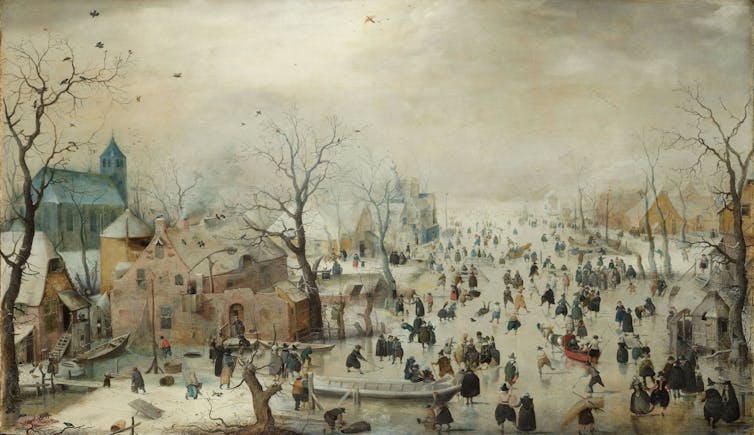
Winter Landscape with Ice Skaters, a painting by Durch artist Hendrick Avercamp (circa 1608).
Winter Landscape with Ice Skaters, by Hendrick Avercamp (circa 1608). Sepia Times/Universal Images Group via Getty Images

How many ice ages has the Earth experienced?

Geologists agree Earth has gone through six major global ice ages. The oldest ice age occurred some 2,900-2,780 million years ago. The most recent ice age is the one we are currently experiencing, the late Cainozoic-Quaternary Ice Age, which began around 34 million years ago with the glaciation of Antarctica.

Between these two ice-age periods, other ice ages occurred at 2,400-2,100, 715-550, 450-420 and 360-260 million years ago. These six major ice ages lasted between 300 and 30 million years respectively.

Ice ages vary in length of time, extent, and extremes of temperature. The most extensive ice age was the period referred to as “Snowball Earth” when geologists think ice reached all the way to the equator, some 700 million years ago.


At other times within ice ages (such as today), ice is mainly restricted to polar regions and higher mountain chains. But at its greatest extent, the present glacial period produced ice sheets as far south as the southern Great Lakes in the US and the river Thames in the UK. Mountain glaciers also extended much further and sea levels were some 120 metres lower than today.

There are many factors that cause ice ages. The main ones include variations in Earth’s orbit, known as Milankovitch cycles, reductions in solar energy emissions, lower atmospheric greenhouse gas concentrations, variations in ocean currents, tectonic activity, continental configurations, mountain building periods and global volcanism.

Michael Petterson, Professor of Geology, Auckland University of Technology

This article is republished from The Conversation under a Creative Commons license. Read the original article.


Tags: SB001
DMCA.com Protection Status

SUBSCRIBE to our NEWSLETTER

[mc4wp_form id=”2384248″]

Don't Miss

Svitla Systems acquires Australia’s Kiandra IT to expand Global Engineering Footprint and Accelerate AI-Driven delivery

by Pauline Torongo
11 May 2026
Svitla Systems
Business & Finance

Acquisition marks Svitla’s entry into the Australian market and strengthens capabilities in low-code, Microsoft technologies, and enterprise software engineering.

Read moreDetails

Residential Healthcare Practices: Revolution or Evolution?

by Pauline Torongo
11 May 2026
Residential Healthcare Practices: Revolution or Evolution?
Lifestyle

President Bill Lutz’s "revolution" was born from his background in fine dining, which instilled a disciplined, customer-focused approach.

Read moreDetails

Medicana Health Group launches HPV vaccination campaign to support cervical cancer prevention

by Pauline Torongo
28 April 2026
Medicana Health Group launches HPV vaccination campaign to support cervical cancer prevention
Health & Wellness

The Türkiye-based healthcare group has introduced a new awareness campaign focused on HPV vaccination, regular check-ups and early detection, with...

Read moreDetails

How Clevero is helping Australian Service Businesses compete with Enterprises on a Fraction of the Budget

by Pauline Torongo
28 April 2026
How Clevero is helping Australian Service Businesses compete with Enterprises on a Fraction of the Budget
Business & Finance

By consolidating CRM, scheduling, workflow automation, invoicing, reporting, and client communications into a single platform, Clevero gives smaller operators the...

Read moreDetails

How CJAM Group is building 1,100 homes across Southeast Queensland

by Pauline Torongo
24 March 2026
How CJAM Group is building 1,100 homes across Southeast Queensland
Lifestyle

The CJAM Group founder is quietly building a 1,100+ home pipeline, with projects in Hervey Bay and Toowoomba, using a...

Read moreDetails

Design Without Compromise: Where Gutter Protection Meets Modern Architecture

by Fazila Olla-Logday
20 March 2026
Design Without Compromise: Where Gutter Protection Meets Modern Architecture
Business & Finance

Design without compromise by integrating gutter protection seamlessly into modern architecture. Discover how innovative gutter systems enhance your home’s aesthetics...

Read moreDetails

How WageSafe Secured Australia’s Most Reputable Retail Business Among Its Premium Clients

by Fazila Olla-Logday
12 March 2026
How WageSafe Secured Australia’s Most Reputable Retail Business Among Its Premium Clients
at

Learn how WageSafe helps businesses stay compliant with payroll and wage regulations through reliable monitoring, risk management, and expert support—protecting...

Read moreDetails
Load More

Copyright © Blue Sky Publications Ltd. All Rights Reserved.
australiantimes.co.uk is a division of Blue Sky Publications Ltd. Reproduction without permission prohibited. DMCA.com Protection Status

  • About us
  • Write for Us
  • Advertise
  • Contact us
  • T&Cs, Privacy and GDPR
No Result
View All Result
  • News
    • Weather
    • Sport
    • Technology
    • Business & Finance
      • Currency Zone
    • Lotto Results
      • The Lott
  • Lifestyle
    • Entertainment
    • Horoscopes
    • Health & Wellness
    • Recipes
  • Travel
  • Expat Life
  • Move to Australia

Copyright © Blue Sky Publications Ltd. All Rights Reserved.
australiantimes.co.uk is a division of Blue Sky Publications Ltd. Reproduction without permission prohibited. DMCA.com Protection Status

No Result
View All Result
  • News
    • Weather
    • Sport
    • Technology
    • Business & Finance
      • Currency Zone
    • Lotto Results
      • The Lott
  • Lifestyle
    • Entertainment
    • Horoscopes
    • Health & Wellness
    • Recipes
  • Travel
  • Expat Life
  • Move to Australia

Copyright © Blue Sky Publications Ltd. All Rights Reserved.
australiantimes.co.uk is a division of Blue Sky Publications Ltd. Reproduction without permission prohibited. DMCA.com Protection Status





