
• Advertise
  • About us
  • Terms and Conditions
  • Contact us
Tuesday, July 7, 2026
Australian Times News
  • News
    • Weather
    • Sport
    • Technology
    • Business & Finance
      • Currency Zone
    • Lotto Results
      • The Lott
  • Lifestyle
    • Entertainment
    • Horoscopes
    • Health & Wellness
    • Recipes
  • Travel
  • Expat Life
  • Move to Australia
No Result
View All Result
  • News
    • Weather
    • Sport
    • Technology
    • Business & Finance
      • Currency Zone
    • Lotto Results
      • The Lott
  • Lifestyle
    • Entertainment
    • Horoscopes
    • Health & Wellness
    • Recipes
  • Travel
  • Expat Life
  • Move to Australia
No Result
View All Result
Australian Times News
No Result
View All Result
Home Lifestyle

Animal Communication Goes Beyond What Science Can Currently Measure: Zoologist and Spiritual teacher Artemis, the heart whisperer on what the textbooks don’t teach

Animal communication classes and formal training can be valuable, providing tools, structure, and guidance.

Australian Times by Australian Times
07-07-2026 21:36
in Lifestyle
Animal Communication Goes Beyond What Science Can Currently Measure

Animal Communication Goes Beyond What Science Can Currently Measure. Image: Supplied

Most of us grew up learning that animals communicate through sounds, signals, and scent. That’s true, yet it’s also incomplete. The part the textbooks often leave out is not easily captured by traditional scientific frameworks. It’s something anyone who has spent devoted time with animals eventually notices: they don’t just read what you’re doing. They read what you’re feeling.

What Science Has Built and Where It Stops

Academic science has established a solid foundation. Animals communicate through four documented channels: visual signals, auditory cues, chemical messages, and tactile exchange. The behavioural ecology literature is genuinely rich, with Konrad Lorenz’s work on imprinting, Karl von Frisch’s decoding of the honeybee waggle dance, and decades of field research on primate signalling. Through careful observation and rigorous research, these pioneers expanded our understanding of animal communication and established a foundation that continues to inform modern science.

But there’s a gap between what science measures and what emerges from years of experience with animals. According to Artemis, animals do not simply respond to conscious signals. They often appear to react to what lies beneath them, including emotional states and feelings that people themselves may not fully recognise. A horse doesn’t only read your body language; it reads what your body language is working to conceal. The signalling model developed by academic science accounts for the transmission of surface information between humans and animals, but it doesn’t account for the full spectrum of information being received

The Edge of What Research Is Finding
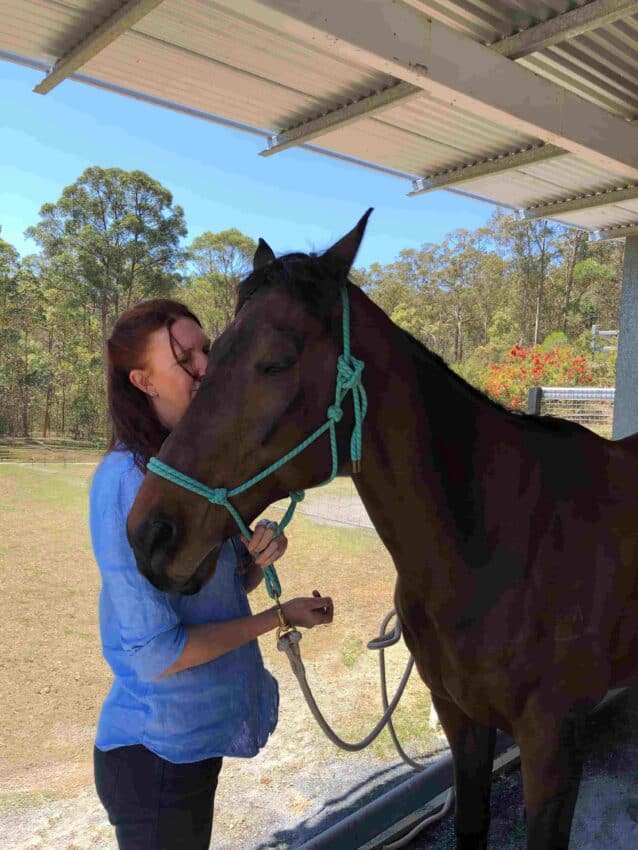


Emerging research continues to reveal greater complexity in human-animal relationships than was once understood, though many aspects of those relationships remain difficult to measure through traditional scientific methods. Studies on emotional contagion, the spread of stress and feelings between individuals, show this phenomenon crossing species lines, not just occurring within them. In one study, researchers analysed hair cortisol concentrations in 58 dog-owner pairs and found measurable long-term stress synchronisation between dogs and their owners. Dogs appeared to absorb and mirror the chronic stress levels of the humans they lived with, influenced by lifestyle, personality, and emotional environment, not just commands or observable behaviour.

This growing body of research reflects a broader cultural reality. Pet ownership in the United States now stands at approximately 95 million households, representing nearly 72% of homes, and the numbers point to something more than affection. Science is beginning to confirm what many owners have sensed intuitively: that the bond between humans and animals not only meets basic physiological needs, but it is also emotionally and psychologically significant.

Some researchers have explored whether neurological mechanisms involved in empathy and social understanding may help explain how animals respond to the emotional states of others. While much remains unknown, this area of research continues to generate interest among scientists studying animal behaviour.

Meanwhile, advances in chemical communication research are revealing that scent can convey far more information than previously understood. Far from being mystical, these findings invite a broader perspective on the relationship between humans and animals. They also echo perspectives found in many indigenous and traditional cultures, where animals are often viewed as mirrors, teachers, or guides that can reflect aspects of human experience.

Artemis The Heart Whisperer, a zoologist and volunteer wildlife rescuer with more than 40 years of direct animal work, puts it plainly: animals respond to your interior condition before your exterior presentation. They don’t respond to the performance of calm. They respond to actual calm or its absence.

This observation is rooted in decades of hands-on experience. After more than eight years spent catching both venomous and non-venomous snakes and rehabilitating sick and injured pythons, Artemis has repeatedly witnessed how sensitive snakes can be to the state of the person handling them. She has found that when a handler approaches an animal with genuine calmness rather than forced confidence, the interaction is often noticeably smoother. Through countless rescues, she has observed that a calm presence frequently leads to a calmer response from the animal, reinforcing her belief that animals perceive far more than outward behaviour alone.

What Fear of an Animal Is Actually Telling You

Fear of a particular animal is often about far more than the animal itself. It can reveal deeper truths about our own beliefs, perceptions, and unresolved fears. Sometimes it reflects a discomfort with the unpredictable or a resistance to what does not behave according to our expectations. In other cases, it stems from inherited stories about what is dangerous and what is safe that have been passed down through family, culture, or society and accepted without question.

Artemis has worked with people who carry a deep fear of snakes. Her genuine appreciation for the inner nature of snakes brings a warmth and authenticity to these conversations, gradually transforming fear into curiosity, respect, and even awe. Time and again, a common pattern emerges: when the narrative surrounding an animal changes, something deeper shifts as well. The animal itself remains unchanged. What changes is the person’s perception, opening the door to a new understanding of both the creature and themselves.

AlsoRead...

Residential Healthcare Practices: Revolution or Evolution?

Residential Healthcare Practices: Revolution or Evolution?

11 May 2026
Medicana Health Group launches HPV vaccination campaign to support cervical cancer prevention

Medicana Health Group launches HPV vaccination campaign to support cervical cancer prevention

28 April 2026

Many indigenous and shamanic traditions have long viewed animals as sources of insight, guidance, or symbolic meaning, although interpretations vary widely across cultures and traditions. Animal communication typically refers to connecting with a specific animal to better understand its experiences, needs, or perspective. Totem and spirit animal traditions, by contrast, focus on the qualities embodied by a species and the lessons those qualities may offer.


An eagle, for example, is often associated with vision and perspective, inviting us to rise above immediate circumstances and see a broader picture. A snake may symbolise transformation, while a wolf can represent loyalty, instinct, or community. In this context, the animal is not viewed simply as a creature to be observed, but as a living expression of qualities that may already exist within us or invite deeper reflection.

This perspective differs from animal communication, which centres on the individual animal rather than the symbolic traits of a species. Yet both approaches share a common premise: that animals have far more to teach us than most people realise.

Whether through a meaningful encounter with a particular animal or reflection on the qualities associated with a species, these traditions suggest that the natural world can offer valuable insights into our own lives. The lessons are often less about the animal itself and more about what our relationship with that animal reveals about us.

How to Start Listening

Animal communication classes and formal training can be valuable, providing tools, structure, and guidance. They are not the true foundation of meaningful connection with animals. Beneath every method and every learned skill lies something far more fundamental: presence.

Find an animal you share space with. Remove your agenda from the encounter. Don’t approach it as an experiment or an opportunity to have an experience. Simply be present, without the usual layer of self-monitoring, and notice what arises in your body before your mind interprets it.

Animals don’t lie, they don’t bypass, and they don’t suffer unnecessarily. That consistency is their most useful quality and their most instructive one. As Artemis observes, human-animal communication at its deepest level isn’t a skill you acquire so much as a layer of noise you learn to subtract.

What that means practically: if you want to understand what an animal is communicating, start by getting honest about what you are communicating and foster a genuine desire to connect with this animal. Animals have an extraordinary ability to respond to authenticity. Their reactions can reveal patterns in how we show up, communicate, and engage with the world around us. Animals respond to it with a consistency that, once you’ve witnessed it enough times, stops being surprising and starts being instructive.

They are, as it turns out, among the most honest teachers most of us will ever encounter.

Tags: animal communicationDigitorial
DMCA.com Protection Status

SUBSCRIBE to our NEWSLETTER

[mc4wp_form id=”2384248″]

Don't Miss

Animal Communication Goes Beyond What Science Can Currently Measure: Zoologist and Spiritual teacher Artemis, the heart whisperer on what the textbooks don’t teach

by Australian Times
7 July 2026
Animal Communication Goes Beyond What Science Can Currently Measure
Lifestyle

Animal communication classes and formal training can be valuable, providing tools, structure, and guidance.

Read moreDetails

Managing Aussie Share Portfolios Abroad: Tips for Growth

by Fazila Olla-Logday
2 July 2026
Managing Aussie Share Portfolios Abroad: Tips for Growth
at

Unlock the secrets to optimizing your Aussie share portfolios abroad. Discover essential tips for growth and navigate the global market...

Read moreDetails

The New Meaning of Luxury: Lessons from Entrepreneur Chloe Hardy

by Pauline Torongo
2 July 2026
The New Meaning of Luxury: Lessons from Entrepreneur Chloe Hardy
Business & Finance

Chloe Hardy, the founder and CEO of Dupes & Co established an Australian-made beauty brand focused on affordability and product...

Read moreDetails

Excel Funding Group emerges as Specialist in SMSF Property Lending amid growing demand

by Pauline Torongo
26 June 2026
Excel Funding Group emerges as Specialist in SMSF Property Lending amid growing demand
Business & Finance

Excel Funding Group has hit a new milestone, tripling its SMSF loan settlement volumes compared to Q1 2025.

Read moreDetails

Svitla Systems acquires Australia’s Kiandra IT to expand Global Engineering Footprint and Accelerate AI-Driven delivery

by Pauline Torongo
11 May 2026
Svitla Systems
Business & Finance

Acquisition marks Svitla’s entry into the Australian market and strengthens capabilities in low-code, Microsoft technologies, and enterprise software engineering.

Read moreDetails

Residential Healthcare Practices: Revolution or Evolution?

by Pauline Torongo
11 May 2026
Residential Healthcare Practices: Revolution or Evolution?
Lifestyle

President Bill Lutz’s "revolution" was born from his background in fine dining, which instilled a disciplined, customer-focused approach.

Read moreDetails

Medicana Health Group launches HPV vaccination campaign to support cervical cancer prevention

by Pauline Torongo
28 April 2026
Medicana Health Group launches HPV vaccination campaign to support cervical cancer prevention
Health & Wellness

The Türkiye-based healthcare group has introduced a new awareness campaign focused on HPV vaccination, regular check-ups and early detection, with...

Read moreDetails
Load More

Copyright © Blue Sky Publications Ltd. All Rights Reserved.
australiantimes.co.uk is a division of Blue Sky Publications Ltd. Reproduction without permission prohibited. DMCA.com Protection Status

  • About us
  • Write for Us
  • Advertise
  • Contact us
  • T&Cs, Privacy and GDPR
No Result
View All Result
  • News
    • Weather
    • Sport
    • Technology
    • Business & Finance
      • Currency Zone
    • Lotto Results
      • The Lott
  • Lifestyle
    • Entertainment
    • Horoscopes
    • Health & Wellness
    • Recipes
  • Travel
  • Expat Life
  • Move to Australia

Copyright © Blue Sky Publications Ltd. All Rights Reserved.
australiantimes.co.uk is a division of Blue Sky Publications Ltd. Reproduction without permission prohibited. DMCA.com Protection Status

No Result
View All Result
  • News
    • Weather
    • Sport
    • Technology
    • Business & Finance
      • Currency Zone
    • Lotto Results
      • The Lott
  • Lifestyle
    • Entertainment
    • Horoscopes
    • Health & Wellness
    • Recipes
  • Travel
  • Expat Life
  • Move to Australia

Copyright © Blue Sky Publications Ltd. All Rights Reserved.
australiantimes.co.uk is a division of Blue Sky Publications Ltd. Reproduction without permission prohibited. DMCA.com Protection Status