



Ewan Gibbs, University of Glasgow
While walking on Glasgow Green in 1765, James Watt had a eureka moment that led to the development of a more efficient steam engine, making coal-powered industry and transport possible. In November, a city with a claim to the dubious mantle of having invented the modern carbon economy will host the most pressing UN climate change conference yet – COP26.
Neither Scotland nor the UK have the strongest record when it comes to transitioning fairly away from fossil fuels. The country’s decarbonisation has so far largely been a product of decommissioning coal-fired power stations after the acceleration of pit closures under Conservative governments during the 1980s and 1990s. This left deep social and economic scars, and the legacy of deindustrialisation continues to blight the former Scottish coalfields with acute education and health inequalities.
Now the country needs to shed its economic reliance on oil and gas, which provides essential employment for a large number of people. So how could Scotland set a new example for the world to follow, with a just transition to low-carbon energy production that supports those who will lose their jobs as a result.
Glasgow was the centre of a Scottish industrial economy at its peak a century ago. Comfortably over 100,000 Scots worked in coal mining and hundreds of thousands of others were employed in steelmaking, railway engineering and shipbuilding. That old industrial economy has all but disappeared.
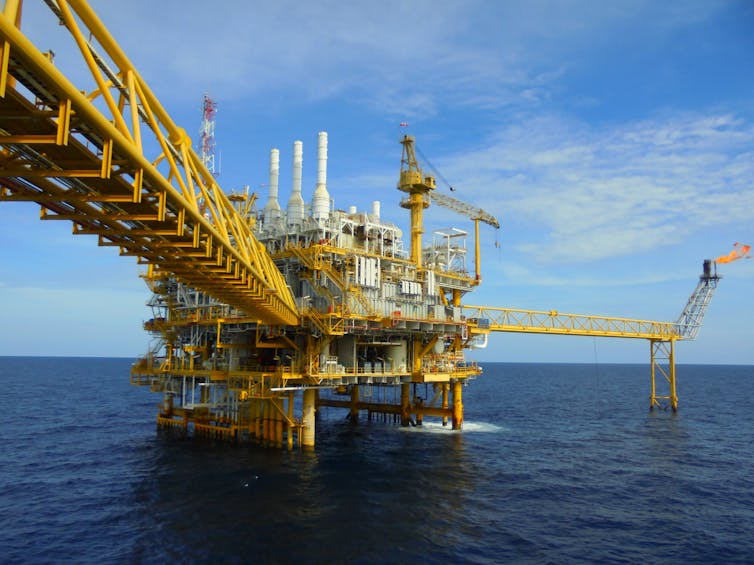
In its place, the growth of oil and gas extraction in the North Sea during the 1970s and 1980s has offered compensatory employment. The Scottish government recently estimated that oil and gas sustained around 100,000 jobs, about 4% of the Scottish workforce. This carbon-intensive industry provides, as one trade union official put it, “one of the increasingly few examples today of working-class prosperity”.
Conditioned by four decades of deindustrialisation and the decline of stable middle-income employment, oil and gas workers are right to be wary of government promises around decarbonisation today. The idea of a just transition is supposed to neutralise these worries, by giving workers in carbon-intensive sectors a chance to retrain and lead the development of the green industries of the future, like offshore wind and solar energy.


American union leader Tony Mazzocchi, who represented oil, nuclear and chemical workers during the late 20th century, first laid the groundwork for this concept with his vision of the right for workers to “work in healthy and safe jobs and to live in communities that are part of life-sustaining ecosystems.”
The Scottish government’s just transition commission, which was set up to establish principles for policy and create a partnership with workers and industry, was inspired by Mazzocchi’s ideas. Its members included business and union representatives from the energy sector, as well as academic economists. The commission reported earlier in 2021 that:
The story of how Scotland lost much of its heavy industry through the 70s and 80s is … an example of how not to manage structural change.
The energy transition
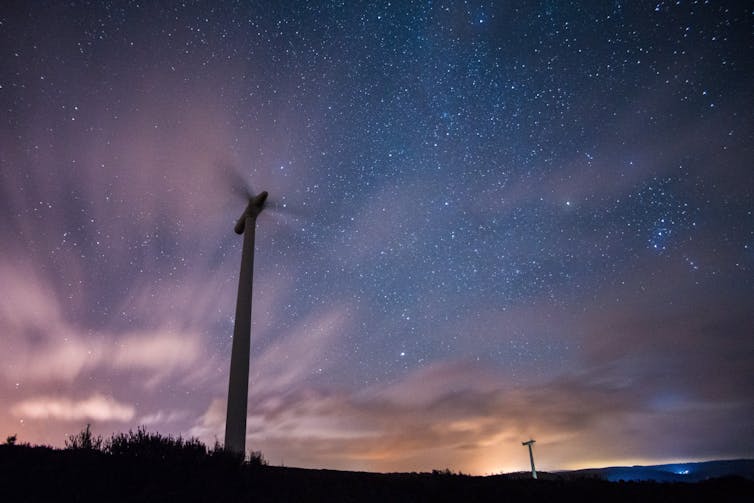
So what does Scotland’s green and just future look like? In 2020, Scotland almost generated its entire electricity demand from renewables, most of it 23 terawatt-hour’s worth of wind power. This record output also helped the country export nearly 20 terawatt-hours of electricity.
The Scottish government will cite these world-leading achievements while hosting COP26. But Scotland’s record on jobs and industry is less impressive. Employment in low-carbon sectors such as wind power has actually fallen in the country since 2016. For workers in carbon-intensive sectors who are eager to transfer to green jobs, these trends aren’t promising.
I was part of a team from the universities of Glasgow and Newcastle which surveyed workers laid off at Rolls Royce’s Inchinnan aeroengine plant in 2020. There were 700 redundancies, and most workers were struggling to find reemployment. While engineers demonstrated a strong interest in renewable energy, few had found appropriate jobs, even after some funded their own retraining.
Another survey of around 1,400 North Sea oil workers conducted during the 2020 price nadir found that over 40% had been furloughed and that over 80% were willing to start work in other sectors such as renewables.
But the recent closure of a yard at Machrihanish near Campbeltown where workers have built wind turbines since 2001 suggests the Scottish government isn’t seizing the opportunity to unite precarious workers in the fossil fuel sector around its decarbonisation plans.
A better approach
Most Scottish politicians agree that offshore oil and gas workers must not suffer the same fate as the coalfields. Guaranteeing that appears to be more difficult. The Scottish government’s decision to abandon plans for a publicly-owned energy company shows a willingness to leave leadership of the sector to volatile market forces. As do primarily UK government subsidies which don’t do enough to incentivise using local suppliers to build wind turbines.
A just transition is only possible if the government tackles inequality with the same vigour as climate change. It would mean building new industries which use Scotland’s natural advantages and emerging technology, such as tidal power. This would potentially have higher initial costs for the national economy than relying on imports of renewable energy equipment, but subsidising and protecting domestic firms could ensure they enjoy the eventual benefits from developing these sectors.
Carbon taxes drove the UK’s dramatic withdrawal from coal-fired electricity in the 2010s. This shows what climate policy can achieve when it intervenes in the free market. Scottish oil and gas workers are eager to play their part. Now Scottish politicians must play theirs.
Tax changes alone won’t be enough to achieve the necessary shifts in renewables manufacturing. The control and ownership of both natural resources and the operation of supply chains will need to be confronted to ensure a just transition.

This story is part of The Conversation’s coverage on COP26, the Glasgow climate conference, by experts from around the world.
Amid a rising tide of climate news and stories, The Conversation is here to clear the air and make sure you get information you can trust. More.
Ewan Gibbs, Lecturer in Global Inequalities, University of Glasgow
This article is republished from The Conversation under a Creative Commons license. Read the original article.







