• Advertise
  • About us
  • Terms and Conditions
  • Contact us
Saturday, December 6, 2025
Australian Times News
  • News
    • Weather
    • Sport
    • Technology
    • Business & Finance
      • Currency Zone
    • Lotto Results
      • The Lott
  • Lifestyle
    • Entertainment
    • Horoscopes
    • Health & Wellness
    • Recipes
  • Travel
  • Expat Life
  • Move to Australia
No Result
View All Result
  • News
    • Weather
    • Sport
    • Technology
    • Business & Finance
      • Currency Zone
    • Lotto Results
      • The Lott
  • Lifestyle
    • Entertainment
    • Horoscopes
    • Health & Wellness
    • Recipes
  • Travel
  • Expat Life
  • Move to Australia
No Result
View All Result
Australian Times News
No Result
View All Result
Home News

Inside the world of tiny phytoplankton – microscopic algae that provide most of our oxygen

Phytoplankton are microscopic algae living throughout the ocean’s surface waters. They can’t swim and are at the mercy of the currents and tides. Despite their small size, phytoplankton enable life in the oceans – and throughout the planet – to exist.

The Conversation by The Conversation
30-04-2021 22:09
in News
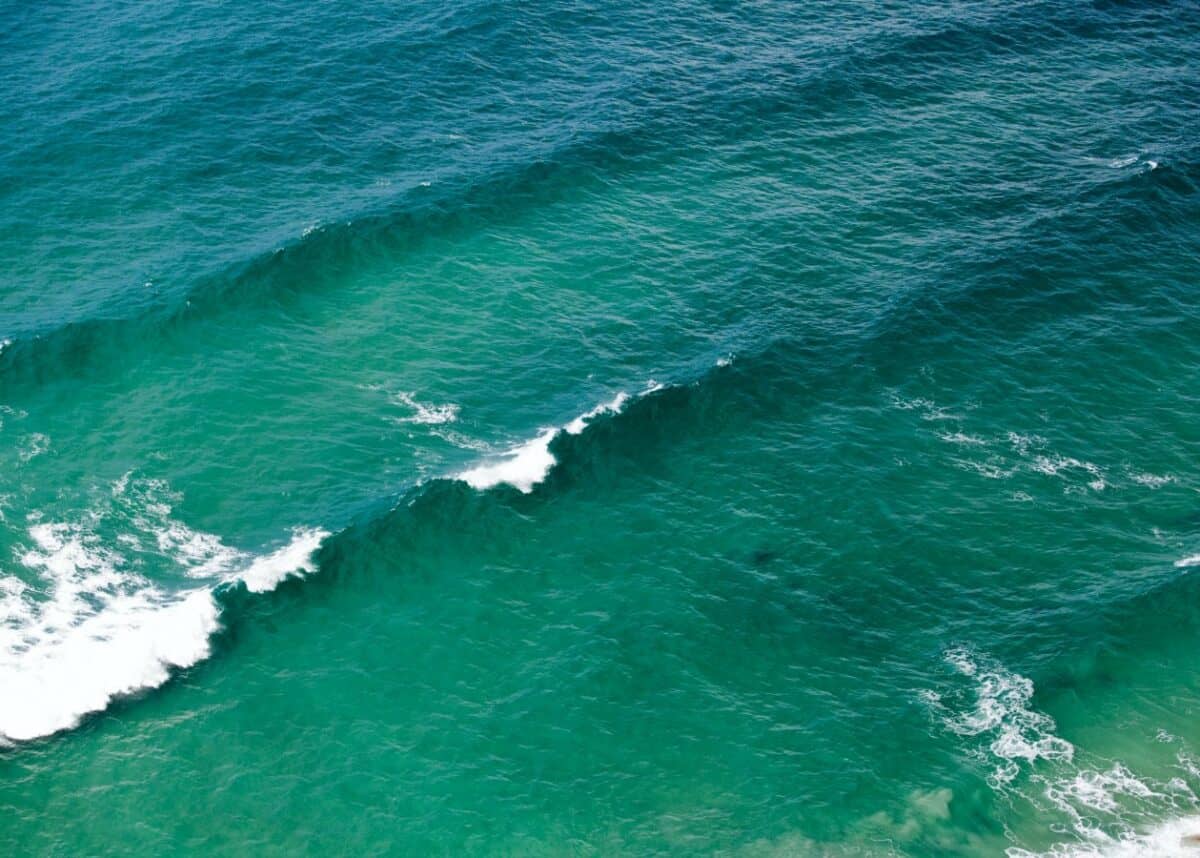
Photo by Photoholgic on Unsplash

Photo by Photoholgic on Unsplash

Abigail McQuatters-Gollop, University of Plymouth

Phytoplankton are microscopic algae living throughout the ocean’s surface waters. They can’t swim and are at the mercy of the currents and tides. Despite their small size, phytoplankton enable life in the oceans – and throughout the planet – to exist.

There are two types of plankton – zooplankton, which are animals, and phytoplankton, which are algae. Phytoplankton are filled with chlorophyll which gives them a green colour, just like land plants. And like land plants, phytoplankton play a critical role, converting carbon dioxide and energy from the sun into food through photosynthesis, producing oxygen.

These tiny organisms have been producing oxygen for the world for hundreds of millions of years. But most people know very little about them, what they do for the rest of the world and the threats they are facing.

Phytoplankton are thought to have made an appearance in the Bible’s Book of Revelation, which says: “A third of the sea turned into blood, a third of the living creatures in the sea died, and a third of the ships were destroyed”. Modern scientists think this must be a reference to a harmful algal bloom, or red tide, that can be cause by phytoplankton and can discolour that water. These can also produce toxins, causing illness and even death in animals – fish, whales, manatees, birds, and even elephants – and people.

They’ve made their way into modern culture, too. Alfred Hitchock’s movie the Birds, where birds attack residents of a California town, was inspired by birds behaving erratically due to toxic phytoplankton.

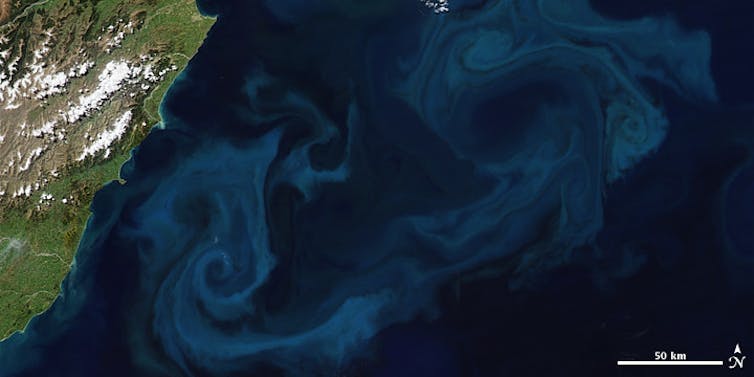
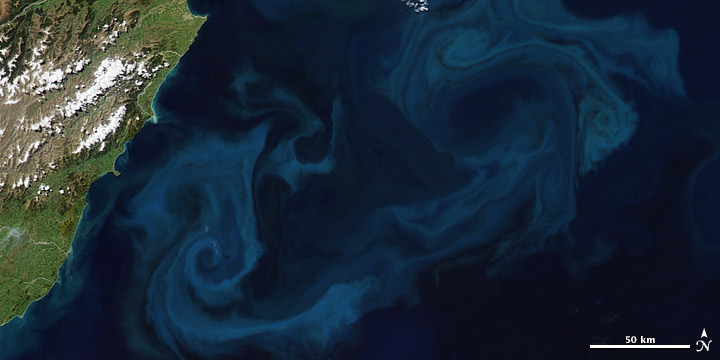
Despite being a source of cultural inspiration, there are many things about phytoplankton most people don’t know – such as the fact they can be seen from space. Unlike land plants which can grow 100 metres (380 feet) in height, phytoplankton individuals consist of a single cell. Individual phytoplankton can usually only be seen with a microscope, but when phytoplankton bloom, the aggregations are so large that they can be seen from satellites.


AlsoRead...

Ryan: Building real freedom through e-commerce

Ryan: Building real freedom through e-commerce

27 November 2025
Design Australia Group: Redefining Drafting as the engine of housing growth

Design Australia Group: Redefining Drafting as the engine of housing growth

26 November 2025
An image of the ocean with a swirling blue pattern, caused by a phytoplankton bloom.
A phytoplankton bloom seen from space. NASA/Robert Simmon and Jesse Allen, CC BY

Although they’re microscopic, phytoplankton are wonderfully diverse, with thousands (or maybe even millions) of different species and hundreds of body shapes. Some have spines or form chains to help them maintain buoyancy, while others have flagella – tiny whip-like appendages – to enable them to orient themselves in the water. Some phytoplankton are covered in CaCO₃ plates, called liths, giving them the appearance of tiny footballs, which play an important role in carbon sequestration.

The lungs of the sea

Rainforests get much of the credit for oxygen production, but phytoplankton produce at least 50% of the Earth’s oxygen. Phytoplankton are the lungs of the sea – the oxygen from one out of every two breaths we take comes from plankton.

Climate change would be much more extreme without phytoplankton. They use carbon dioxide from the atmosphere to fuel photosynthesis. When they die, they sink to the sea floor, locking away that carbon. Phytoplankton absorb up to 50% of anthropogenic CO₂, which, without them, would cause higher atmospheric CO₂ levels.

Nevertheless, climate change is causing changes in phytoplankton communities. In some places, like the North Atlantic, oceans are experiencing tropicalisation – when warming waters enable warm water plankton species to move northwards while colder water species are squeezed towards the pole.
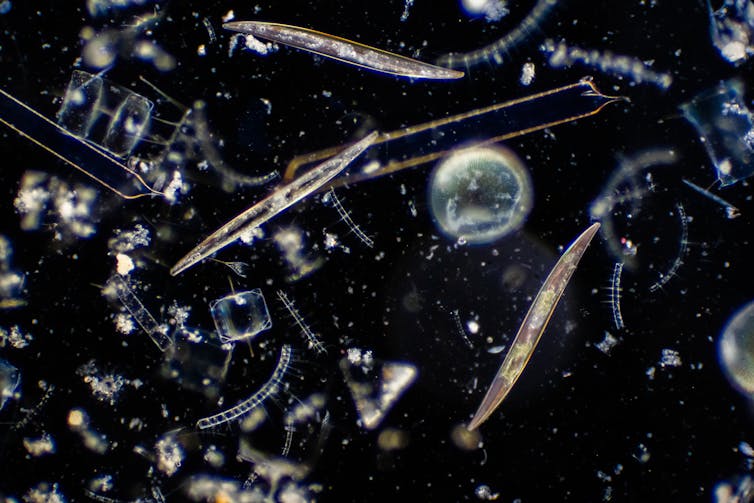
A few different types of phytoplankton under a microscope, in various shapes, with a black background.
Under the microscope. Shutterstock/Choksawatdikorn

Some plankton in the North Atlantic have shifted northwards by over 1,000km (620 miles) in the past 50 years. Warming seas can cause some phytoplankton to change the timing of their blooms. These changes can affect food webs, as the phytoplankton may bloom too early or late to feed the zooplankton that depend on them.

This is why it’s important to monitor them. There are many ways to monitor plankton, including sampling with bottles or nets, or estimating phytoplankton biomass from space using satellites. The Continuous Plankton Recorder survey has monitored plankton in the North Atlantic since 1931, using commercial vessels such as ferries and cargo ships on their normal routes to tow a one metre long recording device through the sea behind the boat.

The devices filter seawater through a moving band of silk, trapping the plankton. The silks are then sent to a laboratory in Plymouth, UK, to identify and count the plankton. The survey has recorded almost 800 taxa of plankton, around 300 of which are phytoplankton. It’s created a 90-year-old record of North Atlantic plankton, allowing us to better understand the marine food web and detect changes in the marine environment caused by pollution, fishing and climate change.

Abigail McQuatters-Gollop, Associate Professor of Marine Conservation, University of Plymouth

This article is republished from The Conversation under a Creative Commons license. Read the original article.


Tags: SB001
DMCA.com Protection Status

SUBSCRIBE to our NEWSLETTER

[mc4wp_form id=”2384248″]

Don't Miss

The evolution of Aesthetic Surgery through the lens of Dr Kourosh Tavakoli

by Pauline Torongo
4 December 2025
The evolution of Aesthetic Surgery through the lens of Dr. Kourosh Tavakoli
Health & Wellness

As global interest in Australian cosmetic surgery continues to grow, the combination of regulation, research and emerging digital tools is...

Read moreDetails

Ryan: Building real freedom through e-commerce

by Pauline Torongo
27 November 2025
Ryan: Building real freedom through e-commerce
Business & Finance

Ryan’s greatest achievement isn’t any single business or revenue milestone — it’s the ecosystem he’s built through the Change community.

Read moreDetails

Design Australia Group: Redefining Drafting as the engine of housing growth

by Pauline Torongo
26 November 2025
Design Australia Group: Redefining Drafting as the engine of housing growth
Business & Finance

Australia is under pressure to build homes faster, but design bottlenecks slow progress. Design Australia Group is fixing this by...

Read moreDetails

Louis Guy Detata builds Global Trading Empires through autonomous systems and disciplined leadership

by Pauline Torongo
25 November 2025
Louis Guy Detata builds Global Trading Empires through autonomous systems and disciplined leadership
Business & Finance

The path from investment banking to leading a global trading platform has taught Louis Detata that sustainable success requires more...

Read moreDetails

Burning Eucalyptus Wood: Tips, Advantages, Disadvantages & Alternatives

by Fazila Olla-Logday
20 November 2025
Image Supplied
Enviroment

Learn about burning eucalyptus wood for stoves and fireplaces. Discover benefits, drawbacks, harvesting tips, and better alternative firewood options for...

Read moreDetails

Everything Parents Need to Know About Baby Soft Play and Why It’s a Game Changer

by Fazila Olla-Logday
11 November 2025
Everything Parents Need to Know About Baby Soft Play
Health & Wellness

Baby soft play is a fun, safe, and educational way for little ones to explore and grow. Discover the benefits...

Read moreDetails

WOMAD Sets Up a New Camp in Wiltshire – Australian festival fans take note!

by Kris Griffiths
11 November 2025
Kumbia Boruka brought their reggae and dancehall flavour to the Taste the World Stage at WOMAD 2024 - Credit - Mike Massaro
Entertainment

With its 2026 edition moving to Neston Park in England, WOMAD offers Aussie music lovers a chance to reconnect with global...

Read moreDetails
Load More

Copyright © Blue Sky Publications Ltd. All Rights Reserved.
australiantimes.co.uk is a division of Blue Sky Publications Ltd. Reproduction without permission prohibited. DMCA.com Protection Status

  • About us
  • Write for Us
  • Advertise
  • Contact us
  • T&Cs, Privacy and GDPR
No Result
View All Result
  • News
    • Weather
    • Sport
    • Technology
    • Business & Finance
      • Currency Zone
    • Lotto Results
      • The Lott
  • Lifestyle
    • Entertainment
    • Horoscopes
    • Health & Wellness
    • Recipes
  • Travel
  • Expat Life
  • Move to Australia

Copyright © Blue Sky Publications Ltd. All Rights Reserved.
australiantimes.co.uk is a division of Blue Sky Publications Ltd. Reproduction without permission prohibited. DMCA.com Protection Status

No Result
View All Result
  • News
    • Weather
    • Sport
    • Technology
    • Business & Finance
      • Currency Zone
    • Lotto Results
      • The Lott
  • Lifestyle
    • Entertainment
    • Horoscopes
    • Health & Wellness
    • Recipes
  • Travel
  • Expat Life
  • Move to Australia

Copyright © Blue Sky Publications Ltd. All Rights Reserved.
australiantimes.co.uk is a division of Blue Sky Publications Ltd. Reproduction without permission prohibited. DMCA.com Protection Status