


• Advertise
  • About us
  • Terms and Conditions
  • Contact us
Thursday, May 14, 2026
Australian Times News
  • News
    • Weather
    • Sport
    • Technology
    • Business & Finance
      • Currency Zone
    • Lotto Results
      • The Lott
  • Lifestyle
    • Entertainment
    • Horoscopes
    • Health & Wellness
    • Recipes
  • Travel
  • Expat Life
  • Move to Australia
No Result
View All Result
  • News
    • Weather
    • Sport
    • Technology
    • Business & Finance
      • Currency Zone
    • Lotto Results
      • The Lott
  • Lifestyle
    • Entertainment
    • Horoscopes
    • Health & Wellness
    • Recipes
  • Travel
  • Expat Life
  • Move to Australia
No Result
View All Result
Australian Times News
No Result
View All Result
Home News

Why the latest travel caps look like an arbitrary restriction on Australians’ right to come home

National cabinet’s decision to halve the number of international arrivals to Australia is yet another blow to the 34,000 Australians overseas trying to return home.

The Conversation by The Conversation
06-07-2021 06:25
in News
Photo by Gus Ruballo on Unsplash

Photo by Gus Ruballo on Unsplash

Jane McAdam, UNSW and Regina Jefferies, UNSW

National cabinet’s decision to halve the number of international arrivals to Australia is yet another blow to the 34,000 Australians overseas trying to return home.

But it is also far more than that. As international law scholars, our view is this latest move — 18 months into the pandemic — contravenes Australians’ right to enter their country.

Back in the 1950s, Australia was keenly involved in the drafting of the International Covenant on Civil and Political Rights — one of two core human rights treaties. The treaty was signed by the Whitlam Labor government and then ratified by the Fraser Liberal government in 1980. This voluntary act committed Australia to abide by its provisions as a matter of international law.

One of its provisions clearly states:

No one shall be arbitrarily deprived of the right to enter his own country.

The Australian government is relying on this provision — namely, the notion of “arbitrarily” — to justify the travel bans and caps during COVID-19. But is this lawful?

The history of the ‘right to enter’

The treaty was drafted by representatives from a number of United Nations member countries in the late 1940s and 50s, before being considered more widely by the General Assembly.


AlsoRead...

Svitla Systems

Svitla Systems acquires Australia’s Kiandra IT to expand Global Engineering Footprint and Accelerate AI-Driven delivery

11 May 2026
How Clevero is helping Australian Service Businesses compete with Enterprises on a Fraction of the Budget

How Clevero is helping Australian Service Businesses compete with Enterprises on a Fraction of the Budget

28 April 2026

Our research into the drafting history of the “right to enter” provision reveals just how narrowly it was intended to be construed. And — most significantly — it shows the drafters considered it should never be used to exclude residents from returning on health grounds.

As the United Kingdom’s representative explained at a session in 1959,

it was inconceivable that a state should prohibit one of its nationals, who held a valid passport, from entering its territory for miscellaneous reasons and, in particular, for reasons of health or morality. Restrictions of that kind would be unprecedented and completely unjustified. Such steps could be taken with respect to foreigners or stateless persons but not with respect to nationals.

The Italian representative similarly stressed:

[it] was not really necessary for an individual to be debarred from re-entering his country for health or morality reasons, for there were other methods of keeping him from contaminating his fellow citizens [such as quarantine].

Approaching the issue from a slightly different perspective, the French and Lebanese delegates had argued a decade earlier:

a country was not entitled to foist its nationals on to other countries, particularly on grounds of disease.

Interestingly, the drafting records show that arbitrary deprivation of the right to return was intended as shorthand for a single exception – namely, the exclusion of individuals who had been lawfully exiled.

The exception for exile had been part of earlier drafts, but was ultimately removed because the practice was considered archaic and inappropriate in a human rights treaty. Instead, the word “arbitrarily” became its proxy.

An arbitrary restriction

In light of this background, Australia’s travel caps look like an arbitrary restriction on Australians’ right to come home.

Even taking a broad interpretation, the right to enter could only reasonably be curtailed by brief, temporary restrictions that pursue a legitimate objective and are necessary, reasonable, proportionate, and based on clear legal criteria.
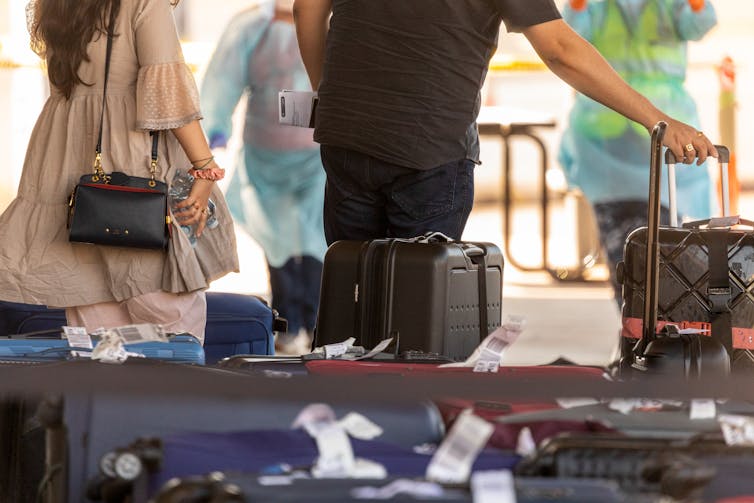
Australians arrive in Darwin on a repatriation flight from India.
Australians have faced enormous financial and bureaucratic hurdles to come home since COVID hit last year. Stewart Gould/AAP

Importantly, the federal government would need to show there were no other, less restrictive measures that can be taken to safeguard public health — such as quarantine. In 1999, the UN Human Rights Committee noted:

there are few, if any, circumstances in which deprivation of the right to enter one’s own country could be reasonable.

It is currently considering a claim by two Australians stranded overseas, and has requested Australia take interim measures to “avoid irreparable damage” to them — a call the government has rejected.


Alternatives to travel caps

Over the past year, Australian public health experts have been pushing for the expansion of national quarantine facilities beyond those at Howard Springs. This was also a recommendation of former health department secretary Jane Halton’s report to the government last year.

Numerous health experts have also supported the idea of home quarantine for some returning international travellers.


National cabinet’s decision to halve the number of incoming travellers does not address these calls. Rather, it caves to demands by some state premiers.

We now have a virtually unprecedented situation in which the states are controlling Australia’s international border settings, and thousands of Australian citizens and residents — many of whom are vaccinated — continue to live in arbitrary exile.

Jane McAdam, Scientia Professor and Director of the Kaldor Centre for International Refugee Law, UNSW and Regina Jefferies, Affiliate, Andrew and Renata Kaldor Centre for International Refugee Law, UNSW

This article is republished from The Conversation under a Creative Commons license. Read the original article.


Tags: SB001
DMCA.com Protection Status

SUBSCRIBE to our NEWSLETTER

[mc4wp_form id=”2384248″]

Don't Miss

Svitla Systems acquires Australia’s Kiandra IT to expand Global Engineering Footprint and Accelerate AI-Driven delivery

by Pauline Torongo
11 May 2026
Svitla Systems
Business & Finance

Acquisition marks Svitla’s entry into the Australian market and strengthens capabilities in low-code, Microsoft technologies, and enterprise software engineering.

Read moreDetails

Residential Healthcare Practices: Revolution or Evolution?

by Pauline Torongo
11 May 2026
Residential Healthcare Practices: Revolution or Evolution?
Lifestyle

President Bill Lutz’s "revolution" was born from his background in fine dining, which instilled a disciplined, customer-focused approach.

Read moreDetails

Medicana Health Group launches HPV vaccination campaign to support cervical cancer prevention

by Pauline Torongo
28 April 2026
Medicana Health Group launches HPV vaccination campaign to support cervical cancer prevention
Health & Wellness

The Türkiye-based healthcare group has introduced a new awareness campaign focused on HPV vaccination, regular check-ups and early detection, with...

Read moreDetails

How Clevero is helping Australian Service Businesses compete with Enterprises on a Fraction of the Budget

by Pauline Torongo
28 April 2026
How Clevero is helping Australian Service Businesses compete with Enterprises on a Fraction of the Budget
Business & Finance

By consolidating CRM, scheduling, workflow automation, invoicing, reporting, and client communications into a single platform, Clevero gives smaller operators the...

Read moreDetails

How CJAM Group is building 1,100 homes across Southeast Queensland

by Pauline Torongo
24 March 2026
How CJAM Group is building 1,100 homes across Southeast Queensland
Lifestyle

The CJAM Group founder is quietly building a 1,100+ home pipeline, with projects in Hervey Bay and Toowoomba, using a...

Read moreDetails

Design Without Compromise: Where Gutter Protection Meets Modern Architecture

by Fazila Olla-Logday
20 March 2026
Design Without Compromise: Where Gutter Protection Meets Modern Architecture
Business & Finance

Design without compromise by integrating gutter protection seamlessly into modern architecture. Discover how innovative gutter systems enhance your home’s aesthetics...

Read moreDetails

How WageSafe Secured Australia’s Most Reputable Retail Business Among Its Premium Clients

by Fazila Olla-Logday
12 March 2026
How WageSafe Secured Australia’s Most Reputable Retail Business Among Its Premium Clients
at

Learn how WageSafe helps businesses stay compliant with payroll and wage regulations through reliable monitoring, risk management, and expert support—protecting...

Read moreDetails
Load More

Copyright © Blue Sky Publications Ltd. All Rights Reserved.
australiantimes.co.uk is a division of Blue Sky Publications Ltd. Reproduction without permission prohibited. DMCA.com Protection Status

  • About us
  • Write for Us
  • Advertise
  • Contact us
  • T&Cs, Privacy and GDPR
No Result
View All Result
  • News
    • Weather
    • Sport
    • Technology
    • Business & Finance
      • Currency Zone
    • Lotto Results
      • The Lott
  • Lifestyle
    • Entertainment
    • Horoscopes
    • Health & Wellness
    • Recipes
  • Travel
  • Expat Life
  • Move to Australia

Copyright © Blue Sky Publications Ltd. All Rights Reserved.
australiantimes.co.uk is a division of Blue Sky Publications Ltd. Reproduction without permission prohibited. DMCA.com Protection Status

No Result
View All Result
  • News
    • Weather
    • Sport
    • Technology
    • Business & Finance
      • Currency Zone
    • Lotto Results
      • The Lott
  • Lifestyle
    • Entertainment
    • Horoscopes
    • Health & Wellness
    • Recipes
  • Travel
  • Expat Life
  • Move to Australia

Copyright © Blue Sky Publications Ltd. All Rights Reserved.
australiantimes.co.uk is a division of Blue Sky Publications Ltd. Reproduction without permission prohibited. DMCA.com Protection Status





