


• Advertise
  • About us
  • Terms and Conditions
  • Contact us
Wednesday, August 12, 2026
Australian Times News
  • News
    • Weather
    • Sport
    • Technology
    • Business & Finance
      • Currency Zone
    • Lotto Results
      • The Lott
  • Lifestyle
    • Entertainment
    • Horoscopes
    • Health & Wellness
    • Recipes
  • Travel
  • Expat Life
  • Move to Australia
No Result
View All Result
  • News
    • Weather
    • Sport
    • Technology
    • Business & Finance
      • Currency Zone
    • Lotto Results
      • The Lott
  • Lifestyle
    • Entertainment
    • Horoscopes
    • Health & Wellness
    • Recipes
  • Travel
  • Expat Life
  • Move to Australia
No Result
View All Result
Australian Times News
No Result
View All Result
Home News

Why China believed it had a case to hit Australian barley with tariffs

Australian officials “did not comply” with its requirements in relation to the Sustainable Rural Water Use and Infrastructure Program.

The Conversation by The Conversation
22-06-2020 09:17
in News
China believed it had a case to hit Australian barley with tariffs

China believed it had a case to hit Australian barley with tariffs Photo by Robert Hoffmann on Unsplash

Weihuan Zhou, UNSW

China’s landmark investigations into Australian barley led to the imposition of “anti-dumping” and “anti-subsidy” tariffs of 80.5% in May, threatening an Australian export market worth $A600 million a year.

China says it made its own calculations on the extent to which Australia subsidised barley after Australian authorities failed to give it all the information it needed in the form it requested.

Shutterstock

It set out its findings on subsidies in a report at present only available in Chinese.

One was that Australian officials “did not comply” with its requirements in relation to the Sustainable Rural Water Use and Infrastructure Program.
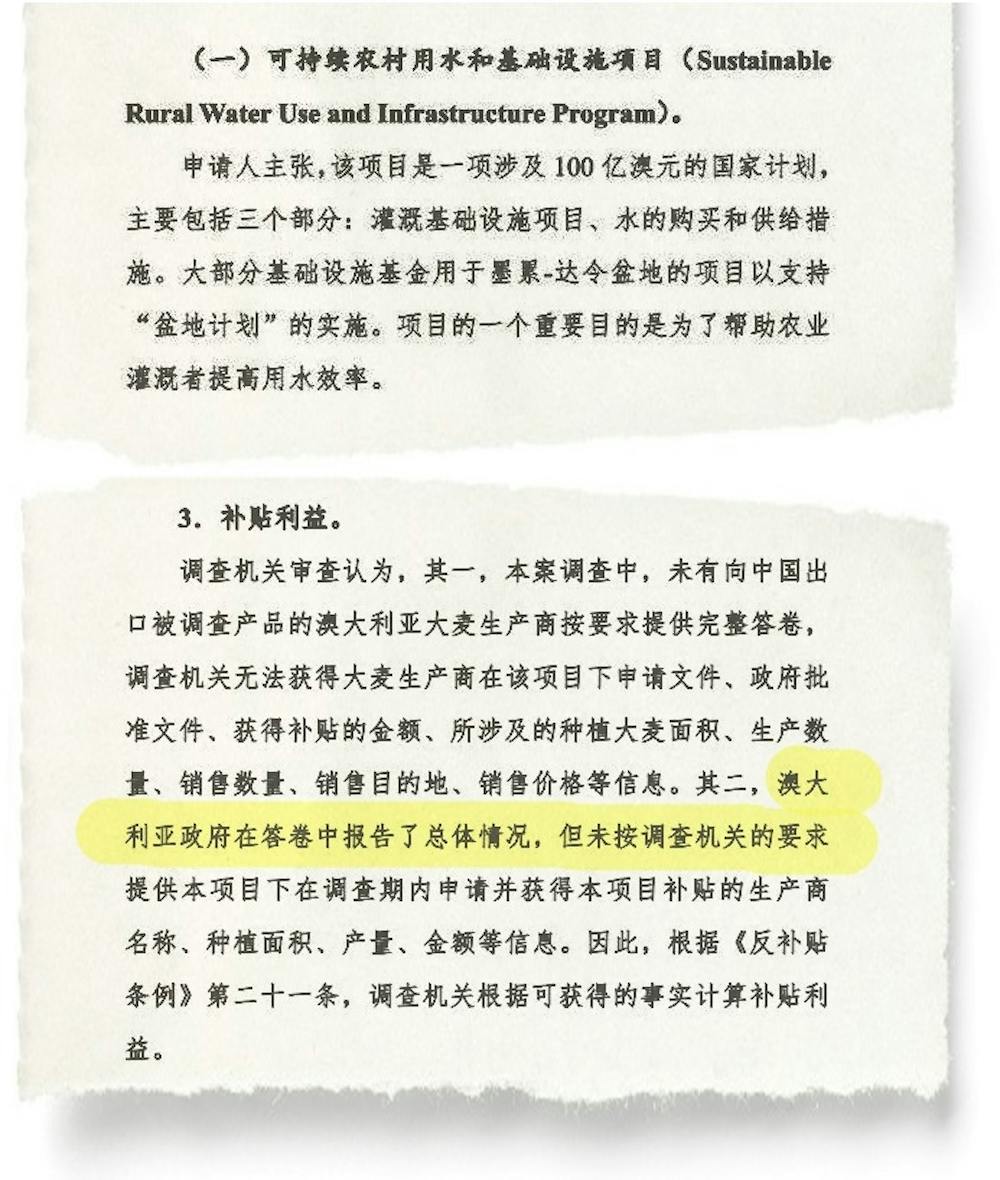
‘The Australian government reported the overall situation in the answer sheet, but did not comply with the requirements of the investigating authority’

Australia disputes that conclusion.

At first glance the possibility that Sustainable Rural Water Use and Infrastructure Program could have had anything to do with subsidising barely exports seems baseless.


AlsoRead...

Managing Aussie Share Portfolios Abroad: Tips for Growth

Managing Aussie Share Portfolios Abroad: Tips for Growth

2 July 2026
The New Meaning of Luxury: Lessons from Entrepreneur Chloe Hardy

The New Meaning of Luxury: Lessons from Entrepreneur Chloe Hardy

2 July 2026

The Murray Darling Basin Plan, of which the Sustainable Rural Water Use and Infrastructure Program is a part, is a long-running program aiming to remedy a century of over-exploitation of water.

It includes no discussion of production targets, export volumes or anything else that might be expected to set off trade alarm bells.

Plan more than environmental

But the plan and its A$13 billion budget is about more than the environment.

It originally prioritised the environment, but in 2010 its goal was explicitly changed to address a triple bottom line of economic, social and environmental concerns.

From there, its management became a major economic and political issue.

Scandals surround huge payments for dubious water rights, infrastructure spending that doesn’t actually save water, and massive subsidisation of irrigation expansion into areas that were not previously irrigated.

Stories abound of favoured companies or regions reaping large windfalls at the expense of taxpayers, other farmers, the environment, or all three.

Administered with ‘habitual’ secrecy

Australia’s Department of Agriculture says the government fully engaged with China’s investigation, “including providing extensive information on production and commercial information on the Australian barley industry”.

But the department hasn’t always been forthcoming about its operations.

A South Australian Royal Commission concluded that its claim to be committed to engaging in public debate and open dialogue should be regarded with “deep suspicion”.

The separate Murray Darling Basin Authority operated with “an unfathomable predilection for secrecy”.

The behaviour was “habitual”, in the assessment of the Royal Commission.

We might have given China a case

Even if Australian officials did participate in the Chinese investigation in good faith, the potential for confusion is considerable given the jargon that engulfs both water management and trade law.

Few water managers speak trade law and equally few trade lawyers understand the jargon of the Murray Darling Basin Plan.

From a trade law perspective, although the Sustainable Rural Water Use and Infrastructure Program and the Basin Plan do not explicitly subsidise exports, the fact that much of the Basin’s produce is exported means it could be argued that they distort trade.

It is open to a country such as China to take action if the program has conferred benefits to an Australian industry and the subsidised exports have caused a material injury to a competing domestic industry.

China alleges this is the case for barley, but a stronger case could perhaps be argued for the Basin’s bigger export crops: cotton, almonds and walnuts.

Part of the reason is that the program involves government spending, but it is possible to argue that the implementation of the Basin Plan has also subsidised exporters in another way, by environmental mismanagement.

The Barwon-Darling has been described by environmental regulators as “an ecosystem in crisis”. Contributing to the crisis has been a system that allocates scarce water to irrigators and diverts huge volumes of floodwater into private dams.

This arguably illegal practice of “floodplain harvesting” provides huge benefits to cotton exporters.

It is uncertain whether China’s barley decision will bring about changes to Australian water management that downstream communities, irrigators, Indigenous nations and environment groups have long called for.

It would help if water regulators explained what they were doing in terms that can be understood by ordinary Australians and Chinese trade experts alike.


Contributing to this article were Maryanne Slattery, a former director at the Murray Darling Basin Authority and a director of water consultancy Slattery Johnson, Rod Campbell, Research Director at the Australia Institute and Allan Behm, director of the Australia Institute’s International and Security Affairs program.

Weihuan Zhou, Senior Lecturer and member of Herbert Smith Freehills CIBEL Centre, Faculty of Law, UNSW Sydney, UNSW

This article is republished from The Conversation under a Creative Commons license. Read the original article.


Tags: SB001
DMCA.com Protection Status

SUBSCRIBE to our NEWSLETTER

[mc4wp_form id=”2384248″]

Don't Miss

Why Smarter Fleet Management Is For All Modern Business Options

by Fazila Olla-Logday
29 July 2026
Smarter Fleet Management
Motoring

Operating a business that relies on vehicles is harder than ever.

Read moreDetails

Animal Communication Goes Beyond What Science Can Currently Measure: Zoologist and Spiritual teacher Artemis, the heart whisperer on what the textbooks don’t teach

by Australian Times
7 July 2026
Animal Communication Goes Beyond What Science Can Currently Measure
Lifestyle

Animal communication classes and formal training can be valuable, providing tools, structure, and guidance.

Read moreDetails

Managing Aussie Share Portfolios Abroad: Tips for Growth

by Fazila Olla-Logday
2 July 2026
Managing Aussie Share Portfolios Abroad: Tips for Growth
at

Unlock the secrets to optimizing your Aussie share portfolios abroad. Discover essential tips for growth and navigate the global market...

Read moreDetails

The New Meaning of Luxury: Lessons from Entrepreneur Chloe Hardy

by Pauline Torongo
2 July 2026
The New Meaning of Luxury: Lessons from Entrepreneur Chloe Hardy
Business & Finance

Chloe Hardy, the founder and CEO of Dupes & Co established an Australian-made beauty brand focused on affordability and product...

Read moreDetails

Excel Funding Group emerges as Specialist in SMSF Property Lending amid growing demand

by Pauline Torongo
26 June 2026
Excel Funding Group emerges as Specialist in SMSF Property Lending amid growing demand
Business & Finance

Excel Funding Group has hit a new milestone, tripling its SMSF loan settlement volumes compared to Q1 2025.

Read moreDetails

Svitla Systems acquires Australia’s Kiandra IT to expand Global Engineering Footprint and Accelerate AI-Driven delivery

by Pauline Torongo
11 May 2026
Svitla Systems
Business & Finance

Acquisition marks Svitla’s entry into the Australian market and strengthens capabilities in low-code, Microsoft technologies, and enterprise software engineering.

Read moreDetails

Residential Healthcare Practices: Revolution or Evolution?

by Pauline Torongo
11 May 2026
Residential Healthcare Practices: Revolution or Evolution?
Lifestyle

President Bill Lutz’s "revolution" was born from his background in fine dining, which instilled a disciplined, customer-focused approach.

Read moreDetails
Load More

Copyright © Blue Sky Publications Ltd. All Rights Reserved.
australiantimes.co.uk is a division of Blue Sky Publications Ltd. Reproduction without permission prohibited. DMCA.com Protection Status

  • About us
  • Write for Us
  • Advertise
  • Contact us
  • T&Cs, Privacy and GDPR
No Result
View All Result
  • News
    • Weather
    • Sport
    • Technology
    • Business & Finance
      • Currency Zone
    • Lotto Results
      • The Lott
  • Lifestyle
    • Entertainment
    • Horoscopes
    • Health & Wellness
    • Recipes
  • Travel
  • Expat Life
  • Move to Australia

Copyright © Blue Sky Publications Ltd. All Rights Reserved.
australiantimes.co.uk is a division of Blue Sky Publications Ltd. Reproduction without permission prohibited. DMCA.com Protection Status

No Result
View All Result
  • News
    • Weather
    • Sport
    • Technology
    • Business & Finance
      • Currency Zone
    • Lotto Results
      • The Lott
  • Lifestyle
    • Entertainment
    • Horoscopes
    • Health & Wellness
    • Recipes
  • Travel
  • Expat Life
  • Move to Australia

Copyright © Blue Sky Publications Ltd. All Rights Reserved.
australiantimes.co.uk is a division of Blue Sky Publications Ltd. Reproduction without permission prohibited. DMCA.com Protection Status





