


• Advertise
  • About us
  • Terms and Conditions
  • Contact us
Wednesday, May 13, 2026
Australian Times News
  • News
    • Weather
    • Sport
    • Technology
    • Business & Finance
      • Currency Zone
    • Lotto Results
      • The Lott
  • Lifestyle
    • Entertainment
    • Horoscopes
    • Health & Wellness
    • Recipes
  • Travel
  • Expat Life
  • Move to Australia
No Result
View All Result
  • News
    • Weather
    • Sport
    • Technology
    • Business & Finance
      • Currency Zone
    • Lotto Results
      • The Lott
  • Lifestyle
    • Entertainment
    • Horoscopes
    • Health & Wellness
    • Recipes
  • Travel
  • Expat Life
  • Move to Australia
No Result
View All Result
Australian Times News
No Result
View All Result
Home News

Victorian police now have ‘shoot to kill’ powers when cars are used as weapons: here’s why this matters

OPINION & ANALYSIS: There are clearly risks in shooting at a moving vehicle. Unlike what happens in films, bullets generally do not stop moving trucks or cars.

The Conversation by The Conversation
28-10-2019 11:50
in News
James Gargasoulas was convicted of six murders using a vehicle in Melbourne’s CBD in 2017. (By David Crosling/ AAP/The Conversation)

James Gargasoulas was convicted of six murders using a vehicle in Melbourne’s CBD in 2017. (By David Crosling/ AAP/The Conversation)

This week, the Victorian police announced a “hostile vehicle” policy, which supports officers to shoot a driver to stop a vehicle deemed to be hostile and a danger to the public.

The policy comes into the force on the eve of a coronial inquest into the crimes of James Gargasoulas, who was convicted of six murders using his car in Bourke Street in Melbourne’s CBD in 2017. This policy doesn’t grant police new powers, but clarifies their responsibilities in facing a hostile driver.

But What threat levels do these kind of attacks represent, and will the new approach be effective?

The justification for the policy

Victoria police have claimed the policy will:

empower officers to take decisive action in the event of a hostile vehicle attack.

It will allow police to use of a range of tactical options in response to a hostile vehicle attack, including the ability to ram offending vehicles, use roadblocks, box in a vehicle or, as a last resort, shoot the offender.

It follows previous legislative changes in Victoria that aimed to clarify laws on lethal use of force and give officers more confidence and protection when using them.

The laws aimed to

AlsoRead...

Svitla Systems

Svitla Systems acquires Australia’s Kiandra IT to expand Global Engineering Footprint and Accelerate AI-Driven delivery

11 May 2026
How Clevero is helping Australian Service Businesses compete with Enterprises on a Fraction of the Budget

How Clevero is helping Australian Service Businesses compete with Enterprises on a Fraction of the Budget

28 April 2026

clarify police powers to use lethal force in response to a life-threatening act where it may be the last opportunity to safely and effectively intervene.

Such moves to increase protections of police when they use lethal force also occurred after the Lindt Cafe seige in Sydney. Then, the legal ability for police to use lethal force before any hostages were harmed was unclear.
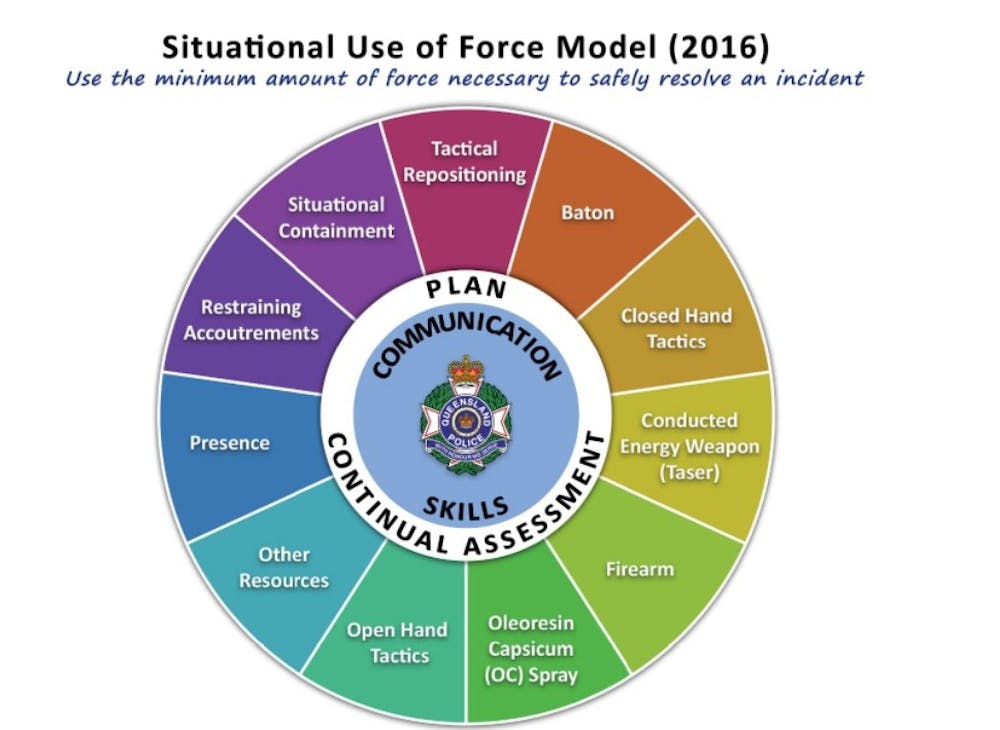
Situational use of force model that shows the various tactical options available to Queensland police. Queensland Police Service

The tactical options police can use expand when the weapon being used is a vehicle. In this scenario, police are not only bound by use of force policies, but also by police pursuit policies. For instance, pursuit policies will govern the use of road spikes and pursuit intervention techniques, such as boxing in or heading off a vehicle.

In essence, every police service in Australia has the ability to use lethal force where there is a reasonable threat the offender will inflict death or serious injury to the officer or a member of the public.

In response to perceived terrorist threats to the public, Australian police have increased general duty officers’ accessibility to military style weaponry in recent years.

What is a hostile vehicle attack?

The use of hostile vehicles has gained notoriety as a low-tech way to conduct a terrorist attack with mass casualties.

In its hostile vehicle guidelines, the Australian and New Zealand Counter Terrorism Committee defines a hostile vehicle as

generally one whose driver is determined to access a restricted or unauthorised area or location in order to cause injury/death to people, disrupt business or effect publicity for a cause.

A hostile vehicle may be used to carry an explosive device or the vehicle itself, travelling at speed, may present the primary danger.

Using such a means to attack requires little training or preparation from the terrorist. And this lack of planning means it’s extremely difficult for authorities to preempt. Such attacks allow for lone wolf type terrorist operations.

But, as the Gargasoulas incident showed, the use of hostile vehicles is not limited to those committing terrorist acts – they can also be used in non-terrorist criminal events.

Hostile vehicles are not new threats

Ramming into crowds with vehicles is not a new phenomenon. Such terrorist attacks have occurred since 2006, but gained widespread attention in 2016 when a lone offender drove a truck into a large crowd celebrating Bastille day, killing 86 people in Nice, France.

Another truck attack in Berlin killed 12 people a few months later.

As a method of attack in Islamist extremist incidents in Western countries, vehicles are becoming more prevalent.

The United States Transport Security Administration termed these attacks as “vehicle ramming”. A 2017 report noted that

from 2014 through 2017, terrorists carried out 17 known vehicle ramming attacks worldwide, resulting in 173 fatalities and 667 injuries.

In terms of the threat to police, one study showed between 1951 and 2007, the deliberate use of a vehicle killed four police in Australia, which is 1.4% of the 281 total police deaths for that period.

Clearer policy for weaponised vehicles

The Victoria Police policy has reinforced what other police services have had in place. Police have always been justified to shoot at a moving vehicle when it’s used as a weapon. The difference now is the policy has been clarified to reflect the changing times, when vehicles are more often used as weapons.

There are clearly risks in shooting at a moving vehicle. Unlike what happens in films, bullets generally do not stop moving trucks or cars.

Shooting the driver may stop the vehicle. Alternatively, the vehicle may continue on as an unguided threat into bystanders.

For instance, in Queensland’s Operational Procedures Manual, states that shooting at a moving vehicle comes with the risk the driver will lose control of the vehicle, putting the offenders, officers and the public in danger.

Even if the driver or vehicle’s engine is immediately incapacitated, the vehicle will continue to travel until stopped by external means, usually a collision.

However, the Queensland policy states police may fire at a vehicle if it’s being used as a weapon.

While much of the focus this week is on the use of force, the issues around the management of police pursuits will come into focus in the coronial inquest into the actions of Victoria Police in the lead up to the events in Bourke Street.

Police will still need to conduct a thorough risk assessment before they shoot at a moving vehicle, and most likely such actions will only be justifiable in the most serious of scenarios.

______________________________________

By Terry Goldsworthy, Associate Professor in Criminology, Bond University

This article is republished from The Conversation under a Creative Commons license. Read the original article.


Tags: terrorism
DMCA.com Protection Status

SUBSCRIBE to our NEWSLETTER

[mc4wp_form id=”2384248″]

Don't Miss

Svitla Systems acquires Australia’s Kiandra IT to expand Global Engineering Footprint and Accelerate AI-Driven delivery

by Pauline Torongo
11 May 2026
Svitla Systems
Business & Finance

Acquisition marks Svitla’s entry into the Australian market and strengthens capabilities in low-code, Microsoft technologies, and enterprise software engineering.

Read moreDetails

Residential Healthcare Practices: Revolution or Evolution?

by Pauline Torongo
11 May 2026
Residential Healthcare Practices: Revolution or Evolution?
Lifestyle

President Bill Lutz’s "revolution" was born from his background in fine dining, which instilled a disciplined, customer-focused approach.

Read moreDetails

Medicana Health Group launches HPV vaccination campaign to support cervical cancer prevention

by Pauline Torongo
28 April 2026
Medicana Health Group launches HPV vaccination campaign to support cervical cancer prevention
Health & Wellness

The Türkiye-based healthcare group has introduced a new awareness campaign focused on HPV vaccination, regular check-ups and early detection, with...

Read moreDetails

How Clevero is helping Australian Service Businesses compete with Enterprises on a Fraction of the Budget

by Pauline Torongo
28 April 2026
How Clevero is helping Australian Service Businesses compete with Enterprises on a Fraction of the Budget
Business & Finance

By consolidating CRM, scheduling, workflow automation, invoicing, reporting, and client communications into a single platform, Clevero gives smaller operators the...

Read moreDetails

How CJAM Group is building 1,100 homes across Southeast Queensland

by Pauline Torongo
24 March 2026
How CJAM Group is building 1,100 homes across Southeast Queensland
Lifestyle

The CJAM Group founder is quietly building a 1,100+ home pipeline, with projects in Hervey Bay and Toowoomba, using a...

Read moreDetails

Design Without Compromise: Where Gutter Protection Meets Modern Architecture

by Fazila Olla-Logday
20 March 2026
Design Without Compromise: Where Gutter Protection Meets Modern Architecture
Business & Finance

Design without compromise by integrating gutter protection seamlessly into modern architecture. Discover how innovative gutter systems enhance your home’s aesthetics...

Read moreDetails

How WageSafe Secured Australia’s Most Reputable Retail Business Among Its Premium Clients

by Fazila Olla-Logday
12 March 2026
How WageSafe Secured Australia’s Most Reputable Retail Business Among Its Premium Clients
at

Learn how WageSafe helps businesses stay compliant with payroll and wage regulations through reliable monitoring, risk management, and expert support—protecting...

Read moreDetails
Load More

Copyright © Blue Sky Publications Ltd. All Rights Reserved.
australiantimes.co.uk is a division of Blue Sky Publications Ltd. Reproduction without permission prohibited. DMCA.com Protection Status

  • About us
  • Write for Us
  • Advertise
  • Contact us
  • T&Cs, Privacy and GDPR
No Result
View All Result
  • News
    • Weather
    • Sport
    • Technology
    • Business & Finance
      • Currency Zone
    • Lotto Results
      • The Lott
  • Lifestyle
    • Entertainment
    • Horoscopes
    • Health & Wellness
    • Recipes
  • Travel
  • Expat Life
  • Move to Australia

Copyright © Blue Sky Publications Ltd. All Rights Reserved.
australiantimes.co.uk is a division of Blue Sky Publications Ltd. Reproduction without permission prohibited. DMCA.com Protection Status

No Result
View All Result
  • News
    • Weather
    • Sport
    • Technology
    • Business & Finance
      • Currency Zone
    • Lotto Results
      • The Lott
  • Lifestyle
    • Entertainment
    • Horoscopes
    • Health & Wellness
    • Recipes
  • Travel
  • Expat Life
  • Move to Australia

Copyright © Blue Sky Publications Ltd. All Rights Reserved.
australiantimes.co.uk is a division of Blue Sky Publications Ltd. Reproduction without permission prohibited. DMCA.com Protection Status






