

• Advertise
  • About us
  • Terms and Conditions
  • Contact us
Saturday, August 15, 2026
Australian Times News
  • News
    • Weather
    • Sport
    • Technology
    • Business & Finance
      • Currency Zone
    • Lotto Results
      • The Lott
  • Lifestyle
    • Entertainment
    • Horoscopes
    • Health & Wellness
    • Recipes
  • Travel
  • Expat Life
  • Move to Australia
No Result
View All Result
  • News
    • Weather
    • Sport
    • Technology
    • Business & Finance
      • Currency Zone
    • Lotto Results
      • The Lott
  • Lifestyle
    • Entertainment
    • Horoscopes
    • Health & Wellness
    • Recipes
  • Travel
  • Expat Life
  • Move to Australia
No Result
View All Result
Australian Times News
No Result
View All Result
Home News

The US has turned its back on skilled migrants, giving Australia an opening

The US has traditionally been the preferred destination for migrants. It normally gets close to half of the skilled migrants who come to OECD countries and around one third of skilled migrants globally.

The Conversation by The Conversation
16-11-2020 18:07
in News
Australia can get back what it has lost

Australia can get back what it has lost Photo by ThisisEngineering RAEng on Unsplash

Stephen Kirchner, University of Sydney

The outgoing Trump administration presided over one of the most dramatic tightenings in US immigration policy since the 1930s.

Will Langenberg/Upsplasn

Along with declining fertility, this saw US population growth fall to its lowest rate in a century, even before the onset of the pandemic.
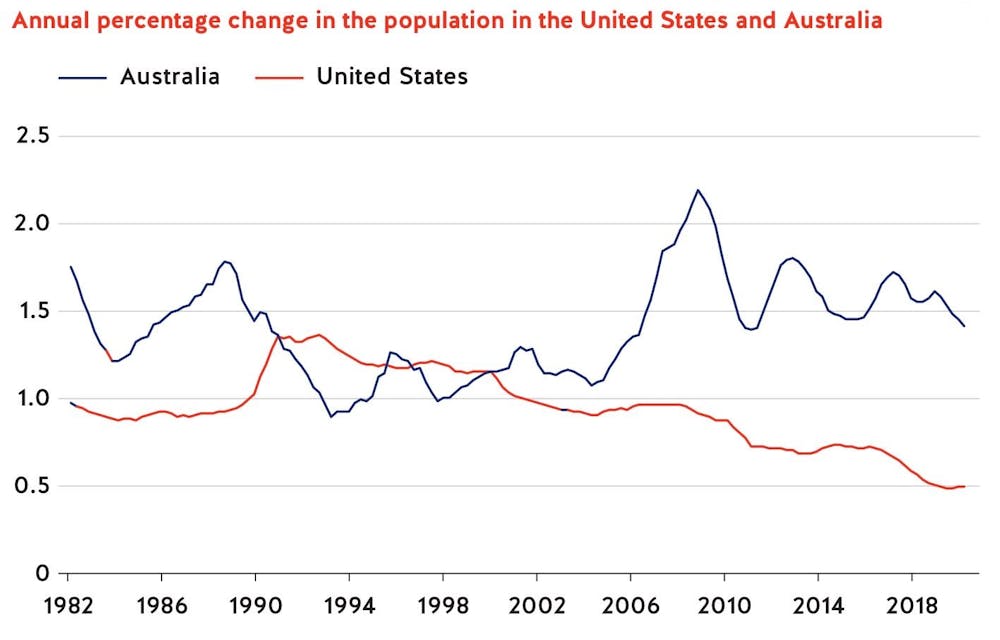

Australian Bureau of Statistics; US Census Bureau

Compared to its peak in the 1990s, the contribution of net migration to growth in the US working age population fell by 60% between 2010 and 2018.

While the incoming Biden Administration is expected to take a more relaxed approach, Trump’s legacy will be difficult to quickly or fully unwind.

Coming to America

The US has traditionally been the preferred destination for migrants. It normally gets close to half of the skilled migrants who come to OECD countries and around one third of skilled migrants globally.

Combined, the English-speaking nations of the US, Canada, the UK and Australia typically capture around 70% of skilled migration flows.


AlsoRead...

Managing Aussie Share Portfolios Abroad: Tips for Growth

Managing Aussie Share Portfolios Abroad: Tips for Growth

2 July 2026
The New Meaning of Luxury: Lessons from Entrepreneur Chloe Hardy

The New Meaning of Luxury: Lessons from Entrepreneur Chloe Hardy

2 July 2026

Immigration has historically been a key source of US national power and a leading driver of innovation and entrepreneurship.

Earlier this year, President Trump suspended new work visas, barring tens of thousands of foreign workers and their dependants from entering, and preventing US companies from hiring in two of the skilled visa categories.

According to a Brookings Institution study, that single order wiped US$100 billion from the market value of US firms, highlighting the extent to which they rely on skilled foreign workers.

Previous studies have found that the arbitrary cap on skilled visas (which was 190,000 and had tightened to 65,000) only served to increase offshoring as US firms hired foreign contractors rather than bringing them on shore.

The work visas executive order was just one of around 400 Trump used to tighten immigration policy.

Going to Australia?

Australia is potentially a close substitute for the US on the part of prospective migrants. It typically ranks just below the US, Canada and Germany as their preferred destination.

Trump’s actions give Australia the opportunity to capture some of the global talent that would have normally gone the US but has been increasingly turned away by its increasingly restrictive approach.
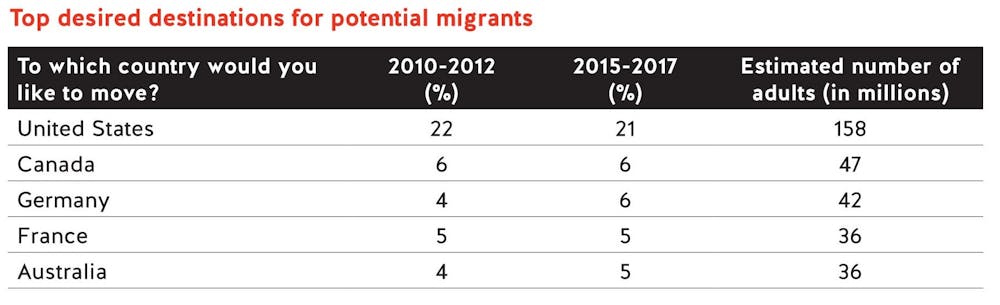

Gallup World Poll, 2015-2017

Australia’s international arrivals are currently capped by limited isolation and quarantine capacity.

Even Australian citizens are finding it difficulty to return.

The government is assuming that Australia will suffer net outflows in 2020-21 and 2021-22, the first time net overseas migration has turned negative since 1946.

Including births and deaths, total population growth is expected to fall to just 0.2% in 2020-21, the lowest since the first world war.

Perhaps more disturbingly, the Australian government is assuming no future adjustments to make up for the losses — neither a return to the previous levels of net overseas migration over the projection period, “due to economic uncertainty and softer labour market conditions” nor accelerated migration beyond that to get back what was lost.

Australia will be left with less population and productive potential than it would have had there been no pandemic. But it needn’t.

Ramp up capacity, change policy

In my new United States Studies Centre report released this morning, I argue Australia can get back what it has lost, in part by taking migrants the US won’t.

The government’s immediate priority should be to fund an increase in managed isolation and quarantine capacity to ramp up our ability to take in migrants.

In the long-term, it should set aside its current annual cap of 160,000 on permanent migration.

The cap won’t matter much for the next few years because it is unlikely to be filled, but it will in future years, denying Australia the ability to get back what it has lost.

As Australia’s economy recovers, skilled workers are going to become scarce.

Experience with Australia’s uncapped temporary skilled visa program shows skilled migration increases the wages of local workers and induces them to specialise in occupations requiring communication and cognitive skills.

Employers are required to pay foreign workers a minimum salary equal to at least that of comparable local workers.

Hong Kong is shaping up to be a good source of skilled foreign workers. The Australian government has already relaxed visa arrangements for Hong Kong but mainly for temporary migrants.

Australia faces competition. Canada is looking to take up to one million skilled migrants through to 2022 — about 350,000 per year.

Stephen Kirchner, Program Director, Trade and Investment, United States Studies Centre, University of Sydney

This article is republished from The Conversation under a Creative Commons license. Read the original article.


Tags: SB001
DMCA.com Protection Status

SUBSCRIBE to our NEWSLETTER

[mc4wp_form id=”2384248″]

Don't Miss

Why Smarter Fleet Management Is For All Modern Business Options

by Fazila Olla-Logday
29 July 2026
Smarter Fleet Management
Motoring

Operating a business that relies on vehicles is harder than ever.

Read moreDetails

Animal Communication Goes Beyond What Science Can Currently Measure: Zoologist and Spiritual teacher Artemis, the heart whisperer on what the textbooks don’t teach

by Australian Times
7 July 2026
Animal Communication Goes Beyond What Science Can Currently Measure
Lifestyle

Animal communication classes and formal training can be valuable, providing tools, structure, and guidance.

Read moreDetails

Managing Aussie Share Portfolios Abroad: Tips for Growth

by Fazila Olla-Logday
2 July 2026
Managing Aussie Share Portfolios Abroad: Tips for Growth
at

Unlock the secrets to optimizing your Aussie share portfolios abroad. Discover essential tips for growth and navigate the global market...

Read moreDetails

The New Meaning of Luxury: Lessons from Entrepreneur Chloe Hardy

by Pauline Torongo
2 July 2026
The New Meaning of Luxury: Lessons from Entrepreneur Chloe Hardy
Business & Finance

Chloe Hardy, the founder and CEO of Dupes & Co established an Australian-made beauty brand focused on affordability and product...

Read moreDetails

Excel Funding Group emerges as Specialist in SMSF Property Lending amid growing demand

by Pauline Torongo
26 June 2026
Excel Funding Group emerges as Specialist in SMSF Property Lending amid growing demand
Business & Finance

Excel Funding Group has hit a new milestone, tripling its SMSF loan settlement volumes compared to Q1 2025.

Read moreDetails

Svitla Systems acquires Australia’s Kiandra IT to expand Global Engineering Footprint and Accelerate AI-Driven delivery

by Pauline Torongo
11 May 2026
Svitla Systems
Business & Finance

Acquisition marks Svitla’s entry into the Australian market and strengthens capabilities in low-code, Microsoft technologies, and enterprise software engineering.

Read moreDetails

Residential Healthcare Practices: Revolution or Evolution?

by Pauline Torongo
11 May 2026
Residential Healthcare Practices: Revolution or Evolution?
Lifestyle

President Bill Lutz’s "revolution" was born from his background in fine dining, which instilled a disciplined, customer-focused approach.

Read moreDetails
Load More

Copyright © Blue Sky Publications Ltd. All Rights Reserved.
australiantimes.co.uk is a division of Blue Sky Publications Ltd. Reproduction without permission prohibited. DMCA.com Protection Status

  • About us
  • Write for Us
  • Advertise
  • Contact us
  • T&Cs, Privacy and GDPR
No Result
View All Result
  • News
    • Weather
    • Sport
    • Technology
    • Business & Finance
      • Currency Zone
    • Lotto Results
      • The Lott
  • Lifestyle
    • Entertainment
    • Horoscopes
    • Health & Wellness
    • Recipes
  • Travel
  • Expat Life
  • Move to Australia

Copyright © Blue Sky Publications Ltd. All Rights Reserved.
australiantimes.co.uk is a division of Blue Sky Publications Ltd. Reproduction without permission prohibited. DMCA.com Protection Status

No Result
View All Result
  • News
    • Weather
    • Sport
    • Technology
    • Business & Finance
      • Currency Zone
    • Lotto Results
      • The Lott
  • Lifestyle
    • Entertainment
    • Horoscopes
    • Health & Wellness
    • Recipes
  • Travel
  • Expat Life
  • Move to Australia

Copyright © Blue Sky Publications Ltd. All Rights Reserved.
australiantimes.co.uk is a division of Blue Sky Publications Ltd. Reproduction without permission prohibited. DMCA.com Protection Status





