


• Advertise
  • About us
  • Terms and Conditions
  • Contact us
Wednesday, May 13, 2026
Australian Times News
  • News
    • Weather
    • Sport
    • Technology
    • Business & Finance
      • Currency Zone
    • Lotto Results
      • The Lott
  • Lifestyle
    • Entertainment
    • Horoscopes
    • Health & Wellness
    • Recipes
  • Travel
  • Expat Life
  • Move to Australia
No Result
View All Result
  • News
    • Weather
    • Sport
    • Technology
    • Business & Finance
      • Currency Zone
    • Lotto Results
      • The Lott
  • Lifestyle
    • Entertainment
    • Horoscopes
    • Health & Wellness
    • Recipes
  • Travel
  • Expat Life
  • Move to Australia
No Result
View All Result
Australian Times News
No Result
View All Result
Home News

The English language dominates global conservation science – which leaves 1 in 3 research papers virtually ignored

English is considered the language of international science. But our new research reveals how important scientific knowledge in other languages is going untapped. This oversight squanders opportunities to help improve the plight of the one million species facing extinction.

The Conversation by The Conversation
09-10-2021 22:17
in News
Photo by National Cancer Institute on Unsplash

Photo by National Cancer Institute on Unsplash

Tatsuya Amano, The University of Queensland

English is considered the language of international science. But our new research reveals how important scientific knowledge in other languages is going untapped. This oversight squanders opportunities to help improve the plight of the one million species facing extinction.

We reviewed almost 420,000 peer-reviewed papers on biodiversity conservation, published in 16 languages other than English. Many non-English-language papers provided evidence on the effectiveness of conservation measures, but they are often not disseminated to the wider scientific community.

History shows many valuable scientific breakthroughs were originally published in a language other than English. The structure of a Nobel Prize–winning antimalarial drug was first published in 1977 in simplified Chinese, as were many of the earliest papers on COVID-19.

Evidence-based conservation is crucial for tackling the Earth’s biodiversity crisis. Our research shows more effort is needed to transcend language barriers in science, maximising scientific contributions to conservation and helping save life on this planet.

woman with clipboard inspects plants
Research findings in non-English papers can provide valuable insights. Shutterstock

Conservation game-changer

Most scientists speak English as a first or second language. And many academic reward programs are skewed towards getting published in international English-language journals.

But important evidence in biodiversity conservation is routinely generated by field conservationists and scientists who are less fluent in English. They often prefer publishing work in their first language – which for many, is not English.


AlsoRead...

Svitla Systems

Svitla Systems acquires Australia’s Kiandra IT to expand Global Engineering Footprint and Accelerate AI-Driven delivery

11 May 2026
How Clevero is helping Australian Service Businesses compete with Enterprises on a Fraction of the Budget

How Clevero is helping Australian Service Businesses compete with Enterprises on a Fraction of the Budget

28 April 2026

More than one-third of scientific documents on biodiversity conservation are published in languages other than English. However, such knowledge is rarely used at the international level.

Take, for example, the Intergovernmental Science-Policy Platform on Biodiversity and Ecosystem Services (IPBES). Analysis of the IPBES biodiversity assessment reports has found 96% of references cited are written in English.

Clearly, tackling any global challenge, including the biodiversity crisis, hinges on tapping into the best available knowledge, whichever language it’s produced in. Our translatE project aims to overcome the language barriers to improve this information flow.

As part of the project, we screened 419,679 peer-reviewed papers published in 16 non-English languages between 1888 and 2020 across a wide range of fields. These spanned biodiversity, ecology, conservation biology, forestry and agricultural science, to name a few.

We found 1,234 papers across the 16 non-English languages that provided evidence on the effectiveness of biodiversity conservation interventions. To put this in perspective, the Conservation Evidence database, which documents global research into the effectiveness of conservation actions, holds 4,412 English-language papers.

The rate of publication of relevant studies is increasing over years in six non-English languages: French, German, Japanese, Portuguese, Russian and simplified Chinese.

Among the non-English-language studies we found were a Spanish study on alleviating conflicts between livestock farmers and endangered Andean mountain cats in northern Patagonia, and a Japanese study on the relocation of endangered Blakiston’s fish owls.

Such findings might have valuable insights for human-nature conflicts and threatened bird management in other parts of the world.
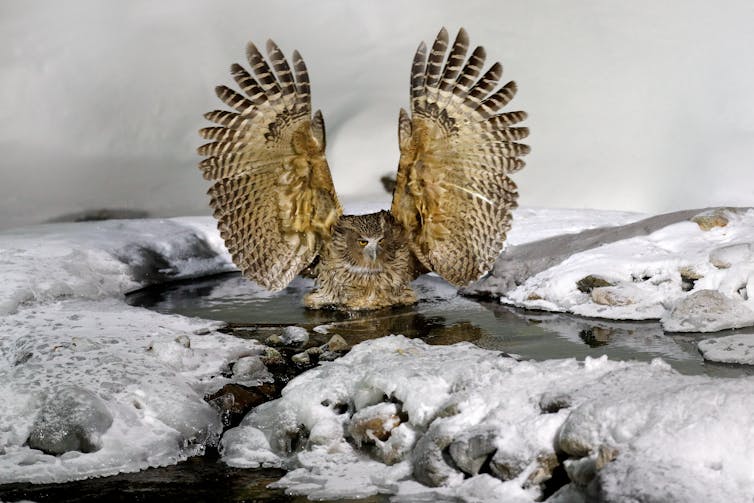


owl in icy water
A Japanese study on Blakiston’s fish owls was among the relevant non-English papers the authors identified. Shutterstock

Most English-language evidence on what works in conservation relates to Europe and North America. In some highly biodiverse regions where conservation is needed most, such as Latin America, evidence is desperately lacking.

Research in languages other than English is especially common in regions where English-language studies are scarce, such as Latin America, Russia and East Asia (see figure below).

Many non-English studies also involve species for which studies in English are few or non-existent. Incorporating non-English studies would expand scientific knowledge into 12-25% more geographic areas and 5-32% more species.
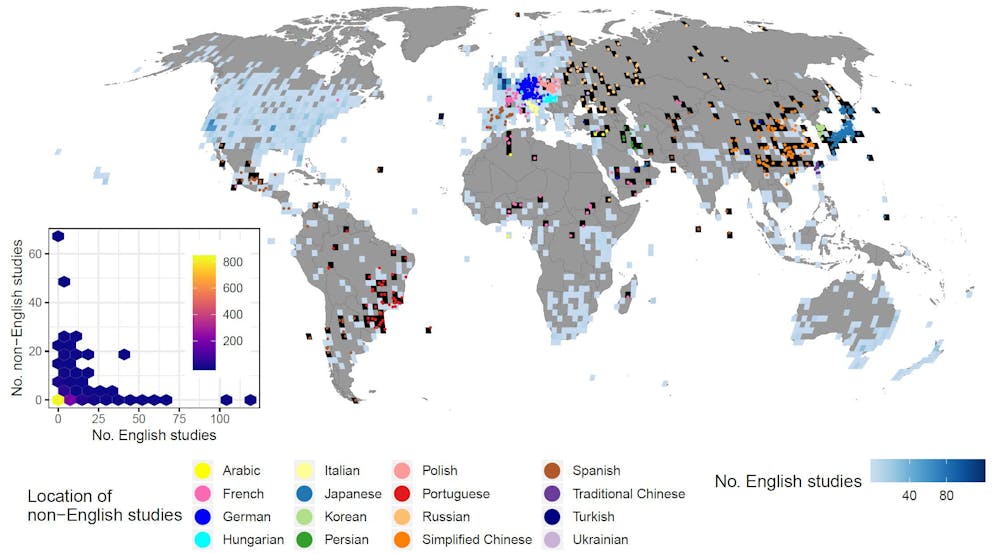
The location of 1,203 non-English-language studies testing the effectiveness of conservation interventions, compared to English-language studies. Amano et al. (2021) Tapping into non-English-language science for the conservation of global biodiversity. PLOS Biology.

Tapping global knowledge

Making the best use of non-English-language science can be a quick, cost-effective way to fill gaps in English-language science.

Our research recommends more effort to synthesise non-English-language studies, and making this knowledge available in English so it can be disseminated to a global audience.

And research projects should seek to involve native speakers of different languages. For our research, we worked with 62 collaborators who, collectively, are native speakers of 17 languages.

To have the best chance of halting Earth’s extinction crisis, we must harness the skills, experience and knowledge of people from around the world.

We also urge wider disciplines to reassess the untapped potential of non-English science to address other global challenges.


Tatsuya Amano, Australian Research Council Future Fellow, The University of Queensland

This article is republished from The Conversation under a Creative Commons license. Read the original article.


Tags: SB001
DMCA.com Protection Status

SUBSCRIBE to our NEWSLETTER

[mc4wp_form id=”2384248″]

Don't Miss

Svitla Systems acquires Australia’s Kiandra IT to expand Global Engineering Footprint and Accelerate AI-Driven delivery

by Pauline Torongo
11 May 2026
Svitla Systems
Business & Finance

Acquisition marks Svitla’s entry into the Australian market and strengthens capabilities in low-code, Microsoft technologies, and enterprise software engineering.

Read moreDetails

Residential Healthcare Practices: Revolution or Evolution?

by Pauline Torongo
11 May 2026
Residential Healthcare Practices: Revolution or Evolution?
Lifestyle

President Bill Lutz’s "revolution" was born from his background in fine dining, which instilled a disciplined, customer-focused approach.

Read moreDetails

Medicana Health Group launches HPV vaccination campaign to support cervical cancer prevention

by Pauline Torongo
28 April 2026
Medicana Health Group launches HPV vaccination campaign to support cervical cancer prevention
Health & Wellness

The Türkiye-based healthcare group has introduced a new awareness campaign focused on HPV vaccination, regular check-ups and early detection, with...

Read moreDetails

How Clevero is helping Australian Service Businesses compete with Enterprises on a Fraction of the Budget

by Pauline Torongo
28 April 2026
How Clevero is helping Australian Service Businesses compete with Enterprises on a Fraction of the Budget
Business & Finance

By consolidating CRM, scheduling, workflow automation, invoicing, reporting, and client communications into a single platform, Clevero gives smaller operators the...

Read moreDetails

How CJAM Group is building 1,100 homes across Southeast Queensland

by Pauline Torongo
24 March 2026
How CJAM Group is building 1,100 homes across Southeast Queensland
Lifestyle

The CJAM Group founder is quietly building a 1,100+ home pipeline, with projects in Hervey Bay and Toowoomba, using a...

Read moreDetails

Design Without Compromise: Where Gutter Protection Meets Modern Architecture

by Fazila Olla-Logday
20 March 2026
Design Without Compromise: Where Gutter Protection Meets Modern Architecture
Business & Finance

Design without compromise by integrating gutter protection seamlessly into modern architecture. Discover how innovative gutter systems enhance your home’s aesthetics...

Read moreDetails

How WageSafe Secured Australia’s Most Reputable Retail Business Among Its Premium Clients

by Fazila Olla-Logday
12 March 2026
How WageSafe Secured Australia’s Most Reputable Retail Business Among Its Premium Clients
at

Learn how WageSafe helps businesses stay compliant with payroll and wage regulations through reliable monitoring, risk management, and expert support—protecting...

Read moreDetails
Load More

Copyright © Blue Sky Publications Ltd. All Rights Reserved.
australiantimes.co.uk is a division of Blue Sky Publications Ltd. Reproduction without permission prohibited. DMCA.com Protection Status

  • About us
  • Write for Us
  • Advertise
  • Contact us
  • T&Cs, Privacy and GDPR
No Result
View All Result
  • News
    • Weather
    • Sport
    • Technology
    • Business & Finance
      • Currency Zone
    • Lotto Results
      • The Lott
  • Lifestyle
    • Entertainment
    • Horoscopes
    • Health & Wellness
    • Recipes
  • Travel
  • Expat Life
  • Move to Australia

Copyright © Blue Sky Publications Ltd. All Rights Reserved.
australiantimes.co.uk is a division of Blue Sky Publications Ltd. Reproduction without permission prohibited. DMCA.com Protection Status

No Result
View All Result
  • News
    • Weather
    • Sport
    • Technology
    • Business & Finance
      • Currency Zone
    • Lotto Results
      • The Lott
  • Lifestyle
    • Entertainment
    • Horoscopes
    • Health & Wellness
    • Recipes
  • Travel
  • Expat Life
  • Move to Australia

Copyright © Blue Sky Publications Ltd. All Rights Reserved.
australiantimes.co.uk is a division of Blue Sky Publications Ltd. Reproduction without permission prohibited. DMCA.com Protection Status





