• Advertise
  • About us
  • Terms and Conditions
  • Contact us
Thursday, May 14, 2026
Australian Times News
  • News
    • Weather
    • Sport
    • Technology
    • Business & Finance
      • Currency Zone
    • Lotto Results
      • The Lott
  • Lifestyle
    • Entertainment
    • Horoscopes
    • Health & Wellness
    • Recipes
  • Travel
  • Expat Life
  • Move to Australia
No Result
View All Result
  • News
    • Weather
    • Sport
    • Technology
    • Business & Finance
      • Currency Zone
    • Lotto Results
      • The Lott
  • Lifestyle
    • Entertainment
    • Horoscopes
    • Health & Wellness
    • Recipes
  • Travel
  • Expat Life
  • Move to Australia
No Result
View All Result
Australian Times News
No Result
View All Result
Home News

Lighter pavement really does cool cities when it’s done right

Research shows that building lighter-colored, more reflective roads has the potential to lower air temperatures by more than 2.5 degrees Fahrenheit (1.4 C) and, in the process, reduce the frequency of heat waves by 41% across U.S. cities.

The Conversation by The Conversation
20-06-2021 06:03
in News
Photo by Linda Gerbec on Unsplash

Photo by Linda Gerbec on Unsplash

Hessam AzariJafari, Massachusetts Institute of Technology and Randolph E. Kirchain, Massachusetts Institute of Technology

When heat waves hit, people start looking for anything that might lower the temperature. One solution is right beneath our feet: pavement.
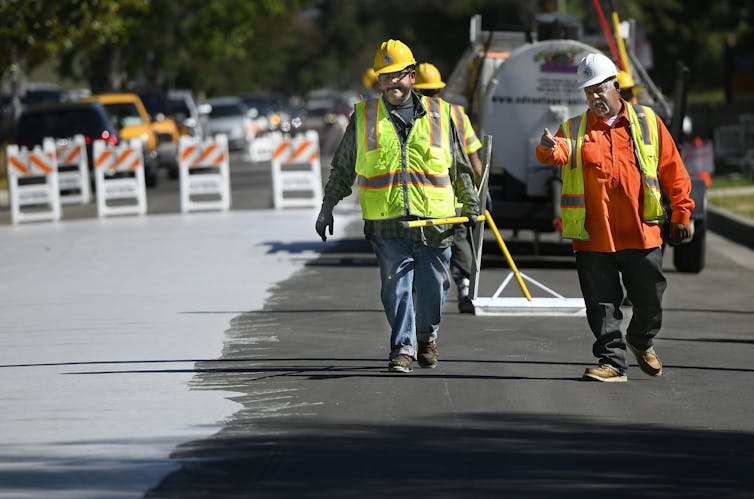
A road crew paints a street in Los Angeles with coating designed to reduce heat. John McCoy/MediaNews Group/Los Angeles Daily News via Getty Images

Think about how hot the soles of your shoes can get when you’re walking on dark pavement or asphalt. A hot street isn’t just hot to touch – it also raises the surrounding air temperature.

Research shows that building lighter-colored, more reflective roads has the potential to lower air temperatures by more than 2.5 degrees Fahrenheit (1.4 C) and, in the process, reduce the frequency of heat waves by 41% across U.S. cities. But reflective surfaces have to be used strategically – the wrong placement can actually heat up nearby buildings instead of cooling things down.

As researchers in MIT’s Concrete Sustainability Hub, we have been modeling these surfaces and determining the right balance for lowering the heat and helping cities reduce their greenhouse gas emissions. Here’s how reflective pavement works and what cities need to think about.

Why surfaces heat up

All surfaces, depending on the amount of radiation they absorb or reflect, can affect air temperatures in cities.

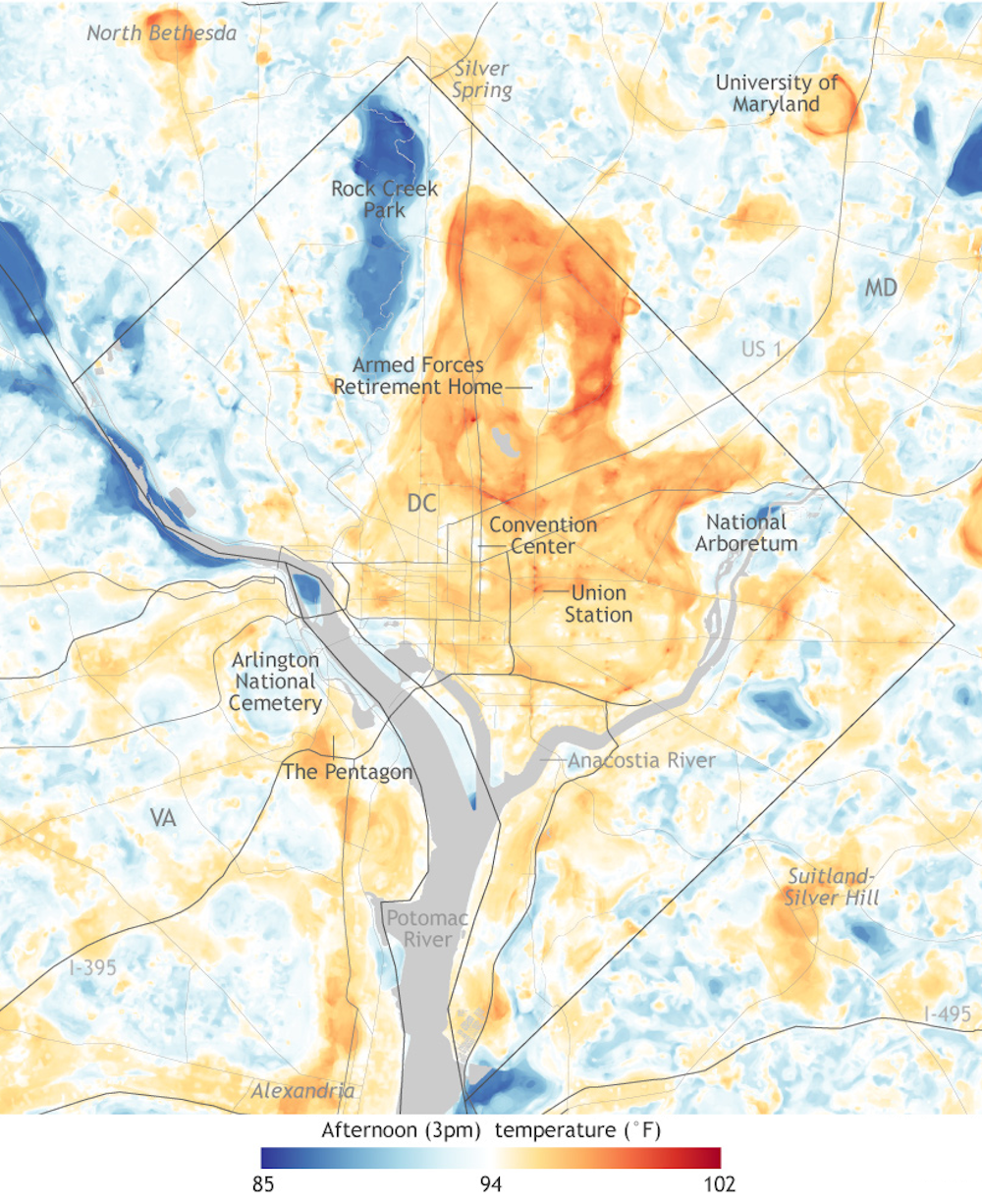
In urban areas, about 40% of the land is paved, and that pavement absorbs solar radiation. The absorbed heat in the pavement mass is released gradually, warming the surrounding environment. This can exacerbate urban heat islands and worsen the effects of heat waves. It’s part of the reason cities are regularly a few degrees warmer in summer than nearby rural areas and leafy suburbs.


AlsoRead...

Svitla Systems

Svitla Systems acquires Australia’s Kiandra IT to expand Global Engineering Footprint and Accelerate AI-Driven delivery

11 May 2026
How Clevero is helping Australian Service Businesses compete with Enterprises on a Fraction of the Budget

How Clevero is helping Australian Service Businesses compete with Enterprises on a Fraction of the Budget

28 April 2026
A map of Washington, D.C., and some of its suburbs showing heat islands on downtown areas.
The urban heat island effect in Washington, D.C., on Aug. 28, 2018. NOAA Climate.gov

Reflective materials on pavement can prevent that heat from building up and help counteract climate change by reflecting solar radiation back to the top of the atmosphere. White roofs can have the same effect.

To estimate a pavement’s reflectivity, we use a measure called albedo. Albedo refers to the proportion of light reflected by a surface. The lower a surface’s albedo, the more light it absorbs and, consequentially, the more heat it traps.

Typically, the darker the surface, the lower the albedo. Conventional pavements such as asphalt have a low albedo of around 0.05-0.1, meaning they reflect only 5% to 10% of the light they receive and absorb as much as 95%.

When pavements instead use brighter additives, reflective aggregates, light-reflective surface coatings or lighter paving materials like concrete, they can triple the albedo, sending more radiation back into space.

Though the benefits of reflective pavements can vary across the nation’s 4 million miles of roads, they are, on the whole, immense. An MIT CSHub model estimated that an increase in pavement albedo on all U.S. roads could lower energy use for cooling and reduce greenhouse gas emissions equivalent to 4 million cars driven for one year. And when materials are locally sourced, such as light-colored binders or aggregates, the crushed stone, gravel or other hard materials in concrete, these roads can also save money.

Location matters

But not all paved areas are ideal for cool roads. Within cities, and even within urban neighborhoods, the benefits differ.

When brighter pavements reflect radiation onto buildings – called incident radiation – they can warm nearby buildings in the summer, actually increasing the demand for air conditioning. That’s why attention to location matters.
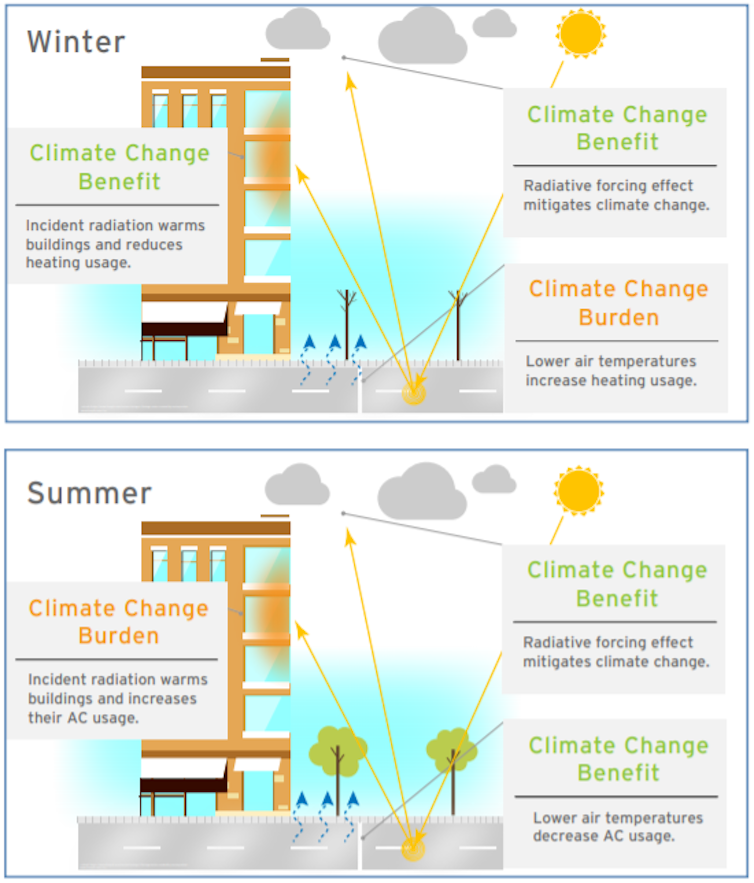
Illustrations of a building with text describing the different effects by season.
Reflective roads can have different effects in summer and winter depending on the surrounding buildings. MIT

Consider the differences between Boston and Phoenix.

Boston’s dense downtown of narrow streets has tall buildings that block light from directly hitting the pavement most hours of the day. Reflective pavement won’t help or harm much there. But Boston’s unobstructed freeways and its suburbs would see a net benefit from reflecting a large fraction of incoming sunlight to the top of the atmosphere. Using models, we found that doubling the traditional albedo of the city’s roads could cut peak summer temperatures by 1 to 2.7 F (0.3 to 1.7 C).

Phoenix could reduce its summer temperatures even more – by 2.5 to 3.6 F (1.4 to 2.1 C) – but the effects in some parts of its downtown are complicated. In a few low, sparse downtown neighborhoods, we found that reflective pavement could raise the demand for cooling because of increased incident radiation on the buildings.

In Los Angeles, where the city has been experimenting with a cooler coating over asphalt, researchers found another effect to consider. When the coating was used in areas where people walk, the ground itself was as much as 11 F (6.1 C) cooler, but a few feet off the ground, the temperature rose as the sun’s rays were reflected. The results suggest such coatings might be better for roads than for sidewalks or playgrounds.

An elegant solution, if used with care

Cities will need to consider all of these effects.

Reflective pavements are an elegant solution that can transform something we use every day to reduce urban warming. The full lifecycle emissions of roads, including the materials used in them, have to be factored in. But as cities consider ways to combat the effects of climate change, we believe strategically optimizing pavement is a smart option that can make urban cores more livable.

Hessam AzariJafari, Postdoctoral Associate in Engineering, Massachusetts Institute of Technology and Randolph E. Kirchain, Co-Director, MIT Concrete Sustainability Hub, Massachusetts Institute of Technology

This article is republished from The Conversation under a Creative Commons license. Read the original article.


Tags: SB001
DMCA.com Protection Status

SUBSCRIBE to our NEWSLETTER

[mc4wp_form id=”2384248″]

Don't Miss

Svitla Systems acquires Australia’s Kiandra IT to expand Global Engineering Footprint and Accelerate AI-Driven delivery

by Pauline Torongo
11 May 2026
Svitla Systems
Business & Finance

Acquisition marks Svitla’s entry into the Australian market and strengthens capabilities in low-code, Microsoft technologies, and enterprise software engineering.

Read moreDetails

Residential Healthcare Practices: Revolution or Evolution?

by Pauline Torongo
11 May 2026
Residential Healthcare Practices: Revolution or Evolution?
Lifestyle

President Bill Lutz’s "revolution" was born from his background in fine dining, which instilled a disciplined, customer-focused approach.

Read moreDetails

Medicana Health Group launches HPV vaccination campaign to support cervical cancer prevention

by Pauline Torongo
28 April 2026
Medicana Health Group launches HPV vaccination campaign to support cervical cancer prevention
Health & Wellness

The Türkiye-based healthcare group has introduced a new awareness campaign focused on HPV vaccination, regular check-ups and early detection, with...

Read moreDetails

How Clevero is helping Australian Service Businesses compete with Enterprises on a Fraction of the Budget

by Pauline Torongo
28 April 2026
How Clevero is helping Australian Service Businesses compete with Enterprises on a Fraction of the Budget
Business & Finance

By consolidating CRM, scheduling, workflow automation, invoicing, reporting, and client communications into a single platform, Clevero gives smaller operators the...

Read moreDetails

How CJAM Group is building 1,100 homes across Southeast Queensland

by Pauline Torongo
24 March 2026
How CJAM Group is building 1,100 homes across Southeast Queensland
Lifestyle

The CJAM Group founder is quietly building a 1,100+ home pipeline, with projects in Hervey Bay and Toowoomba, using a...

Read moreDetails

Design Without Compromise: Where Gutter Protection Meets Modern Architecture

by Fazila Olla-Logday
20 March 2026
Design Without Compromise: Where Gutter Protection Meets Modern Architecture
Business & Finance

Design without compromise by integrating gutter protection seamlessly into modern architecture. Discover how innovative gutter systems enhance your home’s aesthetics...

Read moreDetails

How WageSafe Secured Australia’s Most Reputable Retail Business Among Its Premium Clients

by Fazila Olla-Logday
12 March 2026
How WageSafe Secured Australia’s Most Reputable Retail Business Among Its Premium Clients
at

Learn how WageSafe helps businesses stay compliant with payroll and wage regulations through reliable monitoring, risk management, and expert support—protecting...

Read moreDetails
Load More

Copyright © Blue Sky Publications Ltd. All Rights Reserved.
australiantimes.co.uk is a division of Blue Sky Publications Ltd. Reproduction without permission prohibited. DMCA.com Protection Status

  • About us
  • Write for Us
  • Advertise
  • Contact us
  • T&Cs, Privacy and GDPR
No Result
View All Result
  • News
    • Weather
    • Sport
    • Technology
    • Business & Finance
      • Currency Zone
    • Lotto Results
      • The Lott
  • Lifestyle
    • Entertainment
    • Horoscopes
    • Health & Wellness
    • Recipes
  • Travel
  • Expat Life
  • Move to Australia

Copyright © Blue Sky Publications Ltd. All Rights Reserved.
australiantimes.co.uk is a division of Blue Sky Publications Ltd. Reproduction without permission prohibited. DMCA.com Protection Status

No Result
View All Result
  • News
    • Weather
    • Sport
    • Technology
    • Business & Finance
      • Currency Zone
    • Lotto Results
      • The Lott
  • Lifestyle
    • Entertainment
    • Horoscopes
    • Health & Wellness
    • Recipes
  • Travel
  • Expat Life
  • Move to Australia

Copyright © Blue Sky Publications Ltd. All Rights Reserved.
australiantimes.co.uk is a division of Blue Sky Publications Ltd. Reproduction without permission prohibited. DMCA.com Protection Status