


Samantha Vanderslott, University of Oxford
The Greek prime minister, Kyriakos Mitsotakis, recently announced plans to fine people aged 60 and over who refuse the COVID vaccine. A monthly fine of €100 (£85) will be imposed from January 16.
Faced with surges in COVID in some regions and the sudden emergence of a new variant of concern (omicron), a growing number of countries are tightening their vaccination rules: from increasing the requirement for boosters to mandatory vaccines for certain occupations and businesses, and sometimes the wider public.
Among the first countries to impose vaccine mandates were Indonesia, Micronesia and Turkmenistan. More recently, Austria introduced mandatory vaccination in response to rising COVID cases, while Germany is considering a similar move.
But this is not the first time that governments have made vaccination mandatory to increase uptake. Looking at previous mandates (before COVID) can provide further insight into the current situation. My colleague Tatjana Marks and I recently reviewed mandatory vaccination policies around the world, with a concentration on childhood vaccines.
We found that many western European countries imposed mandatory vaccination in the 19th century (against smallpox, and often including adults) and many eastern European countries imposed them during the Soviet era.
For Europe, the early introduction of these mandates was met with a swift pushback by anti-vaccination leagues who saw them as an encroachment of the state into the private sphere.


The health authorities and governments who initiated these vaccine mandates later changed tack, preferring to foster mutual trust and responsibility with citizens for their health and to protect others. In more recent times, when mandates have been imposed, they have mainly come about in reaction to vaccination rates not being high enough to stop outbreaks from happening.
Current vaccine mandates
In the past few years, vaccine mandates were introduced in Europe in the wake of outbreaks of childhood diseases – particularly measles. These were extending current mandates (France), clarifying existing mandates (Italy), or introducing a new mandate (Germany, which was only for measles).
Mandatory vaccination for travellers and certain occupations has also been commonplace in many countries around the world. What is unusual are vaccination mandates for adults during an epidemic. Samoa is one exception to this. In 2019, the Polynesian island country introduced mandatory measles vaccination for the whole population during a state of national emergency, which suffered thousands of cases and more than 80 deaths from a preventable disease, many of whom were children. This is within a small population of only around 200,000 people.
The mandatory vaccination order resulted in nearly all the population being vaccinated, and the outbreak was eventually halted. Unfortunately, one of the original reasons for a low vaccination rate in the country resulted from a mistake with preparing a vaccine for two children that resulted in their deaths. This incident shows how quickly confidence can be knocked if vaccination services are not up to standard.
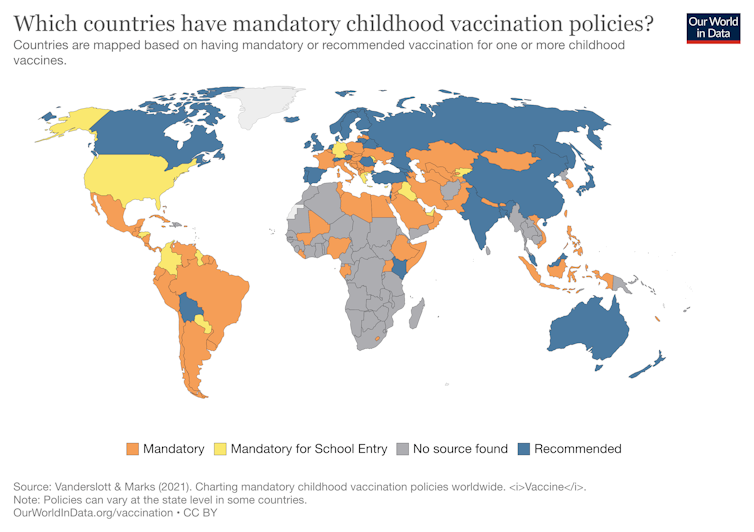
The recent vaccine mandates in Europe were put in place because of falling vaccination rates and the rise of outbreaks from vaccine-preventable diseases – especially measles.
France made all recommended vaccines mandatory in 2017, with fines and possible prison sentences for those who didn’t comply. This extended three mandatory vaccines to 11. The reason for doing so was that parents had viewed the recommended vaccines as not being as important as the mandatory ones and so tended to avoid them.
Germany made measles vaccination mandatory for school and day-care attendance (it’s worth noting that it’s illegal to home school children in Germany), as well as other public spaces, such as refugee shelters and clinics.
Italy, which had a history of not strongly enforcing vaccination mandates, had mandatory vaccination for four diseases, but the fines for not complying were rarely applied. In 2017, Italy made an additional six vaccines mandatory for minors and pre-school attendance, with parents who didn’t comply being issued with fines or their children being denied entry to pre-school.
Mandates do increase uptake
Since introducing mandatory vaccination, coverage rates have increased in France, Italy and Germany. However, an assessment of success depends on whether a country can introduce these policies in the first place, without opposition.
Ukraine has had an unfortunate experience with mandatory vaccination, as a country that has had the largest outbreaks of measles in Europe. Forty-six thousand people contracted measles and rubella in 2005 and 2006. As a result, the Ministry of Health introduced mandatory vaccines for measles and rubella. But negative media attention and controversy over alleged side-effects ended the campaign.
Although not enough time has passed to fully judge success rates, mandatory vaccination does tend to improve uptake. These improvements are usually only small percentages, as most people get vaccinated voluntarily. Still, it is small drops in coverage that lead to vulnerable clusters of people making the threat of outbreaks real.
The “pass sanitaire” requirement in France allowed only fully vaccinated or those with a negative test to gain access to public spaces. The millions who booked their jabs straight after the announcement was a strong indication of how effective a vaccine mandate could be in speeding up uptake when during an outbreak. And speed is of the essence.
There are, of course, potential downsides to mandatory vaccination in further polarising society and neglecting other means to increase vaccination – such as awareness campaigns. Concerns over backlash and the breaking down of trust and responsibility for health between states and their citizens is another reason to be cautious. But in an emergency, when mandatory vaccination is known to improve uptake, countries can be left with little choice.
Samantha Vanderslott, University Research Lecturer, University of Oxford
This article is republished from The Conversation under a Creative Commons license. Read the original article.







