


• Advertise
  • About us
  • Terms and Conditions
  • Contact us
Thursday, May 14, 2026
Australian Times News
  • News
    • Weather
    • Sport
    • Technology
    • Business & Finance
      • Currency Zone
    • Lotto Results
      • The Lott
  • Lifestyle
    • Entertainment
    • Horoscopes
    • Health & Wellness
    • Recipes
  • Travel
  • Expat Life
  • Move to Australia
No Result
View All Result
  • News
    • Weather
    • Sport
    • Technology
    • Business & Finance
      • Currency Zone
    • Lotto Results
      • The Lott
  • Lifestyle
    • Entertainment
    • Horoscopes
    • Health & Wellness
    • Recipes
  • Travel
  • Expat Life
  • Move to Australia
No Result
View All Result
Australian Times News
No Result
View All Result
Home News

G7: why major economies are delaying a break with the fossil fuel industry

The climate crisis is certain to be a hot topic at the G7 summit in Cornwall. While the leaders of the world’s richest countries agree in theory on the need to reach net zero emissions by 2050 at the latest, they remain faithful to a fossil fuel industry reluctant to substantively change its business model.

The Conversation by The Conversation
11-06-2021 18:07
in News
Photo by Alexander Schimmeck on Unsplash

Photo by Alexander Schimmeck on Unsplash

George Ferns, Cardiff University and Marcus Gomes, Cardiff University

The climate crisis is certain to be a hot topic at the G7 summit in Cornwall. While the leaders of the world’s richest countries agree in theory on the need to reach net zero emissions by 2050 at the latest, they remain faithful to a fossil fuel industry reluctant to substantively change its business model.

A recent report by the International Energy Agency, a typically conservative advisory body, argued for an immediate ban on new fossil fuel projects. But investments by oil, gas and coal companies into finding new sources continue, as does industry lobbying to undermine regulation.

The environment ministers of the G7 countries committed to end funding for new overseas coal projects by the end of 2021. But 51% of their COVID-19 economic recovery funds – a total of US$189 billion (£133 billion) – paid between January 2020 and March 2021 were earmarked as financial aid for the fossil fuel industry. Worse, US$8 of every US$10 dedicated to non-renewable energy was paid with no conditions on these companies to reduce their emissions.

Why does it seem so hard for G7 leaders to match their words with action when it comes to the fossil fuel industry?

Betting on the long-term business case

Despite setbacks in volatile markets and oversupply risks, there is still a lot of money to be made from extracting, producing and selling hydrocarbons. Demand for coal has plateaued, but oil and gas demand is predicted to rise at least for the next 15 to 20 years, particularly in emerging economies such as China and India.

This puts G7 leaders in an awkward position. On the one hand, governments need to reboot economic growth after the pandemic slowdown – a profitable energy sector nourished by rising demand abroad is welcome, even though hydrocarbon extraction can be especially polluting in developing countries.


AlsoRead...

Svitla Systems

Svitla Systems acquires Australia’s Kiandra IT to expand Global Engineering Footprint and Accelerate AI-Driven delivery

11 May 2026
How Clevero is helping Australian Service Businesses compete with Enterprises on a Fraction of the Budget

How Clevero is helping Australian Service Businesses compete with Enterprises on a Fraction of the Budget

28 April 2026

Governmental support for the industry in the form of subsidies or tax breaks artificially inflates the profitability of fossil fuels, in turn making renewables a less attractive investment. Put simply, it is less risky and more profitable to – at least for now – invest in oil and gas.


Carbon lock-in

The fossil fuel industry continues to shed public support, but it can rely on the fact that it’s embedded within a complex system of consumers, suppliers and contractors, politicians and the media. The cause-and-effect relations that define such an intricate system often produce unintended outcomes.

This interdependency is referred to as carbon lock-in. Economies have evolved in such a way that they perpetuate an energy landscape dominated by fossil fuels and plagued by an inability to radically change.

Not only does carbon lock-in result in inertia, it causes a tragedy of the commons-type problem. Big oil companies such as BP, Exxon Mobil and Shell are unlikely to make meaningful changes until the rest of the system acts in unison. National oil companies and smaller privately owned fossil fuel companies comprise the bulk of known fossil fuel reserves. But they often evade the spotlight and so can operate with more freedom. For a big oil company to make high-risk changes to its business model while others enjoy a free ride would be seen as a bad business decision.
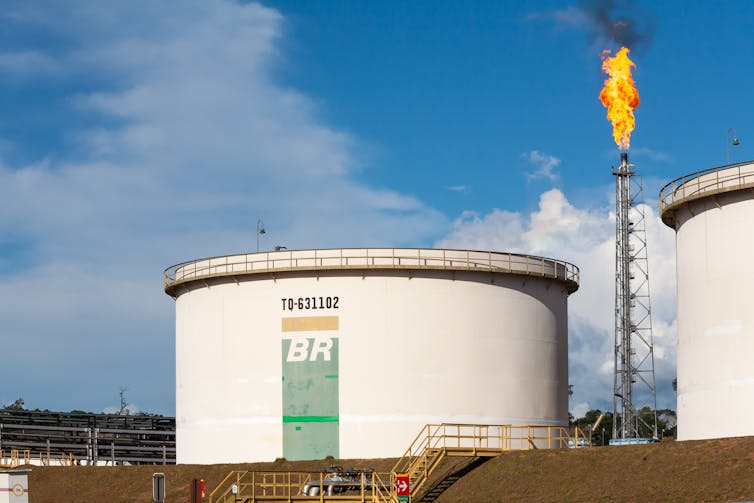
Gas tanks and flare tower owned by Petrobas in Brazil.
State-owned entities tend to slip under the radar. Paralaxis/Shutterstock

Lock-in, as the name suggests, is very difficult to break. That said, G7 members are powerful nodes within this complex network. Strong leadership – such as divestment from fossil fuels and strong support for renewables – would cause reverberations throughout the whole system. But strong commitments coupled with counter-intuitive policies only send a signal that meaningful changes aren’t coming.

Identity crisis

People working in the fossil fuel industry often stay in the sector for their entire career – starting off as students of engineering or geoscience in departments funded by the industry, working all over the world and then heading into management positions.

The industry’s identity is predicated on certain values that have existed since the early days of hydrocarbon exploration, including, as one study found, a deep trust in the potential of science and technology to further humanity’s control over nature and to drive progress and economic development.

The ideological commitments of leaders in the fossil fuel industry will take a firm challenge from governments to overcome. It’s clear from financial decisions in the lead up to the summit that G7 leaders aren’t quite up to that test yet. But the meeting in Cornwall is their opportunity to signal that that cosy relationship is finally coming to an end.

George Ferns, Lecturer in Management, Employment and Organisation, Cardiff University and Marcus Gomes, Lecturer in Organisation Studies and Sustainability, Cardiff University

This article is republished from The Conversation under a Creative Commons license. Read the original article.


Tags: SB001
DMCA.com Protection Status

SUBSCRIBE to our NEWSLETTER

[mc4wp_form id=”2384248″]

Don't Miss

Svitla Systems acquires Australia’s Kiandra IT to expand Global Engineering Footprint and Accelerate AI-Driven delivery

by Pauline Torongo
11 May 2026
Svitla Systems
Business & Finance

Acquisition marks Svitla’s entry into the Australian market and strengthens capabilities in low-code, Microsoft technologies, and enterprise software engineering.

Read moreDetails

Residential Healthcare Practices: Revolution or Evolution?

by Pauline Torongo
11 May 2026
Residential Healthcare Practices: Revolution or Evolution?
Lifestyle

President Bill Lutz’s "revolution" was born from his background in fine dining, which instilled a disciplined, customer-focused approach.

Read moreDetails

Medicana Health Group launches HPV vaccination campaign to support cervical cancer prevention

by Pauline Torongo
28 April 2026
Medicana Health Group launches HPV vaccination campaign to support cervical cancer prevention
Health & Wellness

The Türkiye-based healthcare group has introduced a new awareness campaign focused on HPV vaccination, regular check-ups and early detection, with...

Read moreDetails

How Clevero is helping Australian Service Businesses compete with Enterprises on a Fraction of the Budget

by Pauline Torongo
28 April 2026
How Clevero is helping Australian Service Businesses compete with Enterprises on a Fraction of the Budget
Business & Finance

By consolidating CRM, scheduling, workflow automation, invoicing, reporting, and client communications into a single platform, Clevero gives smaller operators the...

Read moreDetails

How CJAM Group is building 1,100 homes across Southeast Queensland

by Pauline Torongo
24 March 2026
How CJAM Group is building 1,100 homes across Southeast Queensland
Lifestyle

The CJAM Group founder is quietly building a 1,100+ home pipeline, with projects in Hervey Bay and Toowoomba, using a...

Read moreDetails

Design Without Compromise: Where Gutter Protection Meets Modern Architecture

by Fazila Olla-Logday
20 March 2026
Design Without Compromise: Where Gutter Protection Meets Modern Architecture
Business & Finance

Design without compromise by integrating gutter protection seamlessly into modern architecture. Discover how innovative gutter systems enhance your home’s aesthetics...

Read moreDetails

How WageSafe Secured Australia’s Most Reputable Retail Business Among Its Premium Clients

by Fazila Olla-Logday
12 March 2026
How WageSafe Secured Australia’s Most Reputable Retail Business Among Its Premium Clients
at

Learn how WageSafe helps businesses stay compliant with payroll and wage regulations through reliable monitoring, risk management, and expert support—protecting...

Read moreDetails
Load More

Copyright © Blue Sky Publications Ltd. All Rights Reserved.
australiantimes.co.uk is a division of Blue Sky Publications Ltd. Reproduction without permission prohibited. DMCA.com Protection Status

  • About us
  • Write for Us
  • Advertise
  • Contact us
  • T&Cs, Privacy and GDPR
No Result
View All Result
  • News
    • Weather
    • Sport
    • Technology
    • Business & Finance
      • Currency Zone
    • Lotto Results
      • The Lott
  • Lifestyle
    • Entertainment
    • Horoscopes
    • Health & Wellness
    • Recipes
  • Travel
  • Expat Life
  • Move to Australia

Copyright © Blue Sky Publications Ltd. All Rights Reserved.
australiantimes.co.uk is a division of Blue Sky Publications Ltd. Reproduction without permission prohibited. DMCA.com Protection Status

No Result
View All Result
  • News
    • Weather
    • Sport
    • Technology
    • Business & Finance
      • Currency Zone
    • Lotto Results
      • The Lott
  • Lifestyle
    • Entertainment
    • Horoscopes
    • Health & Wellness
    • Recipes
  • Travel
  • Expat Life
  • Move to Australia

Copyright © Blue Sky Publications Ltd. All Rights Reserved.
australiantimes.co.uk is a division of Blue Sky Publications Ltd. Reproduction without permission prohibited. DMCA.com Protection Status





