• Advertise
  • About us
  • Terms and Conditions
  • Contact us
Saturday, August 15, 2026
Australian Times News
  • News
    • Weather
    • Sport
    • Technology
    • Business & Finance
      • Currency Zone
    • Lotto Results
      • The Lott
  • Lifestyle
    • Entertainment
    • Horoscopes
    • Health & Wellness
    • Recipes
  • Travel
  • Expat Life
  • Move to Australia
No Result
View All Result
  • News
    • Weather
    • Sport
    • Technology
    • Business & Finance
      • Currency Zone
    • Lotto Results
      • The Lott
  • Lifestyle
    • Entertainment
    • Horoscopes
    • Health & Wellness
    • Recipes
  • Travel
  • Expat Life
  • Move to Australia
No Result
View All Result
Australian Times News
No Result
View All Result
Home News

Footing the COVID-19 bill: economic case for tax hike on wealthy

Governments shouldn’t be worried that raising taxes on the rich will harm their economies when deciding on how to pay for COVID-19.

The Conversation by The Conversation
17-12-2020 22:11
in News
Tax hike on wealthy

Tax hike on wealthy Photo by JC Gellidon on Unsplash

David Hope, King’s College London and Julian Limberg, King’s College London

Governments shouldn’t be worried that raising taxes on the rich will harm their economies when deciding on how to pay for COVID-19. Our new research on 18 advanced economies shows that major tax cuts for the rich over the past 50 years have pushed up inequality but have had no significant effects on economic growth or unemployment.
Sheila Fitzgerald / Shutterstock.com

These findings shed new light on a debate that has long divided policymakers, with one side claiming higher taxes on the rich could raise revenue and reduce inequality, and the other arguing that low taxes on the rich are the best route to wider economic prosperity.

The data suggests that low taxes on the rich bring economies little benefit, and this suggests there is a strong economic case for raising taxes on the rich to help repair public finances following the pandemic.

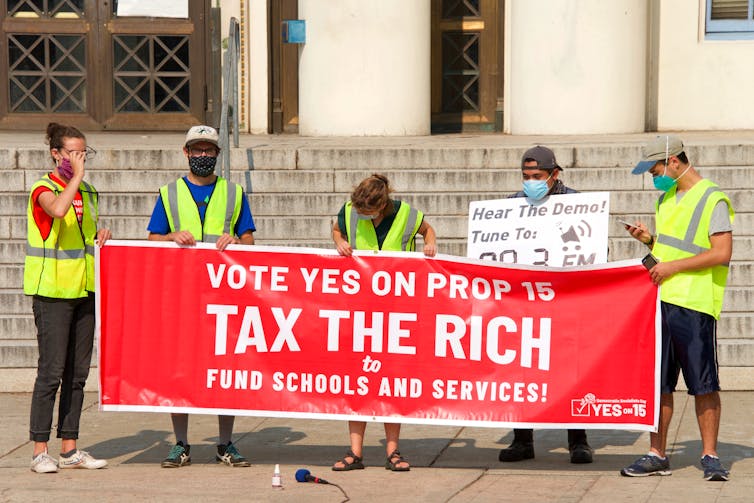
As the COVID-19 pandemic is putting government finances under pressure worldwide, higher taxes on the rich are back on the political agenda. In the US, the president-elect, Joe Biden, has promised to raise taxes on top income earners and corporations. Voices demanding a wealth tax have also become louder in the UK and Germany. Given the damage the pandemic has done to economies, the notion of getting the most affluent to help foot the bill is one that has many supporters. But once again this is being countered by those who insist that low taxes are crucial for stimulating the economy.

Such arguments about the efficiency advantages of low taxes on the rich have been powerful drivers of previous tax cuts. The graph below shows a new comprehensive indicator that measures taxes on the rich across countries and over time by combining the most important taxes on the rich including taxes on top incomes, capital and inheritances. Since the 1980s, many countries have legislated major tax cuts for the rich. For instance, the two Reagan tax cuts in the US reduced top rate taxes substantially in 1982 and 1987. In the UK, taxes on the rich dropped significantly under the Thatcher administration, with major tax cuts in 1979 and 1988.
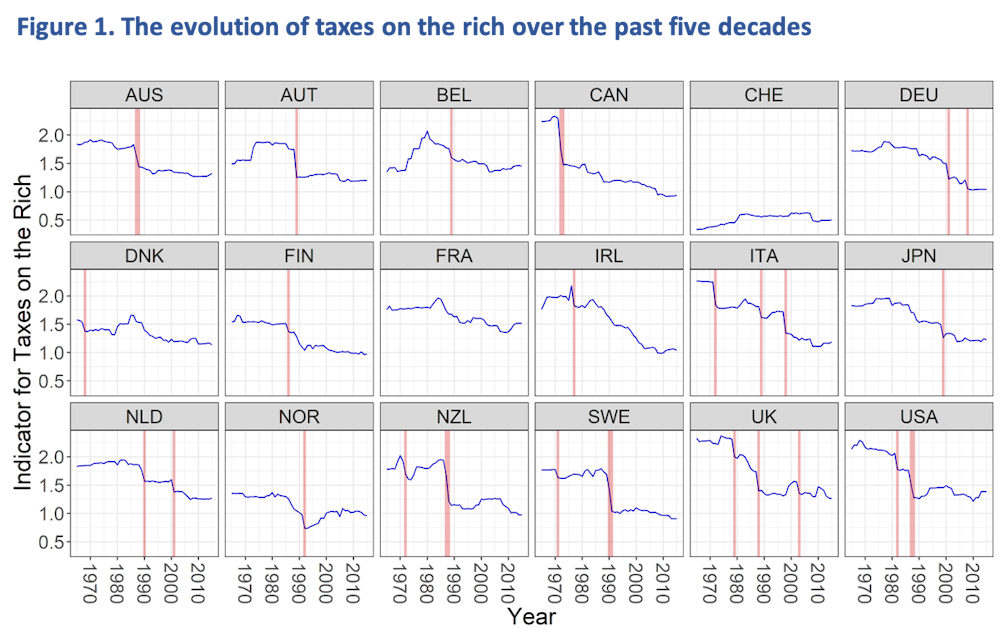
Note: Vertical red lines show years with major tax cuts for the rich. Author provided

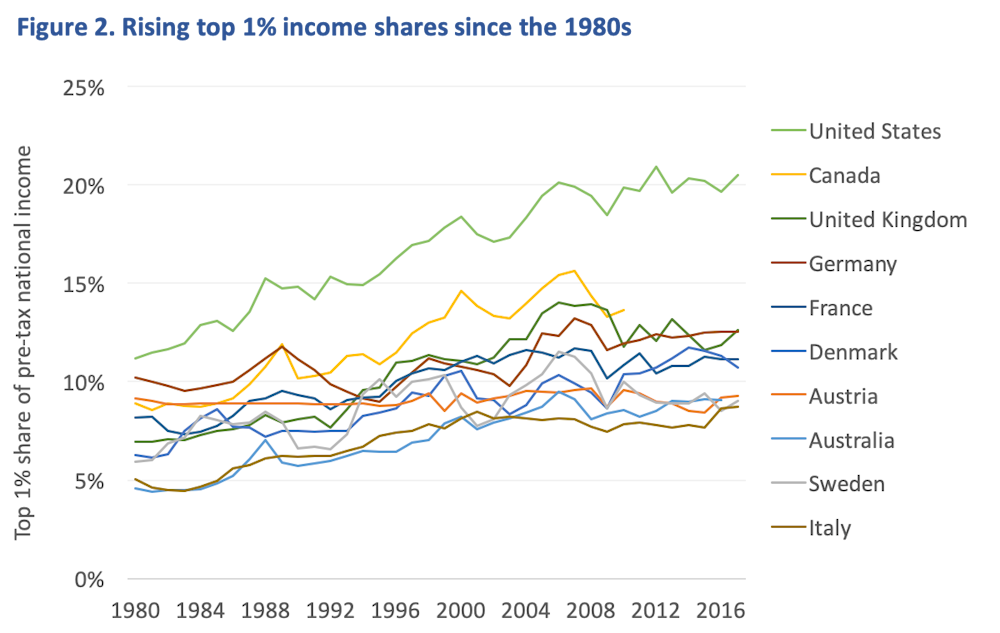
Falling taxes on the rich have coincided with a period of rising inequality, especially at the top of the income distribution as the graph below shows. This trend has been most severe in the Anglo-Saxon countries. The US really stands out, with over one-fifth of pre-tax national income now going to the richest 1% of individuals.


AlsoRead...

Managing Aussie Share Portfolios Abroad: Tips for Growth

Managing Aussie Share Portfolios Abroad: Tips for Growth

2 July 2026
The New Meaning of Luxury: Lessons from Entrepreneur Chloe Hardy

The New Meaning of Luxury: Lessons from Entrepreneur Chloe Hardy

2 July 2026
World Inequality Database, wid.world (data accessed 10 July 2020)

Few economic benefits of low taxes on the rich

Our research compared countries that passed laws for major tax cuts in a given year with those that didn’t. For example, we looked at economic outcomes in Australia following the 1987 tax reform and the USA following the 1982 tax cuts and compare them to economic outcomes in countries that did not cut taxes on the rich at the same time (the results are in the graph below). We repeated such comparisons for each major tax cut for the rich in 18 Organisation for Economic Co-operation and Development (OECD) member countries from 1965 to 2015.
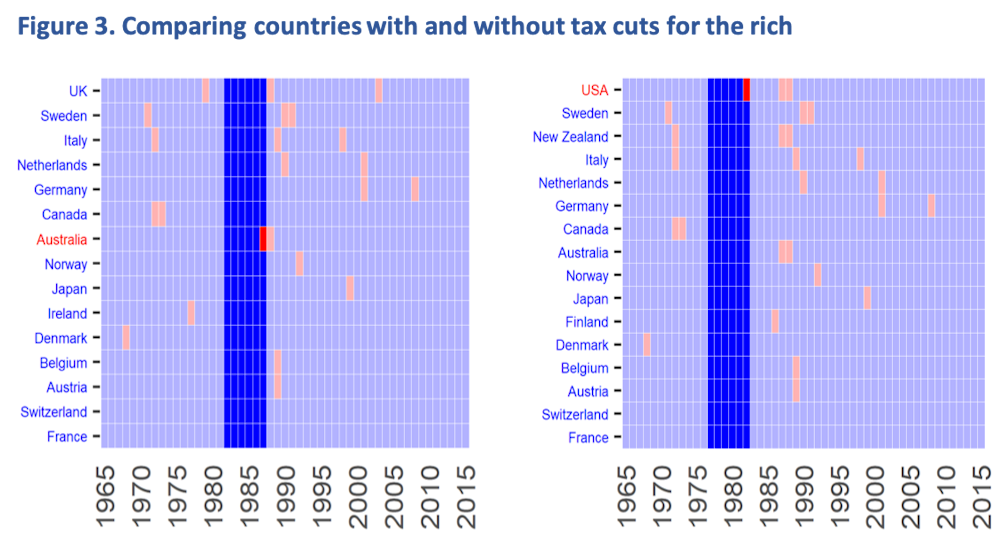
Note: Red squares show years with major tax cuts for the rich, and blue squares show years without. Author provided

Our results show that countries that implemented major tax cuts saw the richest 1% increase their income share in the following years. Five years after reform, the effect was a more than 0.8 percentage points increase in the top 1% income share (see the graph below). As a comparison, in the US, the poorest 10% of income earners have a total income share of 1.8%. In contrast, we did not find any significant effect of tax cuts on economic growth and unemployment. Gross domestic product per capita and unemployment rates are nearly identical after five years in countries that cut taxes on the rich and in those that did not.
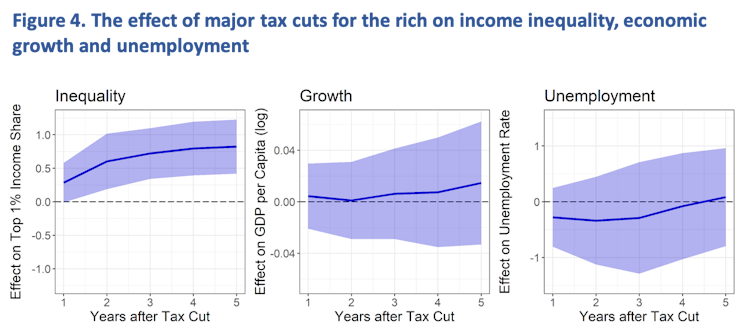
Note: Dark blue line shows the effect of major tax cut for the rich over time. 95% confidence area is shaded in light blue. Author provided

The rich could pay the coronavirus bill

Many analysts and policymakers believe that taxes will need to rise in the coming years to ensure the sustainability of public finances. Higher taxes on the rich could help to fund the substantial and potentially long-lasting expansion of government spending and social protection seen during the pandemic. They could also help address health and economic inequalities, which have only been exacerbated by COVID-19 and its economic fallout.

Such tax rises after crises are not unprecedented. Historically, the main drivers of taxes on the rich were wars and economic catastrophes. The COVID-19 crisis might have a similar effect.

Our recent research shows that the economic case for low taxes on the rich is weak. Major tax cuts for the rich since the 1980s have worsened income inequality without boosting economic performance. This might be welcome news for supporters of higher taxes on the rich in the wake of the pandemic.

David Hope, Lecturer in Political Economy, King’s College London and Julian Limberg, Lecturer in Public Policy, King’s College London

This article is republished from The Conversation under a Creative Commons license. Read the original article.


Tags: SB001
DMCA.com Protection Status

SUBSCRIBE to our NEWSLETTER

[mc4wp_form id=”2384248″]

Don't Miss

Why Smarter Fleet Management Is For All Modern Business Options

by Fazila Olla-Logday
29 July 2026
Smarter Fleet Management
Motoring

Operating a business that relies on vehicles is harder than ever.

Read moreDetails

Animal Communication Goes Beyond What Science Can Currently Measure: Zoologist and Spiritual teacher Artemis, the heart whisperer on what the textbooks don’t teach

by Australian Times
7 July 2026
Animal Communication Goes Beyond What Science Can Currently Measure
Lifestyle

Animal communication classes and formal training can be valuable, providing tools, structure, and guidance.

Read moreDetails

Managing Aussie Share Portfolios Abroad: Tips for Growth

by Fazila Olla-Logday
2 July 2026
Managing Aussie Share Portfolios Abroad: Tips for Growth
at

Unlock the secrets to optimizing your Aussie share portfolios abroad. Discover essential tips for growth and navigate the global market...

Read moreDetails

The New Meaning of Luxury: Lessons from Entrepreneur Chloe Hardy

by Pauline Torongo
2 July 2026
The New Meaning of Luxury: Lessons from Entrepreneur Chloe Hardy
Business & Finance

Chloe Hardy, the founder and CEO of Dupes & Co established an Australian-made beauty brand focused on affordability and product...

Read moreDetails

Excel Funding Group emerges as Specialist in SMSF Property Lending amid growing demand

by Pauline Torongo
26 June 2026
Excel Funding Group emerges as Specialist in SMSF Property Lending amid growing demand
Business & Finance

Excel Funding Group has hit a new milestone, tripling its SMSF loan settlement volumes compared to Q1 2025.

Read moreDetails

Svitla Systems acquires Australia’s Kiandra IT to expand Global Engineering Footprint and Accelerate AI-Driven delivery

by Pauline Torongo
11 May 2026
Svitla Systems
Business & Finance

Acquisition marks Svitla’s entry into the Australian market and strengthens capabilities in low-code, Microsoft technologies, and enterprise software engineering.

Read moreDetails

Residential Healthcare Practices: Revolution or Evolution?

by Pauline Torongo
11 May 2026
Residential Healthcare Practices: Revolution or Evolution?
Lifestyle

President Bill Lutz’s "revolution" was born from his background in fine dining, which instilled a disciplined, customer-focused approach.

Read moreDetails
Load More

Copyright © Blue Sky Publications Ltd. All Rights Reserved.
australiantimes.co.uk is a division of Blue Sky Publications Ltd. Reproduction without permission prohibited. DMCA.com Protection Status

  • About us
  • Write for Us
  • Advertise
  • Contact us
  • T&Cs, Privacy and GDPR
No Result
View All Result
  • News
    • Weather
    • Sport
    • Technology
    • Business & Finance
      • Currency Zone
    • Lotto Results
      • The Lott
  • Lifestyle
    • Entertainment
    • Horoscopes
    • Health & Wellness
    • Recipes
  • Travel
  • Expat Life
  • Move to Australia

Copyright © Blue Sky Publications Ltd. All Rights Reserved.
australiantimes.co.uk is a division of Blue Sky Publications Ltd. Reproduction without permission prohibited. DMCA.com Protection Status

No Result
View All Result
  • News
    • Weather
    • Sport
    • Technology
    • Business & Finance
      • Currency Zone
    • Lotto Results
      • The Lott
  • Lifestyle
    • Entertainment
    • Horoscopes
    • Health & Wellness
    • Recipes
  • Travel
  • Expat Life
  • Move to Australia

Copyright © Blue Sky Publications Ltd. All Rights Reserved.
australiantimes.co.uk is a division of Blue Sky Publications Ltd. Reproduction without permission prohibited. DMCA.com Protection Status