


• Advertise
  • About us
  • Terms and Conditions
  • Contact us
Saturday, August 15, 2026
Australian Times News
  • News
    • Weather
    • Sport
    • Technology
    • Business & Finance
      • Currency Zone
    • Lotto Results
      • The Lott
  • Lifestyle
    • Entertainment
    • Horoscopes
    • Health & Wellness
    • Recipes
  • Travel
  • Expat Life
  • Move to Australia
No Result
View All Result
  • News
    • Weather
    • Sport
    • Technology
    • Business & Finance
      • Currency Zone
    • Lotto Results
      • The Lott
  • Lifestyle
    • Entertainment
    • Horoscopes
    • Health & Wellness
    • Recipes
  • Travel
  • Expat Life
  • Move to Australia
No Result
View All Result
Australian Times News
No Result
View All Result
Home News

Food in good times and bad: what did 2020 teach us about the way we eat?

This year has taught us a lot, including about food and what it means to us. It’s also highlighted just how differently modern Australians behave in relation to food, especially when comparing our behaviour during the COVID-19 pandemic to past crises.
The Conversation by The Conversation
23-12-2020 22:23
in News
Heavy reliance on imports

Heavy reliance on imports Photo by DDP on Unsplash

Barbara Santich

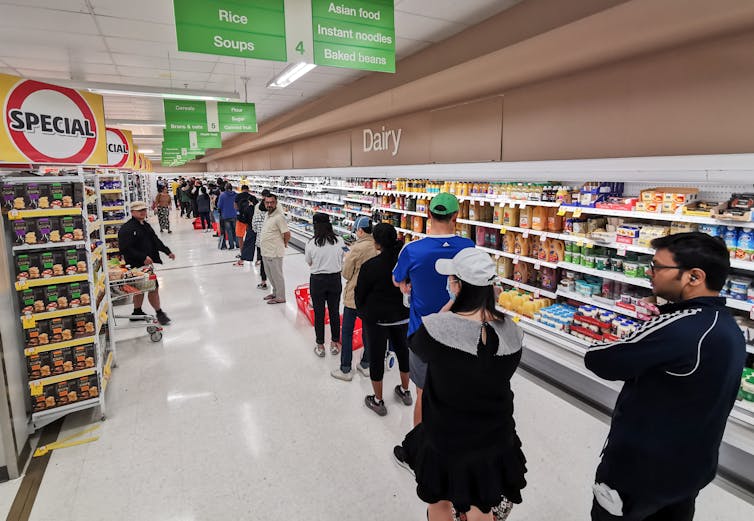
Pasta. Rice. Tinned tomatoes. All staples that, prior to 2020, most of us never thought would be in short supply.

This year has taught us a lot, including about food and what it means to us. It’s also highlighted just how differently modern Australians behave in relation to food, especially when comparing our behaviour during the COVID-19 pandemic to past crises.

James Gourley/AAP

The Depression took place in a much more homogeneous Australia than today, where everyone enjoyed the same repertoire of standard dishes. Everyone made a Sunday roast and then made it last for the next few days.

As the COVID-19 pandemic hit Australia, we were forced to examine many of our social and cultural assumptions. When it comes to food, we are used to having anything we want at any hour of the day, in any season.

Our food choice has expanded exponentially in the past century. Our basic pantry of cooking essentials is more than double what is was 100 years ago.

So why did we hoard? Yes, probably out of panic, but also because we are so used to having plenty that we no longer have the skills to substitute nor, perhaps, the determination to just “make do”.


AlsoRead...

Managing Aussie Share Portfolios Abroad: Tips for Growth

Managing Aussie Share Portfolios Abroad: Tips for Growth

2 July 2026
The New Meaning of Luxury: Lessons from Entrepreneur Chloe Hardy

The New Meaning of Luxury: Lessons from Entrepreneur Chloe Hardy

2 July 2026

Where do we get our food?

2020 has also shown us how the way we eat relies on global, not local, systems. During the Spanish Flu pandemic and the Depression, almost all our food was grown, produced, processed and packaged in Australia.

Today, we are a net importer of seafood. We’re also a net importer of some canned products, such as pineapple. Yes, a lot of our food comes from New Zealand, but a significant percentage also comes from America and China, Thailand and Cambodia.

As we’re seeing now, a heavy reliance on imports doesn’t only affect us during a health crisis like COVID, when freight becomes an issue: the current trade challenges we are having with China also show us how geopolitics can affect a country’s food supply.

Sourdough — not for everyone

With the pandemic as our backdrop, several practices changed for us this year. As supply chains recalibrated (after that initial toilet paper panic) and we could mostly buy what we needed, we continued to cook or bake more – although this was nuanced by privilege.

Sourdough loaf
During the pandemic, pictures of homemade loaves have flooded social media feeds. www.shutterstock.com

Making bread at home is wonderful, but making sourdough bread (an exercise requiring patience, attention and time) was not an option for everyone.

It was those with the means, and the capacity to work at home — without too many caring and home schooling responsibilities — who could indulge in this gourmet foodstuff.


In 2020, this new connection to food was confined to a certain group of people, who might be described as having both cultural and gastronomic capital.

The case for greater self-sufficiency

Another positive longer-term shift for our food culture may come with the current (COVID-amplified) trend to relocate to regional and rural areas. Growing your own vegetables was encouraged during the Depression, and it’s far easier to do on a large rural block than a small urban one.

In the 1950s, home production was 46% of our total production of eggs. There has been a call for some time for more self-sufficiency in Australia. But we’ve also had policies where our most valuable seafood goes overseas because people there are willing to pay more for it than people here. We also export about 30% of our cherries.

This needs to change, but it comes down to all of us being prepared to pay more for our food. We are so used to buying based on the cheapest price – a habit the supermarkets have fostered. If we want to permanently become more self-sufficient, we have to get rid of this cheap food mentality and pay a proper price for our food.

How can we use food to stay connected at Christmas?

If there was ever a time to think about these issues, it’s now. As we sit down for a meal with friends and family over the holiday season, many of us will be looking for the experience of “commonsensality” — the shared connection made with others through food.

Friends gathered around the table for a Christmas meal.
When we share special food, we can also share memories. www.shutterstock.com

Eating “together” can happen virtually — sitting in our respective locations enjoying the same meal, even if far apart. Dishes can inspire shared memories, as evidence of the connection that food gives us in good times and bad.

Maybe this is an old family recipe, or a traditional dish. Maybe it’s just prawns and mangoes.

Of all the things we want to leave behind in 2020, a better understanding of where our food comes from, and how it connects us, are changes worth keeping.

Barbara Santich also talks about how food connects us on the Seriously Social podcast by the Academy of the Social Sciences in Australia.

Barbara Santich, Graduate Program in Food Studies

This article is republished from The Conversation under a Creative Commons license. Read the original article.


Tags: SB001
DMCA.com Protection Status

SUBSCRIBE to our NEWSLETTER

[mc4wp_form id=”2384248″]

Don't Miss

Why Smarter Fleet Management Is For All Modern Business Options

by Fazila Olla-Logday
29 July 2026
Smarter Fleet Management
Motoring

Operating a business that relies on vehicles is harder than ever.

Read moreDetails

Animal Communication Goes Beyond What Science Can Currently Measure: Zoologist and Spiritual teacher Artemis, the heart whisperer on what the textbooks don’t teach

by Australian Times
7 July 2026
Animal Communication Goes Beyond What Science Can Currently Measure
Lifestyle

Animal communication classes and formal training can be valuable, providing tools, structure, and guidance.

Read moreDetails

Managing Aussie Share Portfolios Abroad: Tips for Growth

by Fazila Olla-Logday
2 July 2026
Managing Aussie Share Portfolios Abroad: Tips for Growth
at

Unlock the secrets to optimizing your Aussie share portfolios abroad. Discover essential tips for growth and navigate the global market...

Read moreDetails

The New Meaning of Luxury: Lessons from Entrepreneur Chloe Hardy

by Pauline Torongo
2 July 2026
The New Meaning of Luxury: Lessons from Entrepreneur Chloe Hardy
Business & Finance

Chloe Hardy, the founder and CEO of Dupes & Co established an Australian-made beauty brand focused on affordability and product...

Read moreDetails

Excel Funding Group emerges as Specialist in SMSF Property Lending amid growing demand

by Pauline Torongo
26 June 2026
Excel Funding Group emerges as Specialist in SMSF Property Lending amid growing demand
Business & Finance

Excel Funding Group has hit a new milestone, tripling its SMSF loan settlement volumes compared to Q1 2025.

Read moreDetails

Svitla Systems acquires Australia’s Kiandra IT to expand Global Engineering Footprint and Accelerate AI-Driven delivery

by Pauline Torongo
11 May 2026
Svitla Systems
Business & Finance

Acquisition marks Svitla’s entry into the Australian market and strengthens capabilities in low-code, Microsoft technologies, and enterprise software engineering.

Read moreDetails

Residential Healthcare Practices: Revolution or Evolution?

by Pauline Torongo
11 May 2026
Residential Healthcare Practices: Revolution or Evolution?
Lifestyle

President Bill Lutz’s "revolution" was born from his background in fine dining, which instilled a disciplined, customer-focused approach.

Read moreDetails
Load More

Copyright © Blue Sky Publications Ltd. All Rights Reserved.
australiantimes.co.uk is a division of Blue Sky Publications Ltd. Reproduction without permission prohibited. DMCA.com Protection Status

  • About us
  • Write for Us
  • Advertise
  • Contact us
  • T&Cs, Privacy and GDPR
No Result
View All Result
  • News
    • Weather
    • Sport
    • Technology
    • Business & Finance
      • Currency Zone
    • Lotto Results
      • The Lott
  • Lifestyle
    • Entertainment
    • Horoscopes
    • Health & Wellness
    • Recipes
  • Travel
  • Expat Life
  • Move to Australia

Copyright © Blue Sky Publications Ltd. All Rights Reserved.
australiantimes.co.uk is a division of Blue Sky Publications Ltd. Reproduction without permission prohibited. DMCA.com Protection Status

No Result
View All Result
  • News
    • Weather
    • Sport
    • Technology
    • Business & Finance
      • Currency Zone
    • Lotto Results
      • The Lott
  • Lifestyle
    • Entertainment
    • Horoscopes
    • Health & Wellness
    • Recipes
  • Travel
  • Expat Life
  • Move to Australia

Copyright © Blue Sky Publications Ltd. All Rights Reserved.
australiantimes.co.uk is a division of Blue Sky Publications Ltd. Reproduction without permission prohibited. DMCA.com Protection Status





