

• Advertise
  • About us
  • Terms and Conditions
  • Contact us
Monday, September 28, 2026
Australian Times News
  • News
    • Weather
    • Sport
    • Technology
    • Business & Finance
      • Currency Zone
    • Lotto Results
      • The Lott
  • Lifestyle
    • Entertainment
    • Horoscopes
    • Health & Wellness
    • Recipes
  • Travel
  • Expat Life
  • Move to Australia
No Result
View All Result
  • News
    • Weather
    • Sport
    • Technology
    • Business & Finance
      • Currency Zone
    • Lotto Results
      • The Lott
  • Lifestyle
    • Entertainment
    • Horoscopes
    • Health & Wellness
    • Recipes
  • Travel
  • Expat Life
  • Move to Australia
No Result
View All Result
Australian Times News
No Result
View All Result
Home News

Far more adults don’t want children than previously thought

Fertility rates in the United States have plunged to record lows, and this could be related to the fact that more people are choosing not to have children.

The Conversation by The Conversation
06-07-2021 01:59
in News
Photo by Sandy Millar on Unsplash

Photo by Sandy Millar on Unsplash

Jennifer Watling Neal, Michigan State University and Zachary Neal, Michigan State University

Fertility rates in the United States have plunged to record lows, and this could be related to the fact that more people are choosing not to have children.

But just how many “child-free” adults there are has been tricky for researchers to pin down.
CC BY-NC-ND

National fertility data provided by the U.S. Census and Centers for Disease Control and Prevention lump together all adults who aren’t parents, making it difficult to understand how many people identify as child-free.

As social scientists, we think it’s important to distinguish child-free individuals from those who are childless or not yet parents. People who are child-free make the conscious decision not to have kids. They’re distinct from childless individuals – adults who want children but can’t have them – and from people who plan to have children in the future.

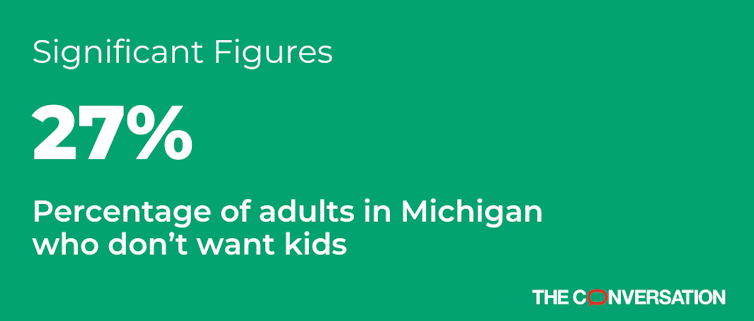
In a recent study of 1,000 people, we found that over 1 in 4 Michigan adults did not want biological or adopted children and were, therefore, child-free. This number was much higher than those reported in the few past national studies that have attempted to identify child-free people, which placed the percentage between 2% and 9%.

Child-free by choice

Although we can’t be sure why we identified more child-free people in our study, we suspect it may have something to do with how we determined who was child-free.


AlsoRead...

How supporting Australia’s Care Workforce could strengthen care in the community

How supporting Australia’s Care Workforce could strengthen care in the community

10 September 2026
What HR Must Champion Next, According to Energy Collective Co

The Future of Work Is Changing: What HR must champion next, according to Energy Collective Co

28 August 2026

Past studies that attempted to estimate the prevalence of child-free individuals often focused only on women and have used criteria based on fertility. These studies left out men, older adults and biologically infertile people who nonetheless didn’t want children.

In our study, we used a more inclusive approach. We looked at both women and men, asking three yes-no questions that allowed us to determine who was child-free based on the desire to have children, rather than fertility:

  • Do you have, or have you ever had, any biological or adopted children?
  • Do you plan to have any biological or adopted children in the future?
  • Do you wish you had or could have biological or adopted children?

Those who answered “no” to all three questions we classified as child-free.

Just like everyone else?

In addition to examining how many child-free people there are, we also examined whether child-free people differed from parents, not-yet-parents and childless individuals in life satisfaction, personality or political views.

We found that child-free people were just as satisfied with their lives as others, and there were few personality differences. However, child-free people were more liberal than parents.

Although child-free people were pretty similar to everyone else, we did find that parents were less warm toward child-free people. This finding suggests that child-free individuals may be stigmatized in the United States.

Looking ahead

Our study suggests that the number of people who choose not to have children may be larger than previously thought. Although our study focused on Michigan residents, the state’s population is similar to the overall U.S. population in terms of age, race, income and education. So we’d expect to see similar numbers of child-free people in other states.

We hope to continue our research by collecting data over time across the country to determine whether it’s becoming more common to be child-free – and to understand how and why people make the choice not to have children.

Jennifer Watling Neal, Associate Professor of Psychology, Michigan State University and Zachary Neal, Associate Professor of Psychology, Michigan State University

This article is republished from The Conversation under a Creative Commons license. Read the original article.


Tags: SB001
DMCA.com Protection Status

SUBSCRIBE to our NEWSLETTER

[mc4wp_form id=”2384248″]

Don't Miss

How supporting Australia’s Care Workforce could strengthen care in the community

by Pauline Torongo
10 September 2026
How supporting Australia’s Care Workforce could strengthen care in the community
News

Australian care funding faces growing scrutiny after a 2025 ANAO report found NDIS losses from fraud, non-compliance, and payment errors...

Read moreDetails

The Future of Work Is Changing: What HR must champion next, according to Energy Collective Co

by Pauline Torongo
28 August 2026
What HR Must Champion Next, According to Energy Collective Co
Business & Finance

Energy Collective Co examines the root causes of performance by considering how work is designed, how leadership is enacted and...

Read moreDetails

From Empathy Burnout to Body-Led Recovery: What Heidi Jane of Intuition Co. learned by living through what she teaches

by Pauline Torongo
25 August 2026
What Heidi Jane of Intuition Co. learned by living through what she teaches
Lifestyle

Recognising emotional exhaustion is only the first step. While supportive habits such as rest, time in nature, hydration, and reduced...

Read moreDetails

Why Smarter Fleet Management Is For All Modern Business Options

by Fazila Olla-Logday
29 July 2026
Smarter Fleet Management
Motoring

Operating a business that relies on vehicles is harder than ever.

Read moreDetails

Animal Communication Goes Beyond What Science Can Currently Measure: Zoologist and Spiritual teacher Artemis, the heart whisperer on what the textbooks don’t teach

by Australian Times
7 July 2026
Animal Communication Goes Beyond What Science Can Currently Measure
Lifestyle

Animal communication classes and formal training can be valuable, providing tools, structure, and guidance.

Read moreDetails

Managing Aussie Share Portfolios Abroad: Tips for Growth

by Fazila Olla-Logday
2 July 2026
Managing Aussie Share Portfolios Abroad: Tips for Growth
at

Unlock the secrets to optimizing your Aussie share portfolios abroad. Discover essential tips for growth and navigate the global market...

Read moreDetails

The New Meaning of Luxury: Lessons from Entrepreneur Chloe Hardy

by Pauline Torongo
2 July 2026
The New Meaning of Luxury: Lessons from Entrepreneur Chloe Hardy
Business & Finance

Chloe Hardy, the founder and CEO of Dupes & Co established an Australian-made beauty brand focused on affordability and product...

Read moreDetails
Load More

Copyright © Blue Sky Publications Ltd. All Rights Reserved.
australiantimes.co.uk is a division of Blue Sky Publications Ltd. Reproduction without permission prohibited. DMCA.com Protection Status

  • About us
  • Write for Us
  • Advertise
  • Contact us
  • T&Cs, Privacy and GDPR
No Result
View All Result
  • News
    • Weather
    • Sport
    • Technology
    • Business & Finance
      • Currency Zone
    • Lotto Results
      • The Lott
  • Lifestyle
    • Entertainment
    • Horoscopes
    • Health & Wellness
    • Recipes
  • Travel
  • Expat Life
  • Move to Australia

Copyright © Blue Sky Publications Ltd. All Rights Reserved.
australiantimes.co.uk is a division of Blue Sky Publications Ltd. Reproduction without permission prohibited. DMCA.com Protection Status

No Result
View All Result
  • News
    • Weather
    • Sport
    • Technology
    • Business & Finance
      • Currency Zone
    • Lotto Results
      • The Lott
  • Lifestyle
    • Entertainment
    • Horoscopes
    • Health & Wellness
    • Recipes
  • Travel
  • Expat Life
  • Move to Australia

Copyright © Blue Sky Publications Ltd. All Rights Reserved.
australiantimes.co.uk is a division of Blue Sky Publications Ltd. Reproduction without permission prohibited. DMCA.com Protection Status





