
• Advertise
  • About us
  • Terms and Conditions
  • Contact us
Wednesday, November 18, 2026
Australian Times News
  • News
    • Weather
    • Sport
    • Technology
    • Business & Finance
      • Currency Zone
    • Lotto Results
      • The Lott
  • Lifestyle
    • Entertainment
    • Horoscopes
    • Health & Wellness
    • Recipes
  • Travel
  • Expat Life
  • Move to Australia
No Result
View All Result
  • News
    • Weather
    • Sport
    • Technology
    • Business & Finance
      • Currency Zone
    • Lotto Results
      • The Lott
  • Lifestyle
    • Entertainment
    • Horoscopes
    • Health & Wellness
    • Recipes
  • Travel
  • Expat Life
  • Move to Australia
No Result
View All Result
Australian Times News
No Result
View All Result
Home News

COVID-19: does exercising really reduce the risk?

A new US study shows that people who are less physically active are more likely to be hospitalised and die with COVID-19. According to these new calculations, being inactive puts you at a greater risk from COVID-19 than any other risk factor except age and having had an organ transplant. If this is right, it’s a big deal.

The Conversation by The Conversation
18-04-2021 22:19
in News
Photo by Fitsum Admasu on Unsplash

Photo by Fitsum Admasu on Unsplash

Jamie Hartmann-Boyce, University of Oxford

A new US study shows that people who are less physically active are more likely to be hospitalised and die with COVID-19. According to these new calculations, being inactive puts you at a greater risk from COVID-19 than any other risk factor except age and having had an organ transplant. If this is right, it’s a big deal.

In the study, healthcare providers asked people about how much they exercised over a two-year period prior to the pandemic. Using this information, people were categorised into three groups. The first group – described as “consistently inactive” – exercised for no more than 10 minutes per week. The second group engaged in “some activity” – exercising for between 11 minutes and 149 minutes a week. The third group consistently met physical activity guidelines, exercising for 150 minutes a week or more. Exercise was defined as moderate to strenuous activity, an example being a “brisk walk”.

Compared to people who were exercising for at least 150 minutes a week, people who were consistently inactive were over twice as likely to be hospitalised and to die due to COVID-19. They also had a greater risk of hospitalisation and death than people doing some physical activity.

There are a lot of reasons to trust this study. It uses data from almost 50,000 people who had COVID-19 between January and October 2020. The information on how much they exercised was collected before COVID-19 came on the scene – which means answers it wasn’t affected by people’s COVID-19 outcomes. The researchers also tried to take into account things that might skew the picture – for example, how old someone was and what other health conditions they had.

However, there are also plenty of reasons to be wary. For a start, people themselves reported how much they exercised, rather than exercise being assessed in some objective way.

The biggest issue, though, is the risk of confounding – that is, of some unmeasured element skewing the picture. This happens when the exposure (in this case exercise) and the outcome (in this case COVID-19 hospitalisation and death) are also influenced by another, unmeasured, variable – the “confounder”.


AlsoRead...

How She Sells with Brooke helps thousands of women build new careers through high-ticket sales

How She Sells with Brooke helps thousands of women build new careers through high-ticket sales

6 October 2026
Mark Levin and Yael Eckstein: Celebrating 250 Years - The Bond Between America and Israel

Mark Levin and Yael Eckstein: Celebrating 250 Years – The Bond Between America and Israel

30 September 2026

Take a classic example: murder and ice cream. If you look over the course of a few years, you’ll find that murders rise and fall in line with ice cream sales. No one, however, thinks that ice cream causes murder, or that, having committed murder, one is more likely to eat ice cream.

The issue here is confounding, and the weather is the confounder. Unsurprisingly, ice cream sales are higher when it’s hot out. Interestingly, murders also rise in higher temperatures.

Laughing teenage girls eating ice cream cones as they walk along a beachfront
Ice cream: not the tell-tale sign of a killer. Flamingo Images/Shutterstock

When we think about the relationship between COVID-19 outcomes and physical activity, the possible confounders are almost endless. Long-term health conditions such as diabetes increase COVID-19 risk and can make it more difficult to exercise. Lack of exercise can also cause or worsen some long-term conditions. Though the authors tried to consider this, it will have been difficult to control for it completely.

In addition, independent of age, frailty is a risk factor for worse outcomes from COVID-19, and frailty of course also impacts physical activity. Socioeconomic factors also have a role to play. It is now well known that people from less advantaged groups are at greater risk from COVID-19. Disadvantage is also linked to fewer opportunities to engage in leisure-time physical activities – for the most part the type of exercise this study was measuring.

In short, many behavioural and environmental factors are interlinked, including diet, weight, alcohol and drug use and physical activity. Disentangling the impact of one from another can be extremely difficult.

Despite these limitations, the good news is that it is just generally a good idea to exercise more, whether or not inactivity is a major risk factor for COVID-19. Being more active improves health and wellbeing and reduces the risk of developing diseases. In people already living with long-term health conditions, it can also improve disease management and outcomes.
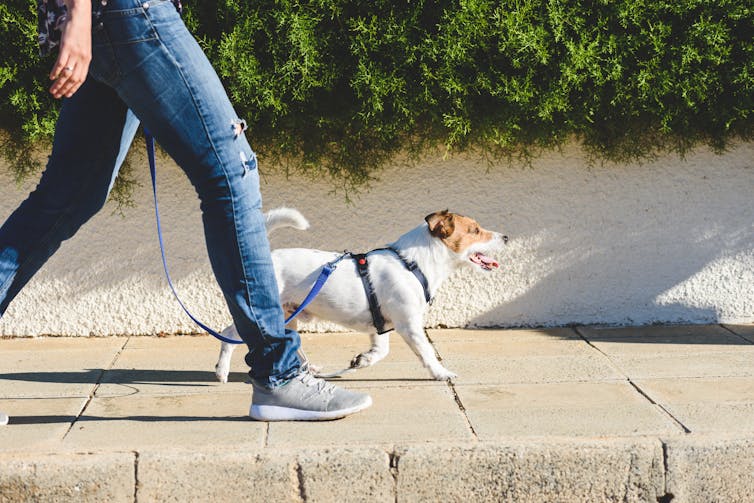
A man walking a dog
Exercise doesn’t have to mean playing sport or going to the gym – dancing, brisk walking or mowing the lawn all count. alexei_tm/Shutterstock

The World Health Organization tells us that some physical activity is better than none and that more physical activity is even better. It also highlights the need to reduce sedentary time – namely time spent sitting or lying down.

So whether or not inactivity doubles the risk of dying from COVID-19, meeting physical activity guidelines is a sensible suggestion. And perhaps the thing to like most about this study is that unlike some of the other risk factors for COVID-19, physical activity is modifiable. We can’t change our age. For the most part, our long-term health conditions are with us to stay. But with the right supports in place, most of us can be more active.

Jamie Hartmann-Boyce, Senior Research Fellow, Departmental Lecturer and Co-Director of Evidence-Based Healthcare DPhil Programme, Centre for Evidence-Based Medicine, University of Oxford

This article is republished from The Conversation under a Creative Commons license. Read the original article.


Tags: SB001
DMCA.com Protection Status

SUBSCRIBE to our NEWSLETTER

[mc4wp_form id=”2384248″]

Don't Miss

NRMA welcomes dogs at four NSW South Coast Holiday Parks

by Pauline Torongo
22 October 2026
NRMA welcomes dogs at four NSW South Coast Holiday Parks
Lifestyle

Pet-friendly stays and nearby beaches give families more coastal holiday options as Australian caravan and camping trips reach record levels.

Read moreDetails

How She Sells with Brooke helps thousands of women build new careers through high-ticket sales

by Pauline Torongo
6 October 2026
How She Sells with Brooke helps thousands of women build new careers through high-ticket sales
Business & Finance

More than 3,000 women have joined She Sells with Brooke Triplett to build careers in high-ticket sales. For many, the...

Read moreDetails

Qualities to look for in a Caribbean Luxury Cruise Experience

by Pauline Torongo
6 October 2026
Qualities to look for in a Caribbean Luxury Cruise Experience. Image: Supplied
Travel

Luxury Caribbean cruises are often associated with beaches, sunshine, and tropical ease, but they can be more than that with...

Read moreDetails

Mark Levin and Yael Eckstein: Celebrating 250 Years – The Bond Between America and Israel

by Pauline Torongo
30 September 2026
Mark Levin and Yael Eckstein: Celebrating 250 Years - The Bond Between America and Israel
News

As America marks 250 years since the Declaration of Independence, Yael Eckstein and Mark Levin explore the biblical values and...

Read moreDetails

How supporting Australia’s Care Workforce could strengthen care in the community

by Pauline Torongo
10 September 2026
How supporting Australia’s Care Workforce could strengthen care in the community
News

Australian care funding faces growing scrutiny after a 2025 ANAO report found NDIS losses from fraud, non-compliance, and payment errors...

Read moreDetails

The Future of Work Is Changing: What HR must champion next, according to Energy Collective Co

by Pauline Torongo
28 August 2026
What HR Must Champion Next, According to Energy Collective Co
Business & Finance

Energy Collective Co examines the root causes of performance by considering how work is designed, how leadership is enacted and...

Read moreDetails

From Empathy Burnout to Body-Led Recovery: What Heidi Jane of Intuition Co. learned by living through what she teaches

by Pauline Torongo
25 August 2026
What Heidi Jane of Intuition Co. learned by living through what she teaches
Lifestyle

Recognising emotional exhaustion is only the first step. While supportive habits such as rest, time in nature, hydration, and reduced...

Read moreDetails
Load More

Copyright © Blue Sky Publications Ltd. All Rights Reserved.
australiantimes.co.uk is a division of Blue Sky Publications Ltd. Reproduction without permission prohibited. DMCA.com Protection Status

  • About us
  • Write for Us
  • Advertise
  • Contact us
  • T&Cs, Privacy and GDPR
No Result
View All Result
  • News
    • Weather
    • Sport
    • Technology
    • Business & Finance
      • Currency Zone
    • Lotto Results
      • The Lott
  • Lifestyle
    • Entertainment
    • Horoscopes
    • Health & Wellness
    • Recipes
  • Travel
  • Expat Life
  • Move to Australia

Copyright © Blue Sky Publications Ltd. All Rights Reserved.
australiantimes.co.uk is a division of Blue Sky Publications Ltd. Reproduction without permission prohibited. DMCA.com Protection Status