


• Advertise
  • About us
  • Terms and Conditions
  • Contact us
Monday, November 23, 2026
Australian Times News
  • News
    • Weather
    • Sport
    • Technology
    • Business & Finance
      • Currency Zone
    • Lotto Results
      • The Lott
  • Lifestyle
    • Entertainment
    • Horoscopes
    • Health & Wellness
    • Recipes
  • Travel
  • Expat Life
  • Move to Australia
No Result
View All Result
  • News
    • Weather
    • Sport
    • Technology
    • Business & Finance
      • Currency Zone
    • Lotto Results
      • The Lott
  • Lifestyle
    • Entertainment
    • Horoscopes
    • Health & Wellness
    • Recipes
  • Travel
  • Expat Life
  • Move to Australia
No Result
View All Result
Australian Times News
No Result
View All Result
Home News

Coronavirus: what happens when a person is simultaneously infected with two variants?

Scientists in Brazil recently reported that two people were simultaneously infected with two different variants of SARS-CoV-2, the virus that causes COVID-19. This co-infection seemed to have no effect on the severity of patients’ illness, and both recovered without needing to be hospitalised.

The Conversation by The Conversation
05-03-2021 06:01
in News
kitchen / Alamy Stock Photo

kitchen / Alamy Stock Photo

Maitreyi Shivkumar, De Montfort University

Scientists in Brazil recently reported that two people were simultaneously infected with two different variants of SARS-CoV-2, the virus that causes COVID-19. This co-infection seemed to have no effect on the severity of patients’ illness, and both recovered without needing to be hospitalised.

Although this is one of the few such cases recorded with SARS-CoV-2 – and the study is yet to be published in a scientific journal – scientists have observed infections with multiple strains with other respiratory viruses, such as influenza. This has raised questions about how these viruses may interact in an infected person, and what it could mean for generating new variants.

Viruses are masters of evolution, constantly mutating and creating new variants with every cycle of replication. Selective pressures in the host, such as our immune response, also drive these adaptations. Most of these mutations won’t have a significant effect on the virus. But ones that give an advantage to the virus – for example, by increasing its ability to replicate or evade the immune system – are cause for concern and need to be closely monitored.

The occurrence of these mutations is down to the error-prone replication machinery that viruses use. RNA viruses, such as influenza and hepatitis C, generate a relatively large number of errors each time they replicate. This creates a “quasi-species” of the virus population, rather like a swarm of viruses, each with related but non-identical sequences. Interactions with the host cells and immune system determine the relative frequencies of the individual variants, and these coexisting variants may affect how the disease progresses or how well treatments work.

Compared with other RNA viruses, coronaviruses have lower mutation rates. This is because they are equipped with a proofreading mechanism that can correct some of the errors that occur during replication. Still, there is evidence of viral genetic diversity in patients infected with SARS-CoV-2.

The detection of multiple variants in a person could be the result of co-infection by the different variants, or the generation of mutations within the patient after the initial infection. One way to discriminate these two scenarios is by comparing the sequences of the variants circulating in the population with those in the patient. In the Brazilian study mentioned above, the variants identified corresponded to different lineages that had been previously detected in the population, implying co-infection by the two variants.


AlsoRead...

How She Sells with Brooke helps thousands of women build new careers through high-ticket sales

How She Sells with Brooke helps thousands of women build new careers through high-ticket sales

6 October 2026
Mark Levin and Yael Eckstein: Celebrating 250 Years - The Bond Between America and Israel

Mark Levin and Yael Eckstein: Celebrating 250 Years – The Bond Between America and Israel

30 September 2026

Mixing it all up

This co-infection has opened concerns of SARS-CoV-2 acquiring new mutations even more rapidly. This is because coronaviruses can also undergo large changes in their genetic sequence by a process called recombination. When two viruses infect the same cell, they can swap large parts of their genomes with each other and create completely new sequences.

This is a known phenomenon in RNA viruses. New variants of influenza are generated by a similar mechanism called “reassortment”. The genome of influenza virus, unlike coronavirus, comprises eight segments or strands of RNA. When two viruses infect the same cell, these segments mix and match to produce viruses with a new combination of genes. Interestingly, pigs can be infected with different strains of influenza viruses, and have been referred to as “mixing vessels” that shuffle them into new strains. The 2009 H1N1 pandemic virus emerged from a reassortment of a human, avian, and two swine influenza viruses.
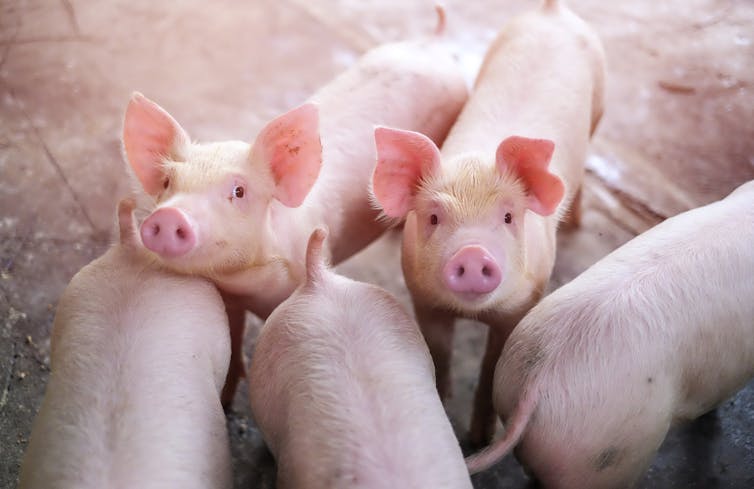
Pigs on a farm.
Mixing vessels. krumanop/Shutterstock

With coronaviruses, which only contain one RNA strand in each virus particle, recombination can only occur between RNA strands derived from one or more viruses in the same cell. Evidence of recombination has been found both in the laboratory and in a patient infected with SARS-CoV-2, suggesting that this could drive the generation of new variants. In fact, the ability of SARS-CoV-2 to infect human cells is proposed to have developed via recombination of the spike protein between closely related animal coronaviruses.

It is important to note that this requires the two viruses to infect the same cell. Even if a person is infected with several variants, if they replicate in different parts of the body, they will not interact with each other. Indeed, this was seen in patients, where different quasi-species of coronaviruses were found in the upper and lower respiratory tracts, suggesting that viruses in these sites were not directly mixing with each other.

The evidence so far does not suggest that infection with more than one variant leads to more severe disease. And although possible, very few cases of co-infection have been reported. More than 90% of the infections in the UK currently are by B117 – the so-called Kent variant. With such a high prevalence of one variant in the population, co-infections are not likely to occur. Still, monitoring this landscape allows scientists to track the emergence of these new variants of concern and understand and respond to any changes in their transmission or vaccine efficacy.

Maitreyi Shivkumar, Senior Lecturer in Molecular Biology, De Montfort University

This article is republished from The Conversation under a Creative Commons license. Read the original article.


Tags: SB001
DMCA.com Protection Status

SUBSCRIBE to our NEWSLETTER

[mc4wp_form id=”2384248″]

Don't Miss

NRMA welcomes dogs at four NSW South Coast Holiday Parks

by Pauline Torongo
22 October 2026
NRMA welcomes dogs at four NSW South Coast Holiday Parks
Lifestyle

Pet-friendly stays and nearby beaches give families more coastal holiday options as Australian caravan and camping trips reach record levels.

Read moreDetails

How She Sells with Brooke helps thousands of women build new careers through high-ticket sales

by Pauline Torongo
6 October 2026
How She Sells with Brooke helps thousands of women build new careers through high-ticket sales
Business & Finance

More than 3,000 women have joined She Sells with Brooke Triplett to build careers in high-ticket sales. For many, the...

Read moreDetails

Qualities to look for in a Caribbean Luxury Cruise Experience

by Pauline Torongo
6 October 2026
Qualities to look for in a Caribbean Luxury Cruise Experience. Image: Supplied
Travel

Luxury Caribbean cruises are often associated with beaches, sunshine, and tropical ease, but they can be more than that with...

Read moreDetails

Mark Levin and Yael Eckstein: Celebrating 250 Years – The Bond Between America and Israel

by Pauline Torongo
30 September 2026
Mark Levin and Yael Eckstein: Celebrating 250 Years - The Bond Between America and Israel
News

As America marks 250 years since the Declaration of Independence, Yael Eckstein and Mark Levin explore the biblical values and...

Read moreDetails

How supporting Australia’s Care Workforce could strengthen care in the community

by Pauline Torongo
10 September 2026
How supporting Australia’s Care Workforce could strengthen care in the community
News

Australian care funding faces growing scrutiny after a 2025 ANAO report found NDIS losses from fraud, non-compliance, and payment errors...

Read moreDetails

The Future of Work Is Changing: What HR must champion next, according to Energy Collective Co

by Pauline Torongo
28 August 2026
What HR Must Champion Next, According to Energy Collective Co
Business & Finance

Energy Collective Co examines the root causes of performance by considering how work is designed, how leadership is enacted and...

Read moreDetails

From Empathy Burnout to Body-Led Recovery: What Heidi Jane of Intuition Co. learned by living through what she teaches

by Pauline Torongo
25 August 2026
What Heidi Jane of Intuition Co. learned by living through what she teaches
Lifestyle

Recognising emotional exhaustion is only the first step. While supportive habits such as rest, time in nature, hydration, and reduced...

Read moreDetails
Load More

Copyright © Blue Sky Publications Ltd. All Rights Reserved.
australiantimes.co.uk is a division of Blue Sky Publications Ltd. Reproduction without permission prohibited. DMCA.com Protection Status

  • About us
  • Write for Us
  • Advertise
  • Contact us
  • T&Cs, Privacy and GDPR
No Result
View All Result
  • News
    • Weather
    • Sport
    • Technology
    • Business & Finance
      • Currency Zone
    • Lotto Results
      • The Lott
  • Lifestyle
    • Entertainment
    • Horoscopes
    • Health & Wellness
    • Recipes
  • Travel
  • Expat Life
  • Move to Australia

Copyright © Blue Sky Publications Ltd. All Rights Reserved.
australiantimes.co.uk is a division of Blue Sky Publications Ltd. Reproduction without permission prohibited. DMCA.com Protection Status