


• Advertise
  • About us
  • Terms and Conditions
  • Contact us
Thursday, May 14, 2026
Australian Times News
  • News
    • Weather
    • Sport
    • Technology
    • Business & Finance
      • Currency Zone
    • Lotto Results
      • The Lott
  • Lifestyle
    • Entertainment
    • Horoscopes
    • Health & Wellness
    • Recipes
  • Travel
  • Expat Life
  • Move to Australia
No Result
View All Result
  • News
    • Weather
    • Sport
    • Technology
    • Business & Finance
      • Currency Zone
    • Lotto Results
      • The Lott
  • Lifestyle
    • Entertainment
    • Horoscopes
    • Health & Wellness
    • Recipes
  • Travel
  • Expat Life
  • Move to Australia
No Result
View All Result
Australian Times News
No Result
View All Result
Home News

Coronavirus is spreading rapidly through workplaces – here’s what is needed to make them safer

Despite varying degrees of lockdown restrictions due to the pandemic, many people in the UK are still going in to their workplaces. Factories, warehouses, schools, farms and some shops and hotels are all still open, and all have been sites of workplace clusters of transmission of COVID-19.

The Conversation by The Conversation
04-11-2020 18:07
in News
COVID-19 workplace clusters

COVID-19 workplace clusters Photo by Walter Otto on Unsplash

Andrew Watterson, University of Stirling

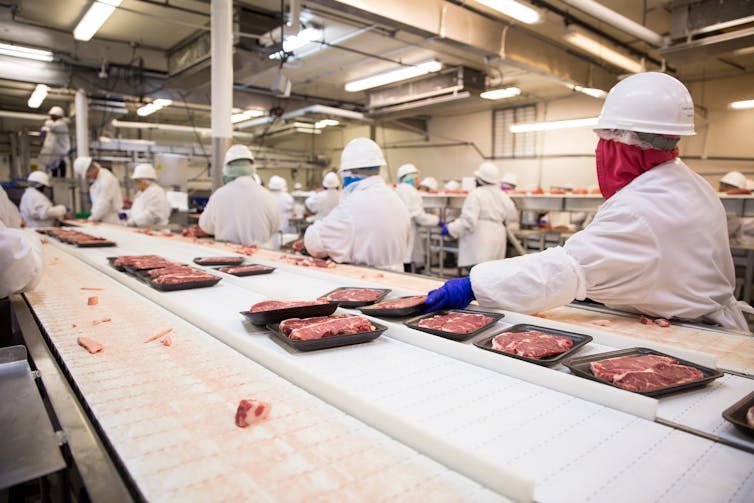
The small town of Watton, Norfolk recently held the unfortunate title of having England’s highest rate of infection with COVID-19 relative to population size, following an outbreak at a food factory.
El Nariz/Shutterstock

Despite varying degrees of lockdown restrictions due to the pandemic, many people in the UK are still going in to their workplaces. Factories, warehouses, schools, farms and some shops and hotels are all still open, and all have been sites of workplace clusters of transmission of COVID-19.

Indeed, the first case of the virus spreading in a workplace stretches back to the one in a Wuhan market in China in December 2019. The major means to prevent workplace transmission were then identified at a global and national level early in 2020. Yet UK prevention or even control of workplace COVID clusters is failing, sometimes badly.

Week by week, we continue to get new workplace clusters. The latest weekly surveillance report from Public Health England revealed 397 suspected outbreaks in care homes and 334 incidents in workplaces between October 19 and 25. Care homes are, of course, workplaces too.

Attempts to dismiss workplace clusters as simply due to non-work factors such as travel to and from work and crowded housing, which in themselves are occupationally-related, are not supported by available evidence. So what is going wrong and how can it be put right?

The COVID workplace threat to employees, their families and communities can only come primarily from three factors. First, control measures built into government and government agency “COVID-secure” guidance on things like social distancing, masks, ventilation, cleaning, and testing and contact tracing could be inadequate or wrong.


AlsoRead...

Svitla Systems

Svitla Systems acquires Australia’s Kiandra IT to expand Global Engineering Footprint and Accelerate AI-Driven delivery

11 May 2026
How Clevero is helping Australian Service Businesses compete with Enterprises on a Fraction of the Budget

How Clevero is helping Australian Service Businesses compete with Enterprises on a Fraction of the Budget

28 April 2026

Second, employer working practices could be poor. Thirdly monitoring, inspection and enforcement of guidance by the health and safety regulators who enforce the law – the Health and Safety Executive (HSE) and in some settings local authority health and safety inspectors – could be deficient. Or there could be a combination of all three factors at work. The problem is that there is little investigation into or publicly available data on what is happening.
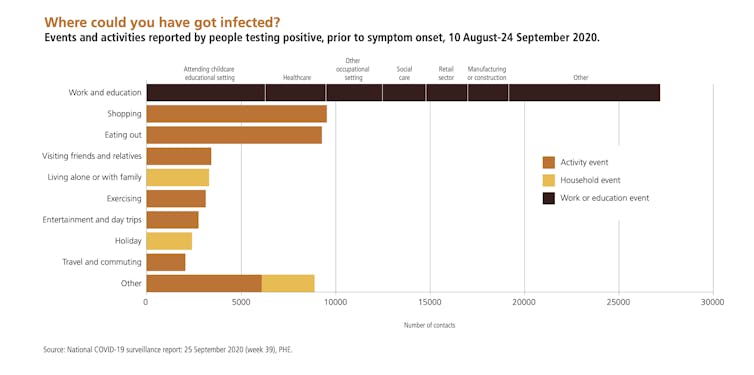
Bar chart showing more than 25,000 people testing positive for COVID-19 had been at a workplace, far more than any other location.
People catching COVID-19 are more likely to have gone to work than carried out any other activity in the days leading up to their infection. Rory O’Neill/Hazards Magazine

One high-risk industry that should have been thoroughly checked for months illustrates the problem. In late October, COVID-19 clusters involving hundreds of workers were still being reported in the East of England meat processing industry. This is despite the fact that the specific risks in the sector became clear at the end of 2019 and means to control risks were widely available by May.

The US government has looked at COVID-19 in workers in 115 meat and poultry processing facilities reported by 19 states up to May 2020. From approximately 130,000 workers at these facilities, 4,913 COVID cases and 20 deaths occurred. Factors potentially affecting infection risks included workplace physical distancing, cleaning and hygiene. No similar statistics for the UK are in the public domain.

In Germany, one large meat processing COVID-19 outbreak, also in May 2020, was immediately investigated and a detailed report found spacing, temperature, humidity and ventilation conditions were all factors in how the virus could be spread over long distances. Again, no such reports have apparently been produced in the UK to examine causes and lessons for the future.

Lack of powers

Investigations of COVID-19 workplace clusters in Britain are led by public health staff at a national and local level and not by the HSE, although joint inspections and investigations may occur. This could could mean some investigators lack the powers and possibly the knowledge and skills to enforce measures to stop the spread of the virus.

The HSE has powers to close a workplace hazardous to health. Local authority inspectors have the power to shut workplaces on environmental health grounds. Directors of Public Health do not have such powers.

Nor, for various reasons connected to patient and commercial confidentiality, have details on working conditions in British meat processing plants with COVID-19 clusters been quickly released by either regulators or public health directors. This lack of information and transparency is proving a major handicap to speedy prevention, along with problems on regulatory inspection, industry practice, worker involvement and flawed government policies.

With winter looming, making workplaces COVID-safe rather than simply COVID-secure is therefore proving a challenge for governments, employers, regulators, and workers. It can be done – and has been elsewhere in the world – by applying the science available, adopting best practice in occupational health and safety, and resolving organisational and policy conflicts and confusion.

Andrew Watterson, Chair in Health Effectiveness, University of Stirling

This article is republished from The Conversation under a Creative Commons license. Read the original article.


Tags: SB001
DMCA.com Protection Status

SUBSCRIBE to our NEWSLETTER

[mc4wp_form id=”2384248″]

Don't Miss

Svitla Systems acquires Australia’s Kiandra IT to expand Global Engineering Footprint and Accelerate AI-Driven delivery

by Pauline Torongo
11 May 2026
Svitla Systems
Business & Finance

Acquisition marks Svitla’s entry into the Australian market and strengthens capabilities in low-code, Microsoft technologies, and enterprise software engineering.

Read moreDetails

Residential Healthcare Practices: Revolution or Evolution?

by Pauline Torongo
11 May 2026
Residential Healthcare Practices: Revolution or Evolution?
Lifestyle

President Bill Lutz’s "revolution" was born from his background in fine dining, which instilled a disciplined, customer-focused approach.

Read moreDetails

Medicana Health Group launches HPV vaccination campaign to support cervical cancer prevention

by Pauline Torongo
28 April 2026
Medicana Health Group launches HPV vaccination campaign to support cervical cancer prevention
Health & Wellness

The Türkiye-based healthcare group has introduced a new awareness campaign focused on HPV vaccination, regular check-ups and early detection, with...

Read moreDetails

How Clevero is helping Australian Service Businesses compete with Enterprises on a Fraction of the Budget

by Pauline Torongo
28 April 2026
How Clevero is helping Australian Service Businesses compete with Enterprises on a Fraction of the Budget
Business & Finance

By consolidating CRM, scheduling, workflow automation, invoicing, reporting, and client communications into a single platform, Clevero gives smaller operators the...

Read moreDetails

How CJAM Group is building 1,100 homes across Southeast Queensland

by Pauline Torongo
24 March 2026
How CJAM Group is building 1,100 homes across Southeast Queensland
Lifestyle

The CJAM Group founder is quietly building a 1,100+ home pipeline, with projects in Hervey Bay and Toowoomba, using a...

Read moreDetails

Design Without Compromise: Where Gutter Protection Meets Modern Architecture

by Fazila Olla-Logday
20 March 2026
Design Without Compromise: Where Gutter Protection Meets Modern Architecture
Business & Finance

Design without compromise by integrating gutter protection seamlessly into modern architecture. Discover how innovative gutter systems enhance your home’s aesthetics...

Read moreDetails

How WageSafe Secured Australia’s Most Reputable Retail Business Among Its Premium Clients

by Fazila Olla-Logday
12 March 2026
How WageSafe Secured Australia’s Most Reputable Retail Business Among Its Premium Clients
at

Learn how WageSafe helps businesses stay compliant with payroll and wage regulations through reliable monitoring, risk management, and expert support—protecting...

Read moreDetails
Load More

Copyright © Blue Sky Publications Ltd. All Rights Reserved.
australiantimes.co.uk is a division of Blue Sky Publications Ltd. Reproduction without permission prohibited. DMCA.com Protection Status

  • About us
  • Write for Us
  • Advertise
  • Contact us
  • T&Cs, Privacy and GDPR
No Result
View All Result
  • News
    • Weather
    • Sport
    • Technology
    • Business & Finance
      • Currency Zone
    • Lotto Results
      • The Lott
  • Lifestyle
    • Entertainment
    • Horoscopes
    • Health & Wellness
    • Recipes
  • Travel
  • Expat Life
  • Move to Australia

Copyright © Blue Sky Publications Ltd. All Rights Reserved.
australiantimes.co.uk is a division of Blue Sky Publications Ltd. Reproduction without permission prohibited. DMCA.com Protection Status

No Result
View All Result
  • News
    • Weather
    • Sport
    • Technology
    • Business & Finance
      • Currency Zone
    • Lotto Results
      • The Lott
  • Lifestyle
    • Entertainment
    • Horoscopes
    • Health & Wellness
    • Recipes
  • Travel
  • Expat Life
  • Move to Australia

Copyright © Blue Sky Publications Ltd. All Rights Reserved.
australiantimes.co.uk is a division of Blue Sky Publications Ltd. Reproduction without permission prohibited. DMCA.com Protection Status





