


Natasha Lindstaedt, University of Essex
In less than a week, the Taliban has captured nearly a dozen key cities in Afghanistan. With the departure of US forces, it is poised to take over the country from the embattled Afghan government.
Over the past 20 years, the US has poured trillions of dollars into Afghanistan to oust the Taliban, an effort that was clearly unsuccessful. But a look at the country’s strategic geographic location and the politics of the region (including support for the Taliban) tells us that this outcome was inevitable.
Afghanistan is strategically located between central and south Asia – a region rich in oil and natural gas. It has also struggled with efforts by different Afghanistan-based ethnic groups to create ancestral homelands. The Pashtun population (and to a lesser extent the Baluch population) are particularly implicated in this.
For these and other reasons, Afghanistan has long faced constant meddling from the Soviet Union/Russia, UK, the US, Iran, Saudi Arabia, India and of course, Pakistan.
Pakistan
Afghanistan’s relationship with Pakistan has been fraught with tension ever since the former was recognised as a sovereign state in 1919.
When Pakistan gained its independence in 1947, Afghanistan was the sole country to vote against its formation in the United Nations. Some of the tension emanated from Afghanistan’s refusal to recognise the Durand Line – the hastily drawn 1,600 mile border that cut across thousands of Pashtun tribes in 1893.


Fearing calls from Pashtuns in both countries to create a national homeland that would cut through North Pakistan, Pakistan has long sought to turn Afghanistan into an Islamic client state – supporting an Islamic identity (over a Pashtun one) in Afghanistan to gain strategic depth against India.
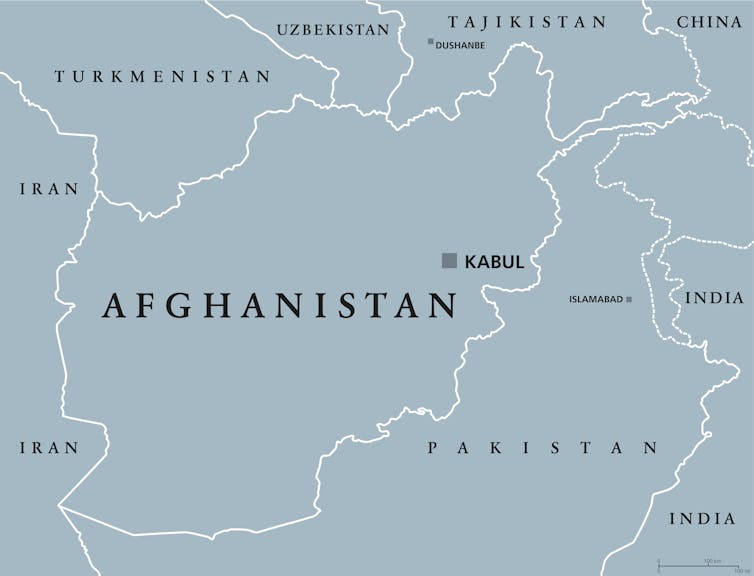
Pakistan helped to empower the Taliban in 1994 and has been Afghanistan’s most involved neighbour. Through its top intelligence agency the ISI, it has has bankrolled Taliban operations, recruited manpower to serve in Taliban armies and helped to plan and arm offensives. It has also occasionally been involved in direct combat support. The ISI’s support for the Taliban was rooted in its aim to erase Pashtun nationalism. But in doing so it may have created a bigger problem for Pakistan, as Taliban rule has led to an exodus of Afghan citizens into Pakistan.
Nevertheless, according to the Afghan government, there are elements within Pakistan’s government, namely the ISI, that still support the Taliban, and ongoing instability in Afghanistan. Furthermore, Pakistan does not have a good relationship with other groups in Afghanistan, so it has little choice but to support the Taliban.
For Pakistan’s government, a worst-case scenario is a protracted conflict, which could lead to another large spillover of refugees into Pakistan.
Iran
Iran’s relationship with Afghanistan, which borders it to the east, is also complicated by regional dynamics and its relationship with the US. As a Shia country, Iran has had long ideological differences with the Taliban. In the 1990s, it sought to make alliances, including with the US, to counter the threat from the Taliban.
But two decades later, US relations with Iran are at an all-time low, affecting Iran’s stance on how to deal with the Taliban. Iran has mostly been hedging its bets — supporting both the Afghan government and the Taliban to keep them divided. And improved relations with Qatar – home to the Taliban’s political office – have also helped Iran’s relationship with the Taliban.
Russia and China
Russia is mostly concerned with preventing instability at its border with Afghanistan, and with keeping Afghanistan free of US influence. Since the 1990s Moscow has been developing relations with different groups in Afghanistan, including the Taliban, despite misgivings about the Taliban’s possible support for terror groups.
These relations intensified after the emergence of Islamic State in 2015. In the fight to defeat IS in Afghanistan, Russia saw the Taliban’s interests coincide with its own.
Reports surfaced that Russia was arming the Afghan Taliban and directly undermining US efforts there, even paying bounties to kill US and allied soldiers. US intelligence has since expressed low confidence in the bounty claims.
China, meanwhile, has always maintained cordial relations with the Taliban. China’s main concern is with extending its influence westward to gain strategic depth against India and the US.
New alliances
For the moment, the rise of the Taliban has not translated into a rise in terrorist activity from groups like al-Qaeda against Afghanistan’s neighbours – a concern of the US pulling out of the region. Sensing the inevitability of the Taliban’s ascension, opportunistic alliances have formed with almost all of Afghanistan’s neighbours with the Taliban, except for India.
India has been mostly reluctant to engage with the Taliban, but recently initiated contact, supported by Qatar. However, New Delhi has also made clear it will not support a violent overthrow of Kabul, Afghanistan’s capital – not yet controlled by the Taliban.
Currently, the beleaguered Afghan government claims that its neighbours are being too sanguine about the Taliban, its ability to reform and whether it will help Afghanistan achieve stability. Senior Afghan officials have warned that a Taliban victory will result in a consolidation of power of various terrorist groups if the Taliban allows them to set up a base to launch attacks.
More important than the Taliban’s hospitality is its willingness to allow terror groups to engage freely in organised crime – Afghanistan an attractive location for this as well.
The Taliban’s resurgence has created an acute humanitarian crisis in Afghanistan alongside terrible human rights abuses. Amid the chaos, the prime minister of Pakistan, Imran Khan, has accused the US of leaving behind a “mess”.
And yet, while many may criticise US President Joe Biden for pulling forces out, there is little likelihood, given all these regional forces at work, that the US could ever have achieved stability in Afghanistan – no matter how long it stayed.
Natasha Lindstaedt, Professor, Department of Government, University of Essex
This article is republished from The Conversation under a Creative Commons license. Read the original article.







