

• Advertise
  • About us
  • Terms and Conditions
  • Contact us
Thursday, May 14, 2026
Australian Times News
  • News
    • Weather
    • Sport
    • Technology
    • Business & Finance
      • Currency Zone
    • Lotto Results
      • The Lott
  • Lifestyle
    • Entertainment
    • Horoscopes
    • Health & Wellness
    • Recipes
  • Travel
  • Expat Life
  • Move to Australia
No Result
View All Result
  • News
    • Weather
    • Sport
    • Technology
    • Business & Finance
      • Currency Zone
    • Lotto Results
      • The Lott
  • Lifestyle
    • Entertainment
    • Horoscopes
    • Health & Wellness
    • Recipes
  • Travel
  • Expat Life
  • Move to Australia
No Result
View All Result
Australian Times News
No Result
View All Result
Home News

Afghanistan peace talks begin – but will the Taliban hold up their end of the deal?

Six months after the United States signed an historic accord with the Taliban of Afghanistan, the Islamic militant group has entered into talks with the Afghan government in Doha, Qatar.

The Conversation by The Conversation
14-09-2020 22:11
in News
Afghanistan peace talks begin

Afghanistan peace talks begin Photo by Agnieszka Świerczek on Unsplash

Sher Jan Ahmadzai, University of Nebraska Omaha

Six months after the United States signed an historic accord with the Taliban of Afghanistan, the Islamic militant group has entered into talks with the Afghan government in Doha, Qatar. Meeting with the Afghan government was a condition of the U.S.-Taliban deal.
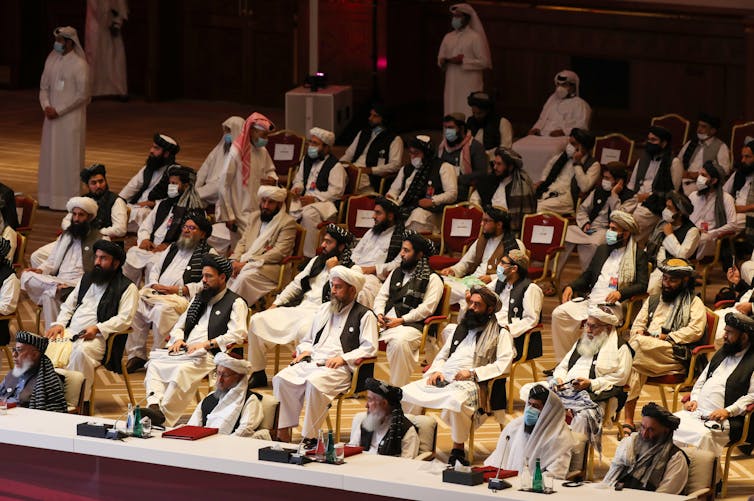
Members of the Taliban delegation attend the opening session of the peace talks with the Afghan government, Doha, Qatar, Sept. 12, 2020. Karim Jaafar/AFP via Getty Images

That deal will end America’s deadly and costly 19-year war in Afghanistan. But it did not resolve the Taliban’s organized military campaign to unseat the Afghan government and rule the country under strict Islamic law. In Doha, the two sides are expected to debate a comprehensive ceasefire and discuss what the Taliban’s role in governing Afghanistan should be, among other topics.

Talks were supposed to begin in March. But the Taliban’s continued attacks on Afghan forces made that impossible. After a brief ceasefire and the release of 5,000 Taliban detainees from Afghan prisons, talks were rescheduled for Aug. 17. Then the Afghan government refused to release its last 320 Taliban prisoners unless the Taliban released more Afghan soldiers from its prisons, leading to another delay.

The commencement on Sept. 12 of the “intra-Afghan” talks represents a significant step forward in the effort to end decades of war in Afghanistan, but peace is far from guaranteed.

I’ve been tracking the progress of the U.S.-Taliban accord in my capacity as director of the Center for Afghanistan Studies at the University of Nebraska, Omaha. My analysis finds that implementation of the Trump administration’s agreement has been halting.

Even on the first day of talks, conflict in Afghanistan killed and wounded more than 100 people.

AlsoRead...

Svitla Systems

Svitla Systems acquires Australia’s Kiandra IT to expand Global Engineering Footprint and Accelerate AI-Driven delivery

11 May 2026
How Clevero is helping Australian Service Businesses compete with Enterprises on a Fraction of the Budget

How Clevero is helping Australian Service Businesses compete with Enterprises on a Fraction of the Budget

28 April 2026
Afghan soldier in fatigues guards a checkpoint, with snow-capped mountains and an Afghan flag in the background
An Afghan soldier stands guard north of Kabul, April 8, 2020. Violence rose after February’s Taliban-US accord. AP Photo/Rahmat Gul, File

What’s in the US-Taliban accord?

The four-part agreement between the U.S. and the Taliban committed the U.S. to withdrawing most of its soldiers from Afghanistan, which it is doing. In exchange, the Taliban provided assurances that Afghanistan would no longer be used as a base from which to wage attacks against the U.S. and its allies. It also agreed to engage with the Afghan government.

But the promises made by the Taliban to meet those goals were vague and very difficult to verify.

Based on publicly available information, I find the Taliban has met only two of the seven conditions stipulated in its peace accord with the U.S.: releasing 1,000 Afghan prisoners and entering talks with the Afghan government.

The remaining five conditions in the U.S.-Taliban deal essentially demand, in various ways, that the Taliban sever all ties with militant organizations, especially al-Qaida. Al-Qaida has long provided funds for the Taliban’s insurgency in Afghanistan. In September 2001, just before the 9/11 attacks, it helped the Taliban assassinate a strong Afghan resistance leader, Commander Ahmad Shah Massoud.

Bearded men walk in a single-file line.
Taliban prisoners are released from Afghanistan’s Bagram Prison, May 26, 2020, in preparation for talks with the Islamic insurgent group. AP Photo/ Rahmat Gul

Broken promises

On the first day of the intra-Afghan talks, Taliban deputy leader Mullah Beradar Akhund claimed in his opening remarks that the group had met the conditions of the U.S.-Taliban deal.

But international and domestic observers of the Afghan peace process have been unable to confirm that the Taliban has severed its relationship with al-Qaida. In fact, according to a May 2020 United Nations report, the Taliban met with al-Qaida repeatedly in 2019 and early 2020 to coordinate “operational planning, training and the provision by the Taliban of safe havens for al-Qaida members inside Afghanistan.”

Since the U.S.-Taliban accord, violence levels in Afghanistan have actually increased. Some Taliban fighters have insisted they will continue their jihad “until an Islamic system is established,” leading to concerns that the organization is not actually committed to peace.

Peace deals generally have enforcement mechanisms that hold each side accountable for their pledges. That is not the case with the U.S.-Taliban deal. It contains no provisions for what will happen if the Taliban breaks their promises, beyond the U.S. pausing its troop withdrawal. The Qataris, who are hosting the Afghanistan peace talks, have no official power to pressure parties into compliance.

Mutual distrust means the peace process could collapse. The Taliban does not accept Afghanistan’s internationally recognized government as legitimate, though it has stood for three elections since taking power after the Taliban’s regime was toppled by the 2001 U.S. invasion.

That’s why the Afghan government was not a party to the U.S.-Taliban agreement. Instead, the February 2020 deal merely committed the Taliban to direct negotiations with the Afghans.
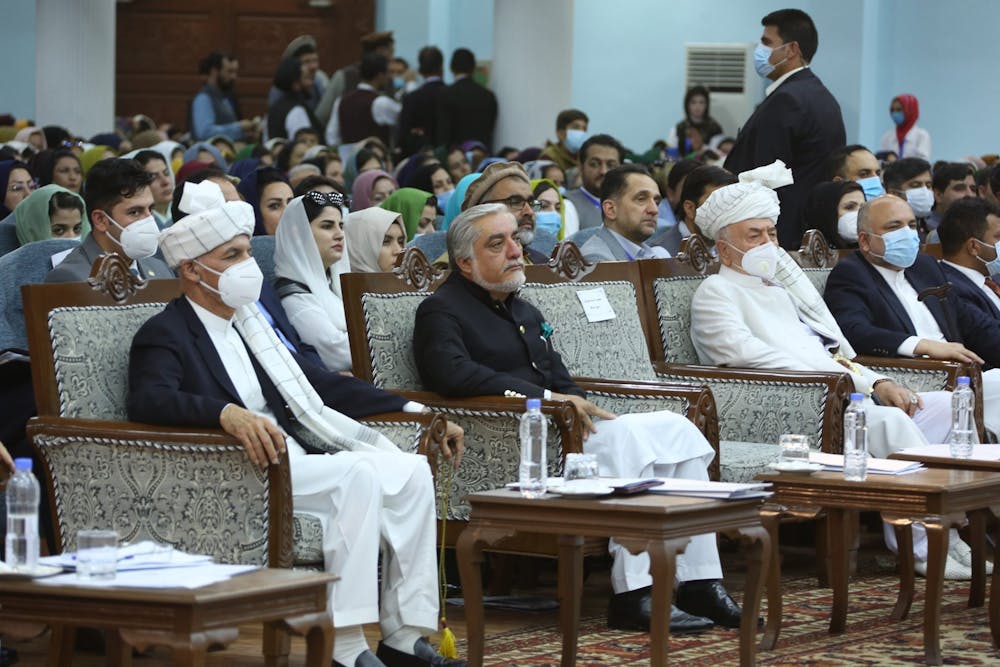
The Afghan president, several other government officials and the Afghan public sit listening in a large assembly, wearing masks
Afghan President Ashraf Ghani, left, at a public assembly to discuss the future of Afghanistan’s peace talks, Aug. 7. 2020. HPC /Handout/Anadolu Agency via Getty Images

Hope and doubt

Some U.S. government officials and former diplomats sharply criticized the concession to exclude Afghanistan’s government from talks with the U.S. and the Taliban about the future of the country.

“This deal is a surrender,” wrote the longtime U.S. diplomat and ambassador to Afghanistan under President Obama, Ryan Crocker, in The Washington Post.

[Insight, in your inbox each day. You can get it with The Conversation’s email newsletter.]

Polling shows the Afghan people were willing to make some compromises for peace. But many question whether the Taliban can be held accountable for what they’ve promised. They also fear losing the meaningful achievements that came out of international engagement in Afghanistan, such as women’s empowerment, increased freedom of speech and a more vibrant press.

Those rights – hard-won with American and Afghan blood – will be among the issues negotiated in the Taliban-Afghan talks. Since 2001, 2,219 U.S. troops and exponentially more Afghan civilians and soldiers lost their lives battling the Taliban. For Afghans, the fight continues to this day.

The stakes of Afghanistan’s peace talks are extremely high. Failure, said President Ashraf Ghani last month, is “not an option.”

This story is an updated version of an article originally published Aug. 26, 2020.

Sher Jan Ahmadzai, Director, Center for Afghanistan Studies, University of Nebraska Omaha

This article is republished from The Conversation under a Creative Commons license. Read the original article.


Tags: SB001
DMCA.com Protection Status

SUBSCRIBE to our NEWSLETTER

[mc4wp_form id=”2384248″]

Don't Miss

Svitla Systems acquires Australia’s Kiandra IT to expand Global Engineering Footprint and Accelerate AI-Driven delivery

by Pauline Torongo
11 May 2026
Svitla Systems
Business & Finance

Acquisition marks Svitla’s entry into the Australian market and strengthens capabilities in low-code, Microsoft technologies, and enterprise software engineering.

Read moreDetails

Residential Healthcare Practices: Revolution or Evolution?

by Pauline Torongo
11 May 2026
Residential Healthcare Practices: Revolution or Evolution?
Lifestyle

President Bill Lutz’s "revolution" was born from his background in fine dining, which instilled a disciplined, customer-focused approach.

Read moreDetails

Medicana Health Group launches HPV vaccination campaign to support cervical cancer prevention

by Pauline Torongo
28 April 2026
Medicana Health Group launches HPV vaccination campaign to support cervical cancer prevention
Health & Wellness

The Türkiye-based healthcare group has introduced a new awareness campaign focused on HPV vaccination, regular check-ups and early detection, with...

Read moreDetails

How Clevero is helping Australian Service Businesses compete with Enterprises on a Fraction of the Budget

by Pauline Torongo
28 April 2026
How Clevero is helping Australian Service Businesses compete with Enterprises on a Fraction of the Budget
Business & Finance

By consolidating CRM, scheduling, workflow automation, invoicing, reporting, and client communications into a single platform, Clevero gives smaller operators the...

Read moreDetails

How CJAM Group is building 1,100 homes across Southeast Queensland

by Pauline Torongo
24 March 2026
How CJAM Group is building 1,100 homes across Southeast Queensland
Lifestyle

The CJAM Group founder is quietly building a 1,100+ home pipeline, with projects in Hervey Bay and Toowoomba, using a...

Read moreDetails

Design Without Compromise: Where Gutter Protection Meets Modern Architecture

by Fazila Olla-Logday
20 March 2026
Design Without Compromise: Where Gutter Protection Meets Modern Architecture
Business & Finance

Design without compromise by integrating gutter protection seamlessly into modern architecture. Discover how innovative gutter systems enhance your home’s aesthetics...

Read moreDetails

How WageSafe Secured Australia’s Most Reputable Retail Business Among Its Premium Clients

by Fazila Olla-Logday
12 March 2026
How WageSafe Secured Australia’s Most Reputable Retail Business Among Its Premium Clients
at

Learn how WageSafe helps businesses stay compliant with payroll and wage regulations through reliable monitoring, risk management, and expert support—protecting...

Read moreDetails
Load More

Copyright © Blue Sky Publications Ltd. All Rights Reserved.
australiantimes.co.uk is a division of Blue Sky Publications Ltd. Reproduction without permission prohibited. DMCA.com Protection Status

  • About us
  • Write for Us
  • Advertise
  • Contact us
  • T&Cs, Privacy and GDPR
No Result
View All Result
  • News
    • Weather
    • Sport
    • Technology
    • Business & Finance
      • Currency Zone
    • Lotto Results
      • The Lott
  • Lifestyle
    • Entertainment
    • Horoscopes
    • Health & Wellness
    • Recipes
  • Travel
  • Expat Life
  • Move to Australia

Copyright © Blue Sky Publications Ltd. All Rights Reserved.
australiantimes.co.uk is a division of Blue Sky Publications Ltd. Reproduction without permission prohibited. DMCA.com Protection Status

No Result
View All Result
  • News
    • Weather
    • Sport
    • Technology
    • Business & Finance
      • Currency Zone
    • Lotto Results
      • The Lott
  • Lifestyle
    • Entertainment
    • Horoscopes
    • Health & Wellness
    • Recipes
  • Travel
  • Expat Life
  • Move to Australia

Copyright © Blue Sky Publications Ltd. All Rights Reserved.
australiantimes.co.uk is a division of Blue Sky Publications Ltd. Reproduction without permission prohibited. DMCA.com Protection Status






