
• Advertise
  • About us
  • Terms and Conditions
  • Contact us
Saturday, November 21, 2026
Australian Times News
  • News
    • Weather
    • Sport
    • Technology
    • Business & Finance
      • Currency Zone
    • Lotto Results
      • The Lott
  • Lifestyle
    • Entertainment
    • Horoscopes
    • Health & Wellness
    • Recipes
  • Travel
  • Expat Life
  • Move to Australia
No Result
View All Result
  • News
    • Weather
    • Sport
    • Technology
    • Business & Finance
      • Currency Zone
    • Lotto Results
      • The Lott
  • Lifestyle
    • Entertainment
    • Horoscopes
    • Health & Wellness
    • Recipes
  • Travel
  • Expat Life
  • Move to Australia
No Result
View All Result
Australian Times News
No Result
View All Result
Home News

2020 Nobel Prize in physics awarded for work on black holes – an astrophysicist explains the trailblazing discoveries

Black holes are perhaps the most mysterious objects in nature. They warp space and time in extreme ways and contain a mathematical impossibility, a singularity – an infinitely hot and dense object within.

The Conversation by The Conversation
07-10-2020 09:17
in News
2020 Nobel Prize in physics awarded for work on black holes

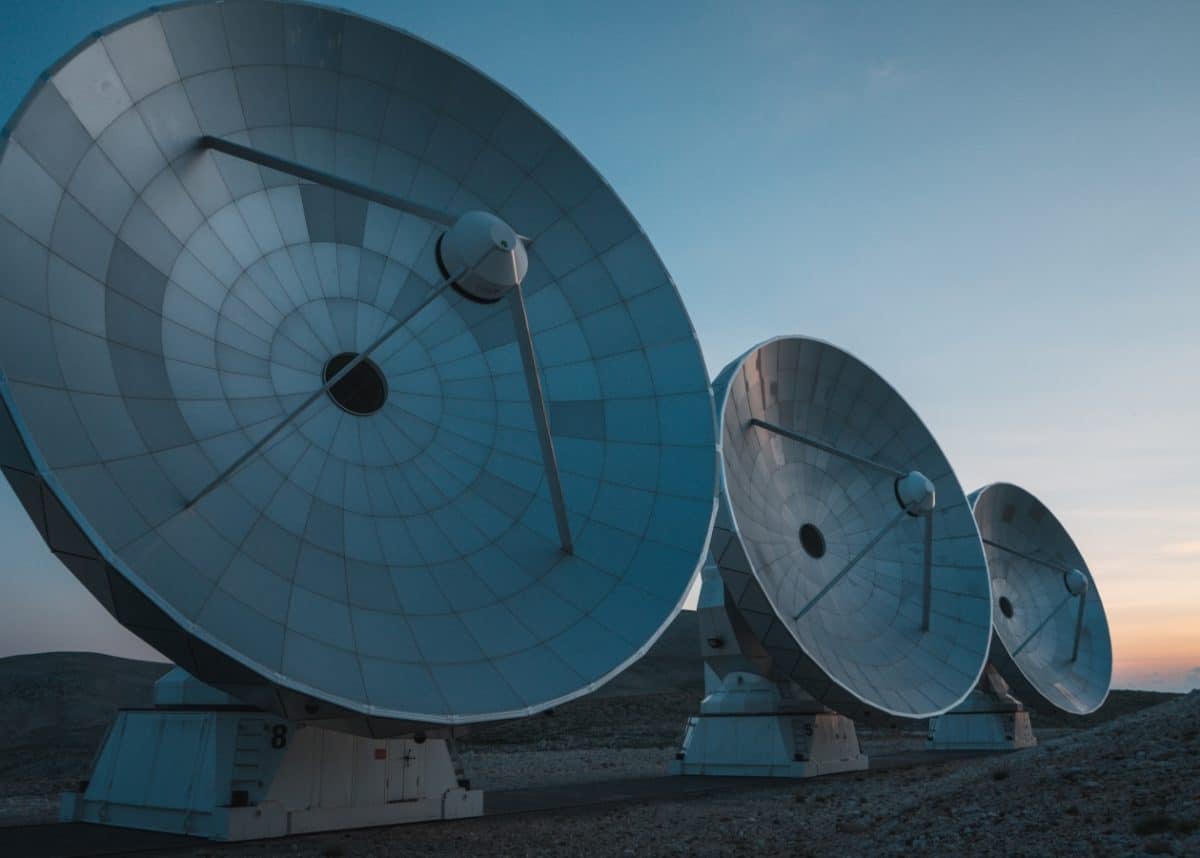
2020 Nobel Prize in physics awarded for work on black holes Photo by Gontran Isnard on Unsplash

Gaurav Khanna, University of Massachusetts Dartmouth

Black holes are perhaps the most mysterious objects in nature. They warp space and time in extreme ways and contain a mathematical impossibility, a singularity – an infinitely hot and dense object within. But if black holes exist and are truly black, how exactly would we ever be able to make an observation?
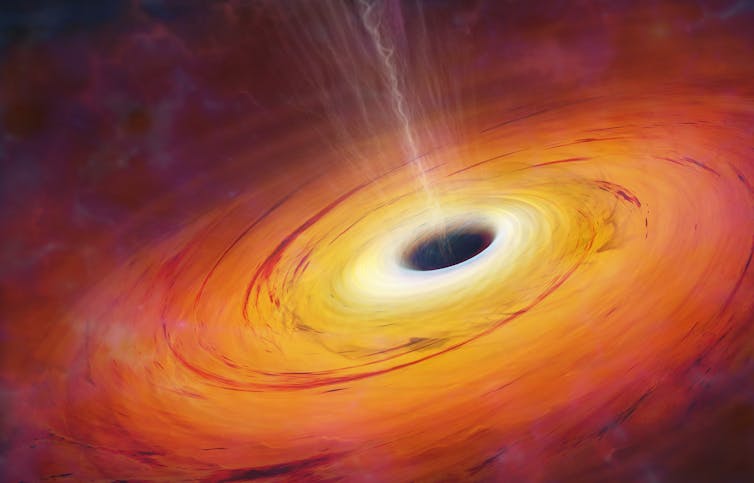
A black hole is an object so compact that nothing can escape its gravitational pull, not even light. They are formed when stars die and start collapsing under their own weight. Deep inside the black hole resides an infinitely hot and dense object, a so-called, singularity. Science Photo Library – MARK GARLICK/Getty Images
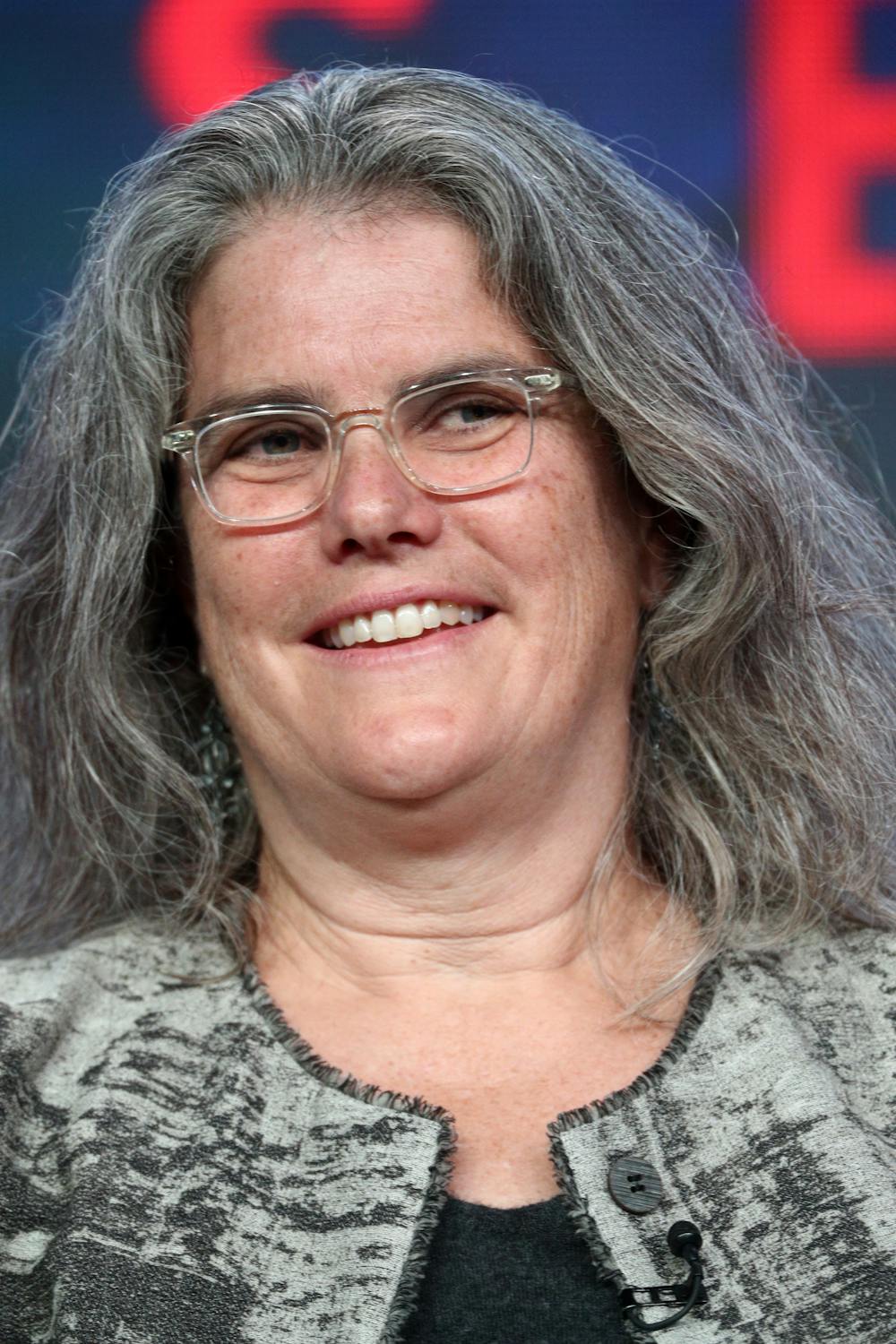
Andrea Ghez, the fourth woman to win the Nobel Prize in physics. Frederick M. Brown/Getty Images

This morning the Nobel Committee announced that the 2020 Nobel Prize in physics will be awarded to three scientists – Sir Roger Penrose, Reinhard Genzel and Andrea Ghez – who helped discover the answers to such profound questions. Andrea Ghez is only the fourth woman to win the Nobel Prize in physics.

Robert Penrose is a theoretical physicist who works on black holes, and his work has influenced not just me but my entire generation through his series of popular books that are loaded with his exquisite hand-drawn illustrations of deep physical concepts.

Roger Penrose was famous for his detailed illustrations. This is one of his diagrams of an empty universe. Roger Penrose via Wikimedia, CC BY-ND

As a graduate student in the 1990s at Penn State, where Penrose holds a visiting position, I had many opportunities to interact with him. For many years I was intimidated by this giant in my field, only stealing glimpses of him working in his office, sketching strange-looking scientific drawings on his blackboard. Later, when I finally got the courage to speak with him, I quickly realized that he is among the most approachable people around.

Dying stars form black holes

Sir Roger Penrose won half the prize for his seminal work in 1965 which proved, using a series of mathematical arguments, that under very general conditions, collapsing matter would trigger the formation of a black hole.

This rigorous result opened up the possibility that the astrophysical process of gravitational collapse, which occurs when a star runs out of its nuclear fuel, would lead to the formation of black holes in nature. He was also able to show that at the heart of a black hole must lie a physical singularity – an object with infinite density, where the laws of physics simply break down. At the singularity, our very conceptions of space, time and matter fall apart and resolving this issue is perhaps the biggest open problem in theoretical physics today.

AlsoRead...

How She Sells with Brooke helps thousands of women build new careers through high-ticket sales

How She Sells with Brooke helps thousands of women build new careers through high-ticket sales

6 October 2026
Mark Levin and Yael Eckstein: Celebrating 250 Years - The Bond Between America and Israel

Mark Levin and Yael Eckstein: Celebrating 250 Years – The Bond Between America and Israel

30 September 2026

Penrose invented new mathematical concepts and techniques while developing this proof. Those equations that Penrose derived in 1965 have been used by physicists studying black holes ever since. In fact, just a few years later, Stephen Hawking, alongside Penrose, used the same mathematical tools to prove that the Big Bang cosmological model – our current best model for how the entire universe came into existence – had a singularity at the very initial moment. These are results from the celebrated Penrose-Hawking Singularity Theorem.

The fact that mathematics demonstrated that astrophysical black holes may exactly exist in nature is exactly what has energized the quest to search for them using astronomical techniques. Indeed, since Penrose’s work in the 1960s, numerous black holes have been identified.

Black holes play yo-yo with stars

The remaining half of the prize was shared between astronomers Reinhard Genzel and Andrea Ghez, who each lead a team that discovered the presence of a supermassive black hole, 4 million times more massive than the Sun, at the center of our Milky Way galaxy.

Genzel is an astrophysicist at the Max Planck Institute for Extraterrestrial Physics, Germany and the University of California, Berkeley. Ghez is an astronomer at the University of California, Los Angeles.
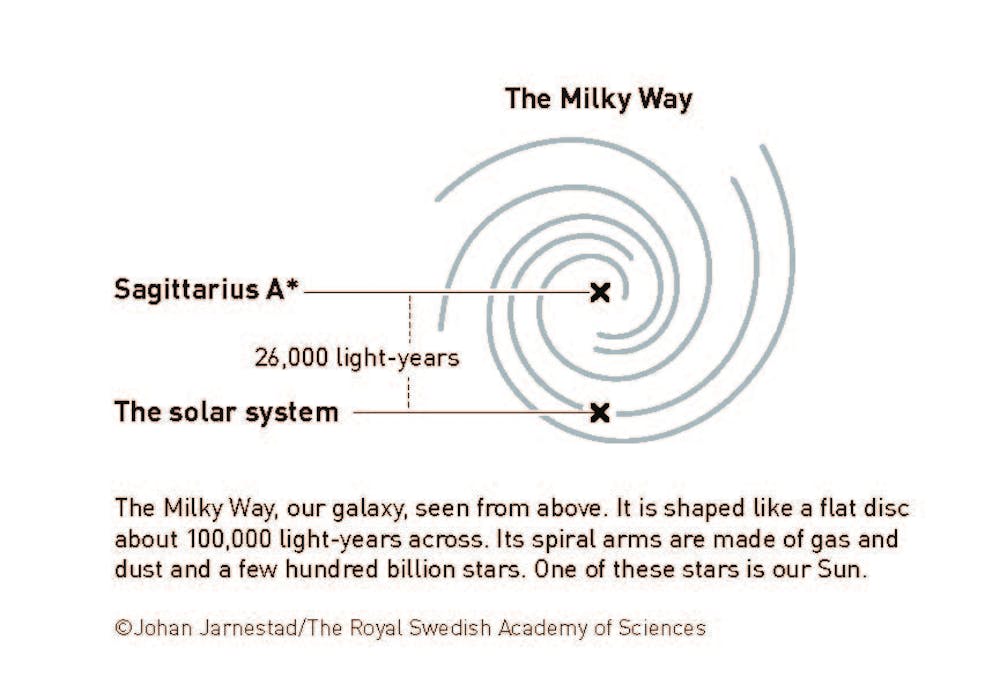
The location of the black hole in the Milky Way galaxy relative to our solar system. Johan Jarnestad/The Royal Swedish Academy of Sciences, CC BY-NC

Genzhel and Ghez used the world’s largest telescopes (Keck Observatory and the Very Large Telescope) and studied the movement of stars in a region called Sagittarius A* at the center of our galaxy. They both independently discovered that an extremely massive – 4 million times more massive than our Sun – invisible object is pulling on these stars, making them move in very unusual ways. This is considered the most convincing evidence of a black hole at the center of our galaxy. https://www.youtube.com/embed/tMax0KgyZZU?wmode=transparent&start=0 Movement of stars at the center of the Milky Way galaxy; evidence for the existence of a supermassive black hole. The stars are the big round bright objects therein. The arcs are tracks of their movement over time. The star symbol in the center is a dark object that everything appears to be moving around. That is indeed the supermassive black hole. This animation was created by Prof. Andrea Ghez and her research team at UCLA and are from data sets obtained with the W. M. Keck Telescopes.

This 2020 Nobel Prize, which follows on the heels of the 2017 Nobel Prize for the discovery of gravitational waves from black holes, and other recent stunning discoveries in the field – such as the the 2019 image of a black hole horizon by the Event Horizon Telescope – serve as great recognition and inspiration for all humankind, especially for those of us in the relativity and gravitation community who follow in the footsteps of Albert Einstein himself.

Gaurav Khanna, Professor of Physics, University of Massachusetts Dartmouth

This article is republished from The Conversation under a Creative Commons license. Read the original article.


Tags: SB001
DMCA.com Protection Status

SUBSCRIBE to our NEWSLETTER

[mc4wp_form id=”2384248″]

Don't Miss

NRMA welcomes dogs at four NSW South Coast Holiday Parks

by Pauline Torongo
22 October 2026
NRMA welcomes dogs at four NSW South Coast Holiday Parks
Lifestyle

Pet-friendly stays and nearby beaches give families more coastal holiday options as Australian caravan and camping trips reach record levels.

Read moreDetails

How She Sells with Brooke helps thousands of women build new careers through high-ticket sales

by Pauline Torongo
6 October 2026
How She Sells with Brooke helps thousands of women build new careers through high-ticket sales
Business & Finance

More than 3,000 women have joined She Sells with Brooke Triplett to build careers in high-ticket sales. For many, the...

Read moreDetails

Qualities to look for in a Caribbean Luxury Cruise Experience

by Pauline Torongo
6 October 2026
Qualities to look for in a Caribbean Luxury Cruise Experience. Image: Supplied
Travel

Luxury Caribbean cruises are often associated with beaches, sunshine, and tropical ease, but they can be more than that with...

Read moreDetails

Mark Levin and Yael Eckstein: Celebrating 250 Years – The Bond Between America and Israel

by Pauline Torongo
30 September 2026
Mark Levin and Yael Eckstein: Celebrating 250 Years - The Bond Between America and Israel
News

As America marks 250 years since the Declaration of Independence, Yael Eckstein and Mark Levin explore the biblical values and...

Read moreDetails

How supporting Australia’s Care Workforce could strengthen care in the community

by Pauline Torongo
10 September 2026
How supporting Australia’s Care Workforce could strengthen care in the community
News

Australian care funding faces growing scrutiny after a 2025 ANAO report found NDIS losses from fraud, non-compliance, and payment errors...

Read moreDetails

The Future of Work Is Changing: What HR must champion next, according to Energy Collective Co

by Pauline Torongo
28 August 2026
What HR Must Champion Next, According to Energy Collective Co
Business & Finance

Energy Collective Co examines the root causes of performance by considering how work is designed, how leadership is enacted and...

Read moreDetails

From Empathy Burnout to Body-Led Recovery: What Heidi Jane of Intuition Co. learned by living through what she teaches

by Pauline Torongo
25 August 2026
What Heidi Jane of Intuition Co. learned by living through what she teaches
Lifestyle

Recognising emotional exhaustion is only the first step. While supportive habits such as rest, time in nature, hydration, and reduced...

Read moreDetails
Load More

Copyright © Blue Sky Publications Ltd. All Rights Reserved.
australiantimes.co.uk is a division of Blue Sky Publications Ltd. Reproduction without permission prohibited. DMCA.com Protection Status

  • About us
  • Write for Us
  • Advertise
  • Contact us
  • T&Cs, Privacy and GDPR
No Result
View All Result
  • News
    • Weather
    • Sport
    • Technology
    • Business & Finance
      • Currency Zone
    • Lotto Results
      • The Lott
  • Lifestyle
    • Entertainment
    • Horoscopes
    • Health & Wellness
    • Recipes
  • Travel
  • Expat Life
  • Move to Australia

Copyright © Blue Sky Publications Ltd. All Rights Reserved.
australiantimes.co.uk is a division of Blue Sky Publications Ltd. Reproduction without permission prohibited. DMCA.com Protection Status