

• Advertise
  • About us
  • Terms and Conditions
  • Contact us
Wednesday, May 13, 2026
Australian Times News
  • News
    • Weather
    • Sport
    • Technology
    • Business & Finance
      • Currency Zone
    • Lotto Results
      • The Lott
  • Lifestyle
    • Entertainment
    • Horoscopes
    • Health & Wellness
    • Recipes
  • Travel
  • Expat Life
  • Move to Australia
No Result
View All Result
  • News
    • Weather
    • Sport
    • Technology
    • Business & Finance
      • Currency Zone
    • Lotto Results
      • The Lott
  • Lifestyle
    • Entertainment
    • Horoscopes
    • Health & Wellness
    • Recipes
  • Travel
  • Expat Life
  • Move to Australia
No Result
View All Result
Australian Times News
No Result
View All Result
Home Lifestyle

The coastal banksia has its roots in ancient Gondwana

Australian native trees and shrubs

The Conversation by The Conversation
13-06-2020 18:05
in Lifestyle
roots in ancient Gondwana

Roots in ancient Gondwana Photo by Joey Csunyo on Unsplash

Gregory Moore, University of Melbourne

If you fondly remember May Gibbs’s Gumnut Baby stories about the adventures of Snugglepot and Cuddlepie, you may also remember the villainous Big Bad Banksia Men (perhaps you’re still having nightmares about them).

But banksias are nothing to be afraid of. They’re a marvellous group of Australian native trees and shrubs, with an ancient heritage and a vital role in Australian plant ecology, colonial history and bushfire regeneration.

The genus Banksia has about 173 native species. It takes its name from botanist Sir Joseph Banks, who collected specimens of four species in 1770 when he arrived in Australia on board Captain Cook’s Endeavour.
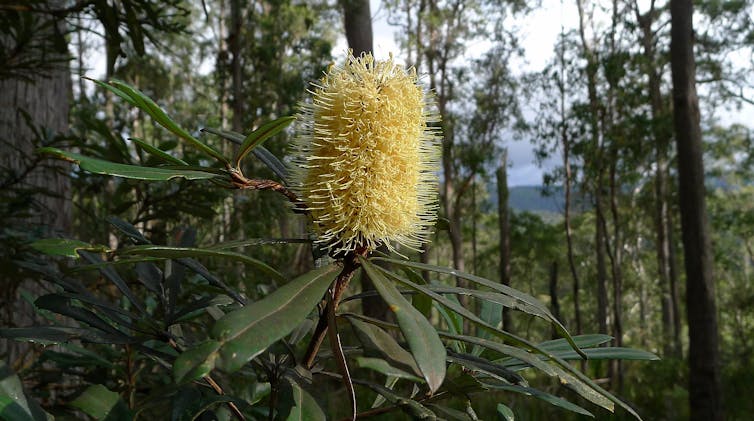
John Tann/Flickr, CC BY

One of the four species he collected was B. integrifolia, the coastal banksia. This can be a small to medium tree about 5m to 15m tall. In the right conditions, it can be quite impressive and grow up to 35m.

It’s found naturally in coastal regions, growing on sand dunes or around coastal marshes from Queensland to Victoria. These can be quite tough environments and, while B. integrifolia tends to grow in slightly protected sites, it still copes well with sandy soils, poor soil nutrition, salt and wind.
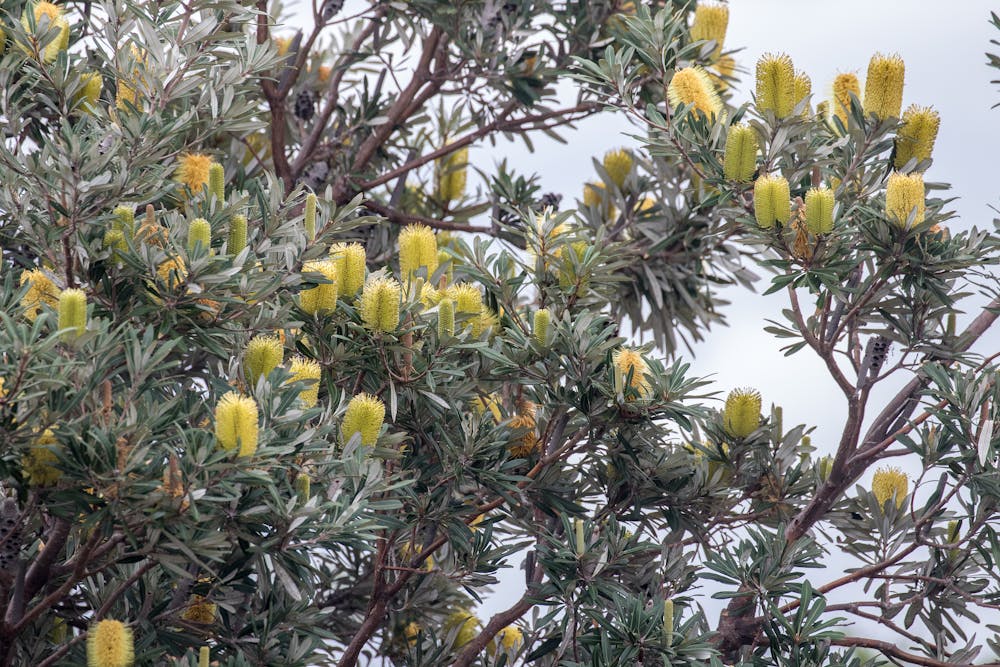
In the right conditions, coastal banksia can grow to 35m tall. Shutterstock

From ancient origins

Coastal banksia – like all banksias – belong to the protea family (Proteaceae). But given the spectacular flowering proteas are of African origin, how did our Australian genera get here?


AlsoRead...

Residential Healthcare Practices: Revolution or Evolution?

Residential Healthcare Practices: Revolution or Evolution?

11 May 2026
Medicana Health Group launches HPV vaccination campaign to support cervical cancer prevention

Medicana Health Group launches HPV vaccination campaign to support cervical cancer prevention

28 April 2026

The members of the Proteaceae belong to an ancient group of flowering plants that evolved almost 100 million years ago on the southern supercontinent Gondwana. When Gondwana fragmented more than 80 million years ago, the proteas remained on the African plate, while the Australian genera remained here.

The spikes of woody fruits on the Australian banksia, sometimes called cones, are made up of several hundred flowers. The flower spikes are beautiful structures, soft and brush-like. But with B. integrifolia, they are pale green, similar to the foliage, and can be hard to see within the canopy at a distance.

Up close, these fruit spikes can look quite spooky, almost sinister, especially when wasps have caused extensive gall formation. Galls are swellings that develop on plant tissues as a result of fungal and insect damage, a bit like a benign tumour.

Maybe this is what led May Gibbs to cast them as the baddies in her Gumnut Baby stories. While the galls may look unsightly, they rarely do serious harm to banksias.
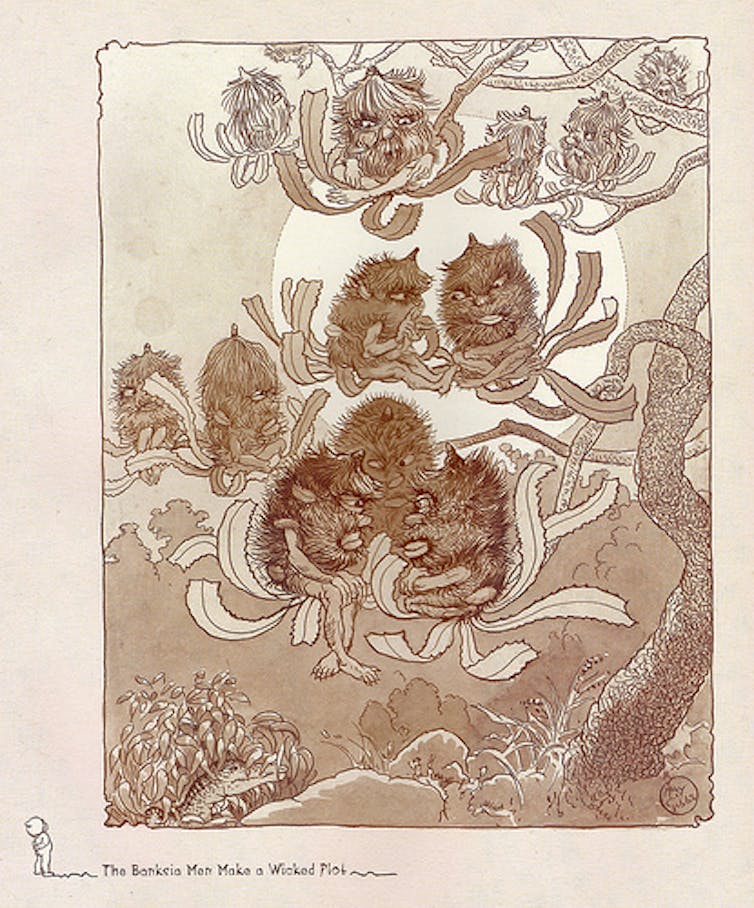
Banksias were depicted as the Big Bad Banksia Men in May Gibbs’s Gumnut stories. May Gibbs/The Northcott Society and Cerebral Palsy Alliance

Indigenous use

Given the fruit spikes of coastal banksia look like brushes, it’s not surprising Indigenous people once used them as paint brushes.

The flowers are very rich in nectar, which attracts insects and birds. If you run your hand along the flower spike you, like generations of Aboriginal people before you, can enjoy the sweet taste if you lick the nectar off your hand. You can also soak the flowers in water and collect a sweet syrup.

In the garden, B. integrifolia is wonderfully attractive to native insects, birds and ringtail possums. It’s easy to establish and, until it grows more than a few metres high, can be successfully moved and transplanted.

Coastal banksia doesn’t need fire to release its seed. Shutterstock

Unlike many other banksia species, coastal banksias don’t need fire to release their seed. For many Australian species, the woody fruits remain solid and sealed, and it’s only when fire comes through that they burn, dry, crack open and release their seed.

This can happen with B. integrifolia too, but in a garden setting the fruits will mature, dry and crack open and release the seeds, which germinate readily. This makes propagating coastal banksia easy work.

In touch with its roots

Perhaps one of the more important, but less obvious, attributes of B. integrifolia are its roots. These are a special type of root possessed by members of the protea family.

The roots form a dense, branched cluster, a bit like the head of a toothbrush, that can be 2-5cm across. They greatly increase the absorbing surface area of the roots, as each root possesses thousands of very fine root hairs.

Proteoid roots can be very handy in sandy and other poor soils, where water drains quickly and nutrients are scarce.

These roots, also described as cluster roots, are often visible in a garden bed just at the interface of the soil with the humus or mulch layer above it. They’re very light brown, almost white, in colour.
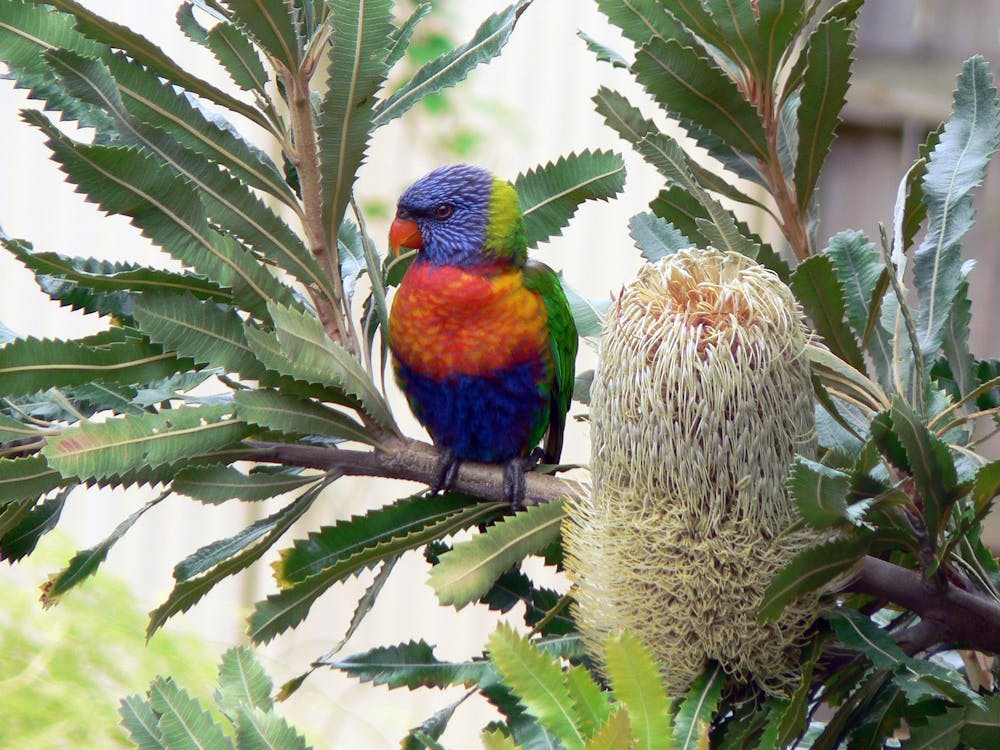
Rainbow lorikeets love hanging around in banksias. Flickr/Salihan, CC BY-NC-ND

B. integrifolia, like other banksias, also has the ability to take in nitrogen and enrich the soil, which can be very handy in soils low in nitrogen. It’s like a natural living and decorative fertiliser.

Proteoid roots are unfortunately very well suited to the presence of Phytophthora cinnamomii (the cinnamon fungus). It causes dieback in many native plant species, but can be particularly virulent for banksias.

But B. Integrifolia is one of the more resistant species to the fungus. Promising experiments have been done on grafting susceptible species onto the roots of B. integrifolia to improve their rates of survival.

This could be important, as banksias have a role in bushfire regeneration in many parts of Australia, so the occurrence of the fungus can compromise fire recovery.

Gregory Moore, Doctor of Botany, University of Melbourne

This article is republished from The Conversation under a Creative Commons license. Read the original article.


Tags: SB001
DMCA.com Protection Status

SUBSCRIBE to our NEWSLETTER

[mc4wp_form id=”2384248″]

Don't Miss

Svitla Systems acquires Australia’s Kiandra IT to expand Global Engineering Footprint and Accelerate AI-Driven delivery

by Pauline Torongo
11 May 2026
Svitla Systems
Business & Finance

Acquisition marks Svitla’s entry into the Australian market and strengthens capabilities in low-code, Microsoft technologies, and enterprise software engineering.

Read moreDetails

Residential Healthcare Practices: Revolution or Evolution?

by Pauline Torongo
11 May 2026
Residential Healthcare Practices: Revolution or Evolution?
Lifestyle

President Bill Lutz’s "revolution" was born from his background in fine dining, which instilled a disciplined, customer-focused approach.

Read moreDetails

Medicana Health Group launches HPV vaccination campaign to support cervical cancer prevention

by Pauline Torongo
28 April 2026
Medicana Health Group launches HPV vaccination campaign to support cervical cancer prevention
Health & Wellness

The Türkiye-based healthcare group has introduced a new awareness campaign focused on HPV vaccination, regular check-ups and early detection, with...

Read moreDetails

How Clevero is helping Australian Service Businesses compete with Enterprises on a Fraction of the Budget

by Pauline Torongo
28 April 2026
How Clevero is helping Australian Service Businesses compete with Enterprises on a Fraction of the Budget
Business & Finance

By consolidating CRM, scheduling, workflow automation, invoicing, reporting, and client communications into a single platform, Clevero gives smaller operators the...

Read moreDetails

How CJAM Group is building 1,100 homes across Southeast Queensland

by Pauline Torongo
24 March 2026
How CJAM Group is building 1,100 homes across Southeast Queensland
Lifestyle

The CJAM Group founder is quietly building a 1,100+ home pipeline, with projects in Hervey Bay and Toowoomba, using a...

Read moreDetails

Design Without Compromise: Where Gutter Protection Meets Modern Architecture

by Fazila Olla-Logday
20 March 2026
Design Without Compromise: Where Gutter Protection Meets Modern Architecture
Business & Finance

Design without compromise by integrating gutter protection seamlessly into modern architecture. Discover how innovative gutter systems enhance your home’s aesthetics...

Read moreDetails

How WageSafe Secured Australia’s Most Reputable Retail Business Among Its Premium Clients

by Fazila Olla-Logday
12 March 2026
How WageSafe Secured Australia’s Most Reputable Retail Business Among Its Premium Clients
at

Learn how WageSafe helps businesses stay compliant with payroll and wage regulations through reliable monitoring, risk management, and expert support—protecting...

Read moreDetails
Load More

Copyright © Blue Sky Publications Ltd. All Rights Reserved.
australiantimes.co.uk is a division of Blue Sky Publications Ltd. Reproduction without permission prohibited. DMCA.com Protection Status

  • About us
  • Write for Us
  • Advertise
  • Contact us
  • T&Cs, Privacy and GDPR
No Result
View All Result
  • News
    • Weather
    • Sport
    • Technology
    • Business & Finance
      • Currency Zone
    • Lotto Results
      • The Lott
  • Lifestyle
    • Entertainment
    • Horoscopes
    • Health & Wellness
    • Recipes
  • Travel
  • Expat Life
  • Move to Australia

Copyright © Blue Sky Publications Ltd. All Rights Reserved.
australiantimes.co.uk is a division of Blue Sky Publications Ltd. Reproduction without permission prohibited. DMCA.com Protection Status

No Result
View All Result
  • News
    • Weather
    • Sport
    • Technology
    • Business & Finance
      • Currency Zone
    • Lotto Results
      • The Lott
  • Lifestyle
    • Entertainment
    • Horoscopes
    • Health & Wellness
    • Recipes
  • Travel
  • Expat Life
  • Move to Australia

Copyright © Blue Sky Publications Ltd. All Rights Reserved.
australiantimes.co.uk is a division of Blue Sky Publications Ltd. Reproduction without permission prohibited. DMCA.com Protection Status





