Robert McLachlan, Massey University
Climate explained is a collaboration between The Conversation, Stuff and the New Zealand Science Media Centre to answer your questions about climate change.
If you have a question you’d like an expert to answer, please send it to climate.change@stuff.co.nz
How are fossil fuels formed, why do they release carbon dioxide and how much of the world’s energy do they provide? And what are the renewable energy sources that could replace fossil fuels?
Fossil fuels were formed over millions of years from the remains of plants and animals trapped in sediments and then transformed by heat and pressure.
Most coal was formed in the Carboniferous Period (360–300 million years ago), an age of amphibians and vast swampy forests. Fossilisation of trees moved enormous amounts of carbon from the air to underground, leading to a decline in atmospheric carbon dioxide (CO₂) levels — enough to bring the Earth close to a completely frozen state.
This change in the climate, combined with the evolution of fungi that could digest dead wood and release its carbon back into the air, brought the coal-forming period to an end.
Oil and natural gas (methane, CH₄) were formed similarly, not from trees but from ocean plankton, and over a longer period. New Zealand’s Maui oil field is relatively young, dating from the Eocene, some 50 million years ago.


Burning buried sunshine
When fossil fuels are burnt, their carbon reacts with oxygen to form carbon dioxide. The energy originally provided by the Sun, stored in chemical bonds for millions of years, is released and the carbon returns to the air. A simple example is the burning of natural gas: one molecule of methane and two of oxygen combine to produce carbon dioxide and water.
CH₄ + 2 O₂ → CO₂ + 2 H₂O
Burning a kilogram of natural gas releases 15kWh of energy in the form of infrared radiation (radiant heat). This is a sizeable amount.
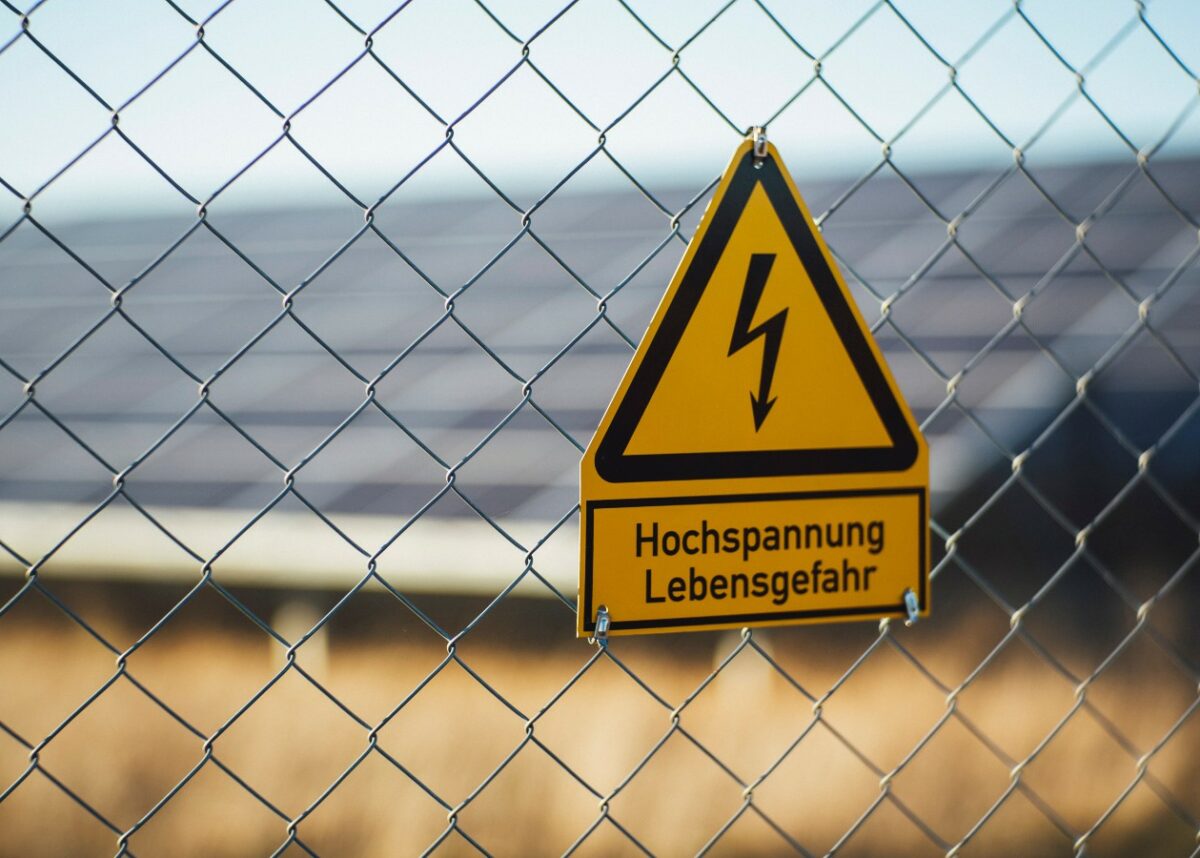
To stop continuously worsening climate change, we need to stop burning fossil fuels for energy. That’s a tall order, because fossil fuels provide 84% of all the energy used by human civilisation. (New Zealand is less reliant on fossil fuels, at 65%.)
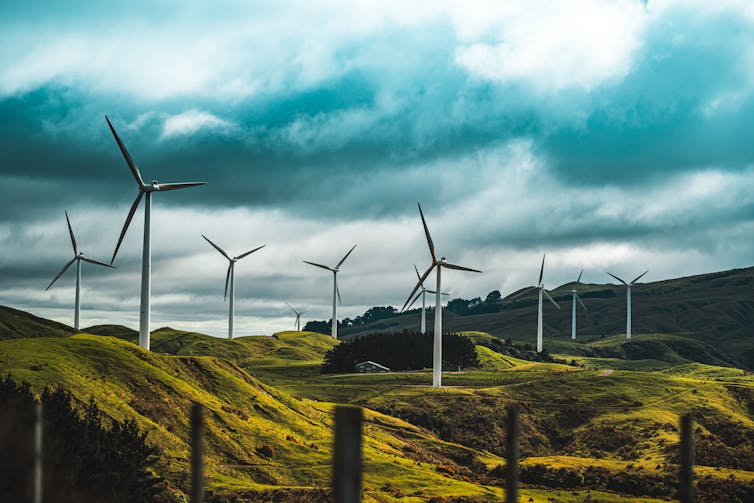
There are many possible sources of renewable or low-carbon energy: nuclear, hydropower, wind, solar, geothermal, biomass (burning plants for energy) and biofuel (making liquid or gaseous fuels out of plants). A handful of tidal power stations are in operation, and experiments are under way with wave and ocean current generation.
But, among these, the only two with the capacity to scale up to the staggering amount of energy we use are wind and solar. Despite impressive growth (doubling in less than five years), wind provides only 2.2% of all energy, and solar 1.1%.
The renewables transition
One saving grace, which suggests a complete transformation to renewable energy may be possible, is that a lot of the energy from fossil fuels is wasted.
First, extraction, refining and transport of fossil fuels accounts for 12% of all energy use. Second, fossil fuels are often burnt in very inefficient ways, for example in internal combustion engines in cars. A world based on renewable energy would need half as much energy in the first place.
The potential solar and wind resource is enormous, and costs have fallen rapidly. Some have argued we could transition to fully renewable energy, including transmission lines and energy storage as well as fully synthetic liquid fuels, by 2050.
One scenario sees New Zealand building 20GW of solar and 9GW of wind power. That’s not unreasonable — Australia has built that much in five years. We should hurry. Renewable power plants take time to build and industries take time to scale up.
Other factors to consider
Switching to renewable energy solves the problems of fuel and climate change, but not those of escalating resource use. Building a whole new energy system takes a lot of material, some of it rare and difficult to extract. Unlike burnt fuel, metal can be recycled, but that won’t help while building a new system for the first time.
Research concluded that although some metals are scarce (particularly cobalt, cadmium, nickel, gold and silver), “a fully renewable energy system is unlikely to deplete metal reserves and resources up to 2050”. There are also opportunities to substitute more common materials, at some loss of efficiency.
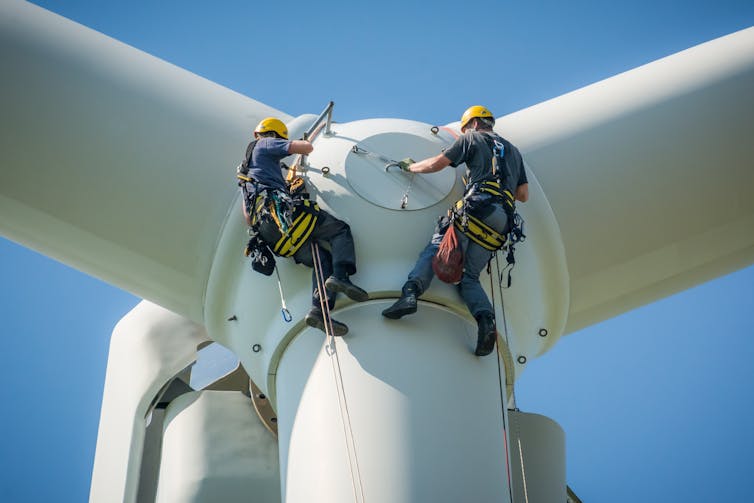
But many metals are highly localised. Half the world’s cobalt reserves are in the Democratic Republic of Congo, half the lithium is in Chile, and 70% of rare earths, used in wind turbines and electric motors, are in China.
Wasteful consumption is another issue. New technologies (robots, drones, internet) and economic growth lead to increased use of energy and resources. Rich people use a disproportionate amount of energy and model excessive consumption and waste others aspire to, including the emerging rich in developing countries.
Research analysing household-level emissions across European countries found the top 1% of the population with the highest carbon footprints produced 55 tonnes of CO₂-equivalent emissions each, compared to a European median of 10 tonnes.
Scientists have warned about consumption by the affluent and there is vigorous debate about how to reduce it while preserving a stable society.
One way of turning these questions around is to start from the bottom and ask: what is the minimum energy required for basic human needs?
One study considered “decent living” to include comfortable housing, enough food and water, 10,000km of travel a year, education, healthcare and telecommunications for everyone on Earth — clearly not something we have managed to achieve so far. It found this would need about 4,000kWh of energy per person per year, less than a tenth of what New Zealanders currently use, and an amount easily supplied by renewable energy.
All that carbon under the ground was energy ripe for the picking. We picked it. But now it is time to stop.
Robert McLachlan, Professor in Applied Mathematics, Massey University
This article is republished from The Conversation under a Creative Commons license. Read the original article.