Xiaoming Xu, University of Illinois at Urbana-Champaign and Atul Jain, University of Illinois at Urbana-Champaign
Producing enough food for a growing world population is an urgent global challenge. And it’s complicated by the fact that climate change is warming the Earth and making farming harder in many places.
Food production is a big contributor to climate change, so it’s critically important to be able to measure greenhouse gas emissions from the food sector accurately. In a new study, we show that the food system generates about 35% of total global man-made greenhouse gas emissions.
Breaking down this share, production of animal-based foods – meat, poultry and dairy products, including growing crops to feed livestock and pastures for grazing – contributes 57% of emissions linked to the food system. Raising plant-based foods for human consumption contributes 29%. The other 14% of agricultural emissions come from products not used as food or feed, such as cotton and rubber.
We are atmospheric scientists who study the effects of agriculture and other human activities on Earth’s climate. It’s well known that producing animal-based foods generates more greenhouse gas emissions than plant-based foods, which is why shifting toward a more plant-based diet is recognized as an option for curbing greenhouse gas emissions and climate change.
But to quantify the potential impact of such a shift, we saw a need for better tools to estimate emissions from individual plant- and animal-based food items, with more details about how emissions are calculated and covering all food-related sub-sectors, such as land use change and actions beyond the farm gate.
Current methods rely on sparse data and simplified representations of many key factors, such as emissions from farmland management. They don’t treat different sub-sectors consistently or calculate emissions for producing many specific commodities.


To fill those gaps, we have developed a comprehensive framework that combines modeling and various databases. It enables us to estimate average yearly global emissions of the greenhouse gases carbon dioxide, methane and nitrous oxide from the production and consumption of plant- and animal-based human food. Currently, our study covers the years 2007-2013. Here are some of the insights it offers, using data that represents an average of those years. https://www.youtube.com/embed/bjN4t9fWza0?wmode=transparent&start=0 Hunger and food insecurity are urgent global challenges. Climate change is one contributing factor.
Greenhouse gases from food production
We considered four major sub-sectors of emissions from plant- and animal-based food production. Overall, we calculated that the food system produces emissions that are equivalent to approximately 17.3 billion metric tons (17.318 teragrams) of carbon dioxide yearly.
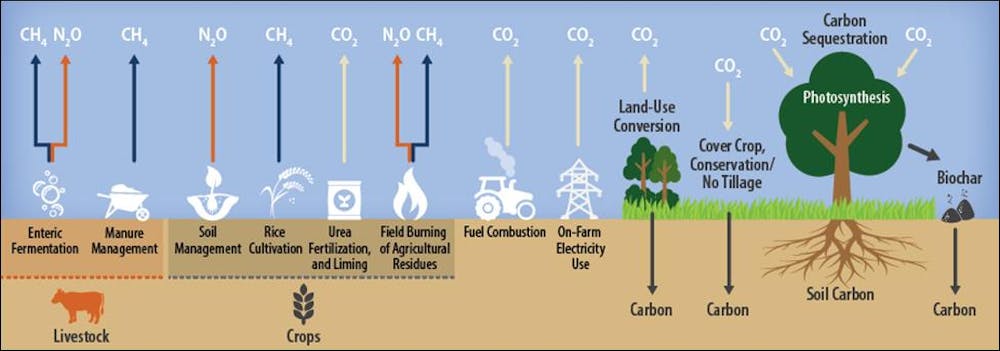
Land use change – clearing forests for farms and ranches, which reduces carbon storage in trees and soils – accounts for 29% of total food production greenhouse gas emissions. Another 38% comes from farmland management activities, such as plowing fields, which reduces soil carbon storage, and treating crops with nitrogen fertilizer. Farmers also burn a lot of fossil fuel to run their tractors and harvesters.
Raising livestock generates 21% of greenhouse gas emissions from food production. It includes methane belched by grazing animals, as well as methane and nitrous oxide released from livestock manure. The remaining 11% comes from activities that occur beyond farm gates, such as mining, manufacturing and transporting fertilizers and pesticides, as well as energy use in food processing.
Which foods generate the most greenhouse gas emissions?
Our framework makes it possible to compare how different food products and food-producing regions affect Earth’s climate.
Among animal-based foods, beef is the largest contributor to climate change. It generates 25% of total food emissions, followed by cow milk (8%) and pork (7%).
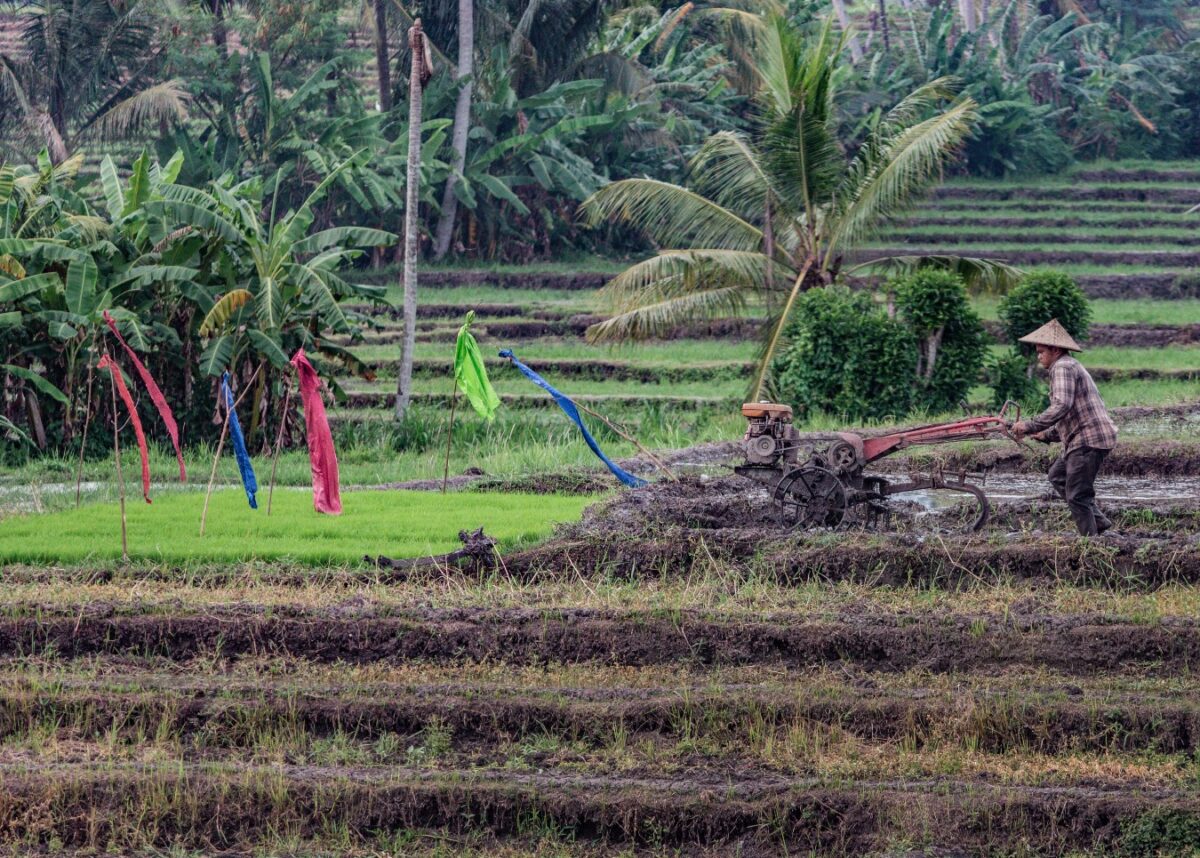
Rice is the largest contributor among plant-based foods, producing 12% of the total greenhouse gas emissions from the food sector, followed by wheat (5%) and sugarcane (2%). Rice stands out because it can grow in water, so many farmers flood their fields to kill weeds, creating ideal conditions for certain bacteria that emit methane.
This helps to explain why South and Southeast Asia have the greatest food-production-related emissions by region, producing 23% of the global total. This region is the only place where plant-based emissions are larger than animal-based emissions. South America is the second-largest emitter at 20%, and has the largest emissions from animal-based food, reflecting the dominance of ranching there.
Among individual countries, China, India and Indonesia have the highest emissions from plant-based food production, contributing 7%, 4%, and 2% respectively of global food-related greenhouse gas emissions. The countries with leading emissions from the production of animal-based foods are China (8%), Brazil (6%), the U.S. (5%) and India (4%).
How food production affects land use
Our framework also shows that raising animal-based foods consumes six times as much land as producing plant-based foods.
Worldwide, we estimate that humans are using 18 million square miles (4.6 billion hectares) of land to produce food – about 31% of Earth’s total land area, excluding areas covered by snow and ice. Of this, 30% is cropland and 70% is various types of grazing land.
Looking at how these areas are managed, we estimate that 13% of total agricultural land is being used to produce plant-based foods. The other 77% is being used to produce animal-based foods, including croplands that are growing animal feed and grazing lands. The remaining 10% is being used to raise other products, such as cotton, rubber and tobacco.
[Over 100,000 readers rely on The Conversation’s newsletter to understand the world. Sign up today.]
Our study uses a consistent framework to provide a complete estimation of greenhouse gas emissions from food production and consumption, covering all food-related sub-sectors, at local, country, regional and global scales. It can help policymakers identify the plant- and animal-based food commodities that contribute the largest shares to climate change, and the higest-emitting sub-sectors at different locations.
Based on these results, governments, researchers and individuals can take actions to reduce emissions from high-emitting food commodities in different places. As U.N. leaders have stated, making food production more climate-friendly is essential to reduce hunger in a warming world.
Xiaoming Xu, Postdoctoral Research Associate in Atmospheric Sciences, University of Illinois at Urbana-Champaign and Atul Jain, Professor of Atmospheric Sciences, University of Illinois at Urbana-Champaign
This article is republished from The Conversation under a Creative Commons license. Read the original article.