David Comerford, University of Stirling
The European Commission is holding a meeting in June that is, on the face of it, very boring. The EU’s senior bureaucrats will be considering at what level to set a tax on carbon emissions for goods imported into the bloc.
Yet the consequences will be pivotal – both to the future of the EU’s world-leading system for managing corporate carbon emissions, and for how this market develops around the world. It’s therefore an absolutely vital part of the battle for net zero global emissions.
Let’s first understand what has prompted the tax. Within the EU, carbon emissions are governed by a cap-and-trade system: a cap is set on the total amount of carbon emissions that can be emitted, and power providers and other firms each get an allowance for how much they can emit themselves.
If their pollution exceeds their permit allowance, they must buy more permits on an open market. Crucially, if they pollute less than their permit allowance, they can sell their unused permits to other firms. The upshot is that firms earn more if they pollute less – a win-win.
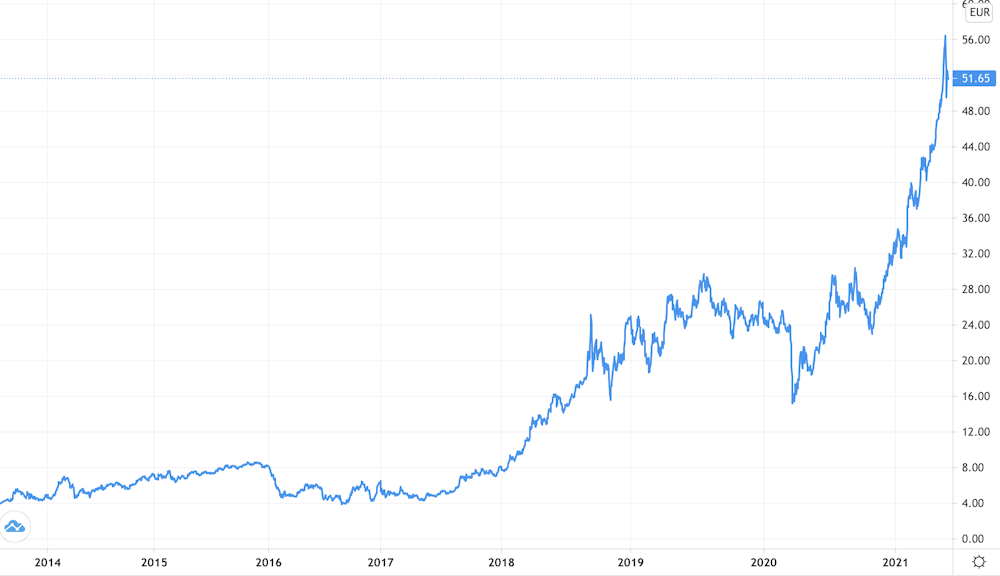
Economists love the European Trading System (ETS) for this reason. Increasingly the market does too. With speculators betting that the days of unrestricted carbon emissions are coming to end, ETS permit prices have doubled since the start of the pandemic.
ETS carbon price


To a large extent, this price hike has been a good thing. It makes it more costly for firms to pollute and so ramps up their incentive to green their production processes. The only problem is that producers outside the EU are not required to pay for their pollution with permits. As permit prices rise, these competitors are becoming relatively less expensive and taking market share from their EU rivals.
To level the playing field, EU industries are in the unusual position of lobbying Brussels to impose a new tax – in this case on the carbon emissions of goods being imported into the bloc. Yet in the teeth of this high-stakes negotiation, several possible outcomes could actually make the situation with carbon emissions much worse than it is already.
Scenario #1: ETS implosion
The worst-case scenario is that the EU sets the tax too low. This could happen because the best outcome for any given EU country is to protect its own industry while not damaging its preferred trading partners outside of the EU. Because each EU member state has different industries and different preferred trading partners, horse-trading is likely to bid the border tax lower. In this case, pollution-intensive industries within the EU would continue to face higher costs relative to their overseas competitors.
This could lead to the ETS being undermined in one of several ways. EU industries might use their political clout to lobby for the ETS rules to be relaxed, for example by creating exemptions. Or firms might simply breach their emissions allowances. The European Commission has a patchy track record for collecting on fines and, again for reasons of political clout, national governments might side with industry against the EU (which happens from time to time). If both these things happen, it could effectively dismantle the ETS, returning us to a world of rising carbon emissions and global climate disaster.
Thankfully, a couple of factors make these outcomes unlikely. One is that Europe’s biggest trading partners are sympathetic to the cause. China already has its own carbon emissions scheme and the Biden administration has signalled a commitment to making deep cuts to US carbon emissions.
But more importantly, the ETS has an in-built release valve. If the scheme makes it too expensive for a firm to produce within the EU, it can shift production overseas. It then ceases to need ETS permits and releases it stock of permits on to the market. Demand reduces, supply increases and the price of permits falls. This might help keep the system intact, but emissions would rise in the meantime.
Scenario #2: widening global inequality
A way to get around the horse-trading is for the EU to pre-commit that no external country will get special treatment. That entails a higher tax rate that reduces the risk of the ETS imploding, but there is a cost that would reveal itself over decades: the tax would disproportionately hit economies that rely on heavy industry.
Countries like Canada that have plenty of (clean) white-collar jobs would be hit less hard than middle-income countries like India, for instance. And more worrisome than the initial hit would be the consequences for business opportunities: a high tax would create opportunities for innovators in green energy.
This might sound like a great thing, but these people – and the tools they require to do their research – are disproportionately located in the developed world. This points to a dystopian future of increasing north/south and white collar/blue collar divergence.
Scenario #3: a better world for all
The European Commission therefore faces two risks here: climate disaster from setting the tax too low, and greater global inequality if the rate is too high. The sweet spot is to set a border tax rate such that the worst-off countries get a break and the best-off countries fully pay their dues. So what would that look like?
One opportunity open to the European Commission is to tax imports in proportion to some reliable metric of development. So imports from countries like New Zealand would be taxed as though they were produced in the EU whereas concessions would be made for those coming from countries with, say, low life expectancy or high levels of poverty. That outcome would build on the promise of the ETS as a means to reduce global carbon emissions and would also rebalance global development.
David Comerford, Senior Lecturer of Economics and Behavioural Science, University of Stirling
This article is republished from The Conversation under a Creative Commons license. Read the original article.