

• Advertise
  • About us
  • Terms and Conditions
  • Contact us
Sunday, December 7, 2025
Australian Times News
  • News
    • Weather
    • Sport
    • Technology
    • Business & Finance
      • Currency Zone
    • Lotto Results
      • The Lott
  • Lifestyle
    • Entertainment
    • Horoscopes
    • Health & Wellness
    • Recipes
  • Travel
  • Expat Life
  • Move to Australia
No Result
View All Result
  • News
    • Weather
    • Sport
    • Technology
    • Business & Finance
      • Currency Zone
    • Lotto Results
      • The Lott
  • Lifestyle
    • Entertainment
    • Horoscopes
    • Health & Wellness
    • Recipes
  • Travel
  • Expat Life
  • Move to Australia
No Result
View All Result
Australian Times News
No Result
View All Result
Home News

Pre-COVID-19 death rates should be a warning for the UK government if it wants to build back better

For more than a century we have enjoyed sustained improvements to our life expectancy. Yet for the UK, there has been very little change in how long we can expect to live since 2011. And in England, the poorest have actually seen their life expectancy fall.

The Conversation by The Conversation
26-03-2021 01:47
in News
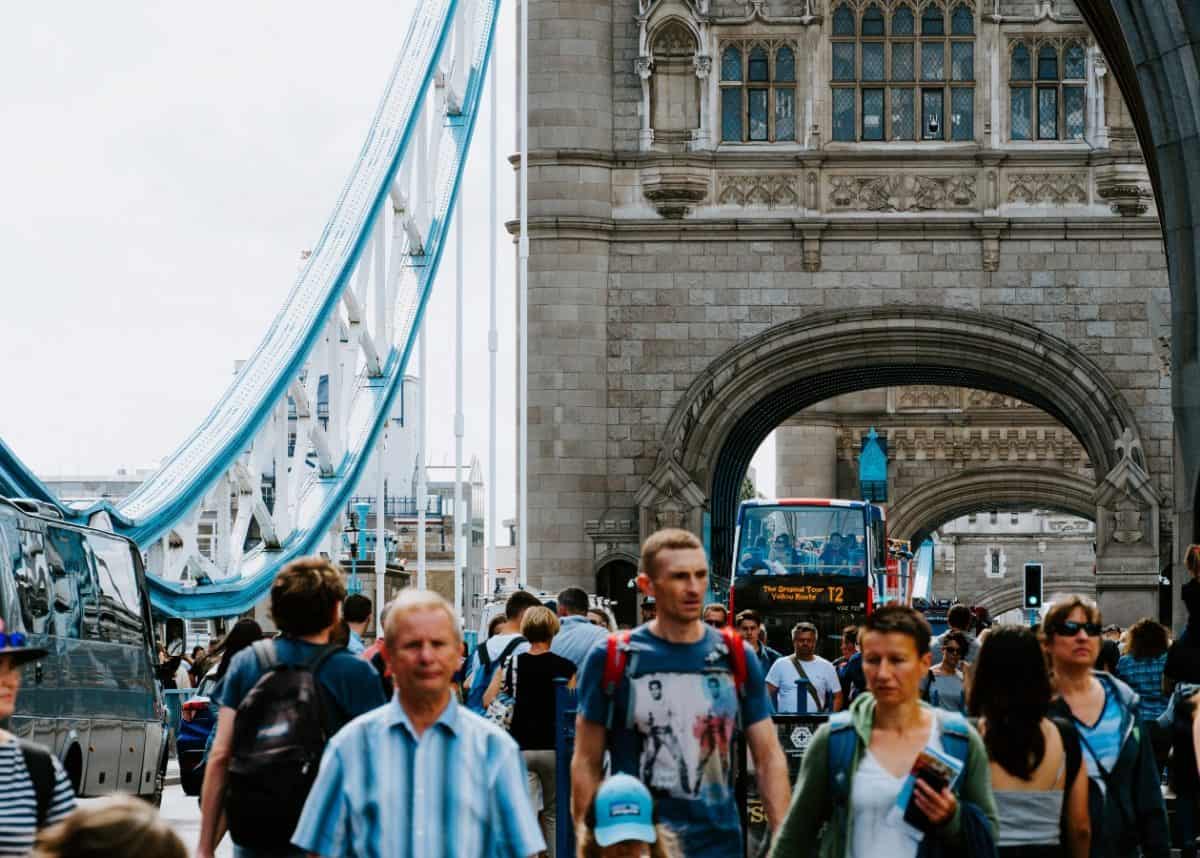
Photo by Jean Carlo Emer on Unsplash

Photo by Jean Carlo Emer on Unsplash

Frances Darlington-Pollock, University of Liverpool; Ludi Simpson, University of Manchester, and Mark Green, University of Liverpool

For more than a century we have enjoyed sustained improvements to our life expectancy. Yet for the UK, there has been very little change in how long we can expect to live since 2011. And in England, the poorest have actually seen their life expectancy fall. To understand why this happened, we compared how the expected number of deaths differed from what actually occurred up to 2017-18, using official projections made in 2010 by the Office for National Statistics.

We estimate that 231,707 more people died between 2010-11 and 2017-18 than was originally anticipated. Over 90% of local authorities in England experienced more deaths than expected (see Figure 1). Almost 90% of these extra deaths have occurred since 2014-15, but well before COVID-19 struck.

This excess of deaths is striking because population projections tend to be conservative in their estimates of how life expectancy will change over time. They generally project a slower rate of improvement than is typically observed in reality. Projections are not cast with a crystal ball, and no demographer would expect to be spot on with numbers but estimates of more than 230,000 deaths than expected warrant investigation.

The austerity era

To pick apart what might explain the excess number of deaths, we tried to understand which areas had more excess deaths than others. Remarkably, levels of poverty or deprivation were not important. In other words, rather than finding more excess deaths in more deprived areas, there was no relationship between level of deprivation and number of excess deaths.
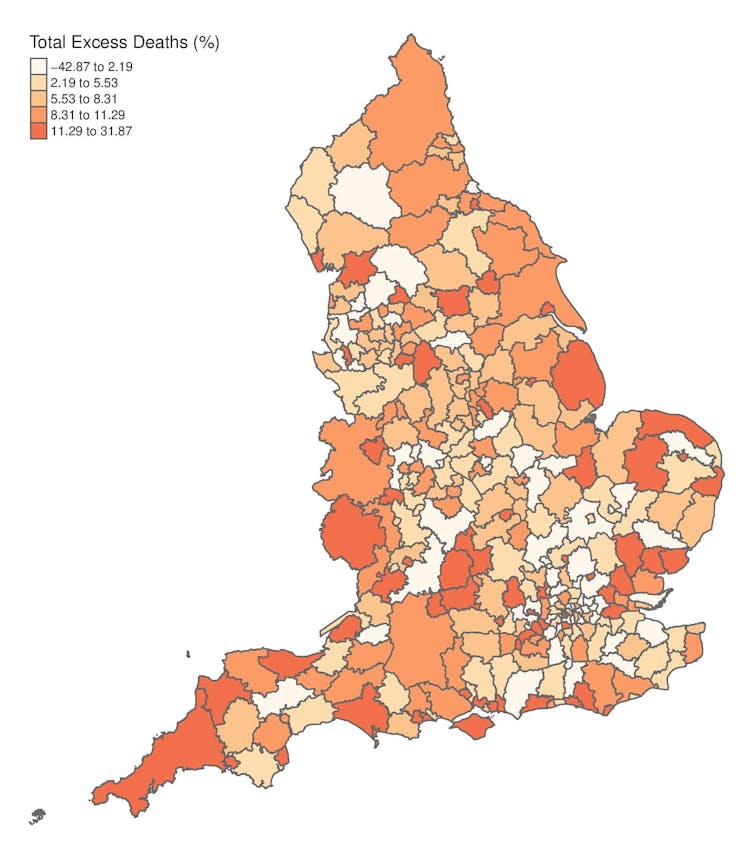
Orange, yellow and white map of England showing excess deaths by local authority
Figure 1: Total excess deaths as a percentage of expected deaths between 2010-11 to 2017-18 by local authority. Author provided

This is surprising because poorer communities have a disproportionate share of deaths for most, if not all, health conditions. It suggests that the issues behind the differences in excess deaths may be something that affects us all, irrespective of our social position. We must ask, then, why this population, at this point in time?

The period from 2010-2018 was characterised by a major policy shift. The introduction of fiscal austerity constrained local government spending and welfare provision. We found that in areas where welfare reforms led to a higher loss in average household income, excess deaths were larger.


AlsoRead...

Ryan: Building real freedom through e-commerce

Ryan: Building real freedom through e-commerce

27 November 2025
Design Australia Group: Redefining Drafting as the engine of housing growth

Design Australia Group: Redefining Drafting as the engine of housing growth

26 November 2025

We did not, however, find a similar relationship between excess deaths and deprivation. The impacts of austerity have been shown to be more keenly felt among poorer people and in more disadvantaged places. But it has also affected a wider range of demographics, from the so-called “struggling middle class” who have seen their pay fall over the decade of austerity to households with new parents who both work full time.

Though it would make sense to assume that older people would be disproportionately affected by these issues, that hasn’t been the case. In fact, excess deaths were most likely among working-age adults, while being the least likely among those aged 85+. This is largely because older age groups were able to enjoy the security of the triple lock protection for their pensions, buffering against the impact of wider welfare reforms at the time. No such protection existed for working age adults. Within this group, those more dependent on the security afforded by welfare provision would have of course found any cuts devastating.

Looking ahead

Our analyses do not prove that austerity caused 231,707 more people to die than should have. But evidence mounts about the harmful impacts of austerity on the health and wellbeing of the population. This plays out in different ways, such as through increasing unemployment or precarious employment, changes to benefits entitlements, and reductions to health and social care services. A return to fiscal austerity, as seen in chancellor Rishi Sunak’s stealthily austere budget or in future budgets, is likely to have significant implications for population health.

Though it may seem as though this sort of slow down is inevitable, the situation is more complex than it appears. It’s true that we don’t anticipate that life expectancy will increase indefinitely. And when we reach the limits of our longevity or indeed the limits of existing medical capacity, we will likely see a slowdown to improvements in life expectancy. But we are not at that point just yet. The UK already has a lower life expectancy than many other comparable countries, which means you’d expect us to continue improving, at least at the same rate that others are. And yet the opposite has been the case: we have seen even less improvement to life expectancy than other countries that have also seen a slowdown.

If England continues to underperform, we have to ask critical questions. Crucially, we’ll need to fully understand the context in which that underperformance plays out. This started long before COVID-19 took hold. So if prime minister Boris Johnson is really committed to “doubling down on levelling up”, “building back better” also has to mean building back different.

Frances Darlington-Pollock, Lecturer in Population Geography, University of Liverpool; Ludi Simpson, , University of Manchester, and Mark Green, Senior Lecturer in Health Geography, University of Liverpool

This article is republished from The Conversation under a Creative Commons license. Read the original article.


Tags: SB001
DMCA.com Protection Status

SUBSCRIBE to our NEWSLETTER

[mc4wp_form id=”2384248″]

Don't Miss

The evolution of Aesthetic Surgery through the lens of Dr Kourosh Tavakoli

by Pauline Torongo
4 December 2025
The evolution of Aesthetic Surgery through the lens of Dr. Kourosh Tavakoli
Health & Wellness

As global interest in Australian cosmetic surgery continues to grow, the combination of regulation, research and emerging digital tools is...

Read moreDetails

Ryan: Building real freedom through e-commerce

by Pauline Torongo
27 November 2025
Ryan: Building real freedom through e-commerce
Business & Finance

Ryan’s greatest achievement isn’t any single business or revenue milestone — it’s the ecosystem he’s built through the Change community.

Read moreDetails

Design Australia Group: Redefining Drafting as the engine of housing growth

by Pauline Torongo
26 November 2025
Design Australia Group: Redefining Drafting as the engine of housing growth
Business & Finance

Australia is under pressure to build homes faster, but design bottlenecks slow progress. Design Australia Group is fixing this by...

Read moreDetails

Louis Guy Detata builds Global Trading Empires through autonomous systems and disciplined leadership

by Pauline Torongo
25 November 2025
Louis Guy Detata builds Global Trading Empires through autonomous systems and disciplined leadership
Business & Finance

The path from investment banking to leading a global trading platform has taught Louis Detata that sustainable success requires more...

Read moreDetails

Burning Eucalyptus Wood: Tips, Advantages, Disadvantages & Alternatives

by Fazila Olla-Logday
20 November 2025
Image Supplied
Enviroment

Learn about burning eucalyptus wood for stoves and fireplaces. Discover benefits, drawbacks, harvesting tips, and better alternative firewood options for...

Read moreDetails

Everything Parents Need to Know About Baby Soft Play and Why It’s a Game Changer

by Fazila Olla-Logday
11 November 2025
Everything Parents Need to Know About Baby Soft Play
Health & Wellness

Baby soft play is a fun, safe, and educational way for little ones to explore and grow. Discover the benefits...

Read moreDetails

WOMAD Sets Up a New Camp in Wiltshire – Australian festival fans take note!

by Kris Griffiths
11 November 2025
Kumbia Boruka brought their reggae and dancehall flavour to the Taste the World Stage at WOMAD 2024 - Credit - Mike Massaro
Entertainment

With its 2026 edition moving to Neston Park in England, WOMAD offers Aussie music lovers a chance to reconnect with global...

Read moreDetails
Load More

Copyright © Blue Sky Publications Ltd. All Rights Reserved.
australiantimes.co.uk is a division of Blue Sky Publications Ltd. Reproduction without permission prohibited. DMCA.com Protection Status

  • About us
  • Write for Us
  • Advertise
  • Contact us
  • T&Cs, Privacy and GDPR
No Result
View All Result
  • News
    • Weather
    • Sport
    • Technology
    • Business & Finance
      • Currency Zone
    • Lotto Results
      • The Lott
  • Lifestyle
    • Entertainment
    • Horoscopes
    • Health & Wellness
    • Recipes
  • Travel
  • Expat Life
  • Move to Australia

Copyright © Blue Sky Publications Ltd. All Rights Reserved.
australiantimes.co.uk is a division of Blue Sky Publications Ltd. Reproduction without permission prohibited. DMCA.com Protection Status

No Result
View All Result
  • News
    • Weather
    • Sport
    • Technology
    • Business & Finance
      • Currency Zone
    • Lotto Results
      • The Lott
  • Lifestyle
    • Entertainment
    • Horoscopes
    • Health & Wellness
    • Recipes
  • Travel
  • Expat Life
  • Move to Australia

Copyright © Blue Sky Publications Ltd. All Rights Reserved.
australiantimes.co.uk is a division of Blue Sky Publications Ltd. Reproduction without permission prohibited. DMCA.com Protection Status





