
Denise Fisher, Australian National University
The future of Australia’s near neighbour, New Caledonia, is uncertain, with signs of a return to the instability and violence of the 1980s. The Australian media and public take little notice, yet developments there carry serious security implications for Australia at a time of regional change.
Bitter ethnic divisions have reignited after 30 years of peace and stability, as peace agreements that ended civil disturbances over independence in the 1980s enter their final stage. The 1998 Noumea Accord provides for up to three independence referendums by 2022. Two have been held, only exacerbating tensions by highlighting solid and growing indigenous support for independence.
After decades of measures to increase autonomy and address economic inequities, the results show support for independence in the predominantly Kanak Northern and Islands Provinces, with pro-France support in the wealthy, predominantly European Southern Province. The resignation of the five pro-independence members of the 11-member “gouvernement” or cabinet on February 2 underlines these deep differences.
Independence leaders are signalling to France and the loyalist parties that they want genuine discussions about the future to begin and their voice to be heard.
Their move follows months of escalating disruption and violent protest over the sale of a multi-billion-dollar nickel plant to a multinational.
Independence leaders want local ownership instead. The territory has seen constant road blockages, throwing of stones and Molotov cocktails. Protesters have also attacked the nickel plant, destroying equipment and vehicles, and burning down buildings.


Managing the nickel resource has been at the heart of independence demands since the 1960s, so the recent return to the violent protest of the past is sobering.
Divisions are deepening
The Noumea Accord prescribes that New Caledonia’s cabinet is collegial, operating by consensus. The 54-member local congress elects the cabinet and its composition is proportional to relative party strength.
If one member resigns then the entire cabinet dissolves, with the congress to elect a new cabinet within two weeks. The new cabinet must then elect a president, a process requiring at least a further two weeks.
Independence leaders say they are taking the step now because of their opposition to the sale of the nickel plant to foreign investors. They are also unhappy about congress’s inability to pass the budget late in 2020 . It has been deferred to March 2021, compounding longstanding socio-economic inequities.
They also cite institutional breakdown in preparing the way for the post-Noumea Accord future, notably the failure of collegiality and consensus. They say France’s recent replacement of senior officials handling the New Caledonia portfolio led to a lack of expertise, attention and responsiveness in Paris to their position.
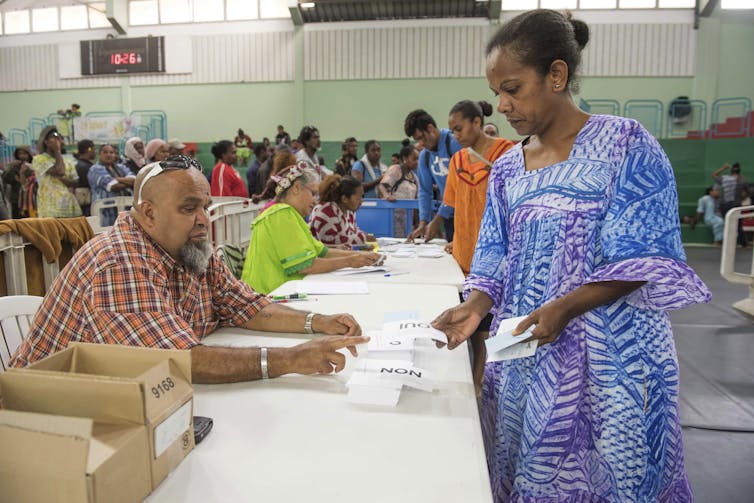
This development reflects a consistent hardening and deepening of divisions over independence, and on ethnic lines, in recent years. The five-year elections for the congress since 1999 have produced an increase in the number of independence seats and corresponding diminution of the loyalist majority and fragmentation of loyalist parties. Independent parties won only 18 of the 54 congress seats in 2004, but increased this to 26 in 2019. Loyalists dropped from 36 in 2004 to 25 in 2019, with an unaligned Polynesian-based party winning three seats.
The final three-phase independence referendum process has sharpened these divisions. The first two votes supported staying with France but with sizeable, and increasing, indigenous Kanak-based minorities for independence from 43% in 2018 to 47% in October 2020.
Both sides have toughened their stance: the loyalists simply claim their stay-with-France side has won twice; the Kanak independence groups see a possible win on the third vote.
A third vote can be held before November 2022, if three-fifths of the congress agree. The independence parties have the numbers and have flagged they will proceed to the third referendum. They are aware that, when the accord expires, the hard-won restricted electorates confining voting to longstanding residents, advantaging indigenous voters, will no longer apply.
Meanwhile, France has sought repeatedly to convene all parties for discussions about the future, whether in France or otherwise. It commissioned two major reports. One in 2013 flagged statutory consequences for four options, including independence. The second report in 2016 followed two years of consultations. These reports detail areas of agreement and disagreement between all parties on a range of governance issues.
The former French prime minister Edouard Philippe personally presided over several dialogue efforts. France’s minister for overseas territories, Sébastian Lecornu, convened a meeting after the second referendum. All these efforts have foundered as parties on both sides have withdrawn for various reasons.
Lecornu has called for a speedy election of a new cabinet and president, a process that in the past has ground government to a halt for months.
Australia should take notice
The future is uncertain. A new vote by the congress may change the mix from the current cabinet party mix of five loyalist, five independence and one minor party. The minor islander party has supported loyalist and independence parties variously in congress, and may well throw its weight behind the independence parties.
Initial loyalist reactions have been negative, although one loyalist party has dissented and could decide on a conciliatory vote with independence leaders to break the deadlock.
Australia should be observing these developments with close interest. New Caledonia has valuable mineral resources, and China is its major customer. The territory straddles our major sea links and forms part of the delicate Melanesian strategic buffer to our north and east.
The Solomon Islands have already claimed significant Australian diplomatic and security capital in recent years to deal with separatism. In 2019, Papua New Guinea’s Bougainville region voted in favour of independence. And West Papuans have been calling for their own independence vote. At the least, this Melanesian security arc becomes more uncertain.
While its approach to date has rightly been to support the full implementation of Noumea Accord processes, Australia needs to reinforce to France the urgency of engaging all major parties in the hard work of defining the future for New Caledonia, regardless of the outcome of the final referendum.
Denise Fisher, Visiting Fellow, Australian National University
This article is republished from The Conversation under a Creative Commons license. Read the original article.