
Robert Wilby, Loughborough University
Another year, another climate record broken. Globally, 2020 tied with 2016 as the warmest year ever recorded. This was all the more remarkable given that cool conditions in the Pacific Ocean – known as La Niña – began to emerge in the second half of the year. The Earth’s mean surface temperature in 2020 was 1.25°C above the global average between 1850 and 1900 – one data point maybe, but part of an unrelenting, upward trend that’s largely driven by greenhouse gases from human activities.

Limiting the average global temperature increase to 1.5°C could help avoid some of the most harmful impacts of climate change. This target will feature prominently at the COP26 discussions, scheduled for Glasgow in November 2021. But whether the world warms by 1.5°C or 4°C, it won’t translate into the same amount of warming for everyone. Previous research with climate models has shown that the Arctic, central Brazil, the Mediterranean basin, and the mainland US could warm by much more than the global average.
So what might that mean for you in the years and decades to come? Statistics for “global mean temperatures” and “regional hotspots” are abstract concepts – helpful for policymakers, but not something anyone can actually feel. What’s more, temperature projections from global climate models are typically for wild or agricultural landscapes, averaged over tens to hundreds of square kilometres.
These projections are far removed from the conditions that will be encountered on city streets, inside workplaces, public spaces, and our homes. But these are the places where health, comfort and productivity will be decided during the more intense heatwaves that climate change will bring.
Feeling the heat
One way of bridging the gap between climate models and the real world is to draw on personal memories of past extreme heat. Stop to think about the highest temperatures you’ve ever experienced outdoors in the shade. For me, it was 43°C in a suburb of Melbourne, Australia. This felt hot but was much less than the highest temperature ever reliably recorded above ground – 54.4°C in Death Valley National Park, California, on August 16 2020.
How about the hottest you’ve ever felt indoors? If I ignore saunas, mine was inside a home in Accra, Ghana. The room had wooden walls, a metal roof, and no air conditioning. Here, the temperature reached 38°C. Even though this was lower than in Melbourne, with the poor ventilation and humid air, the heat felt stifling.



The highest outdoor temperature ever measured in the UK was 38.7°C on July 25 2019 in the Cambridge University Botanic Garden. According to UK Met Office analyses, global temperatures that are 4°C above pre-industrial levels may be reached as soon as the 2060s. Climate projections at the postcode level suggest that 4°C of global warming could bring temperatures of 43°C to Cambridge. I can now recall what the suburb felt like in Australia, and understand that this could be Cambridge in 40 years’ time.
But this projection for the hottest summer day for Cambridge in the 2060s involved tuning climate models with temperatures averaged from weather stations. These tend to be located away from artificial heat sources and often in areas with grass and vegetation. Asphalt surfaces and high-density city centres are typically several degrees warmer and behave very differently to rural weather stations.
Even when climate models simulate temperatures for urban areas, projections may be simplified in other ways. To produce monthly temperature averages, models might smooth out the peaks and troughs of individual days. Urban land may be fixed at its present extent and possible actions that cities might take to adapt to rising temperatures – such as more green spaces or reflective roofs – are ignored. Complex variations in temperature between streets are still not resolved either. This means that even state-of-the-art models probably underestimate the true severity of future warming in urban areas.
Bringing climate science indoors
We also spend much of our lives indoors so, if we really want to translate climate change into human experiences, we have to simulate conditions within homes and workplaces. To capture this “felt” temperature, the heat we experience, other factors have to be considered, such as humidity, ventilation, and heat radiating from hot surfaces, plus the metabolic rate of occupants and their clothing. An air temperature of 38°C is dangerous at 30% relative humidity but can be lethal at 80%. This is because high humidity reduces the effectiveness of sweating – our natural mechanism for keeping cool.
What might that room in Accra feel like with 4°C of global warming? Indoor conditions will track outdoor temperatures because the room has no air conditioning. Worldwide, more than one billion people live in similar conditions. Without any adaptations, high indoor temperatures with high humidity could become unbearable – even deadly – for millions.
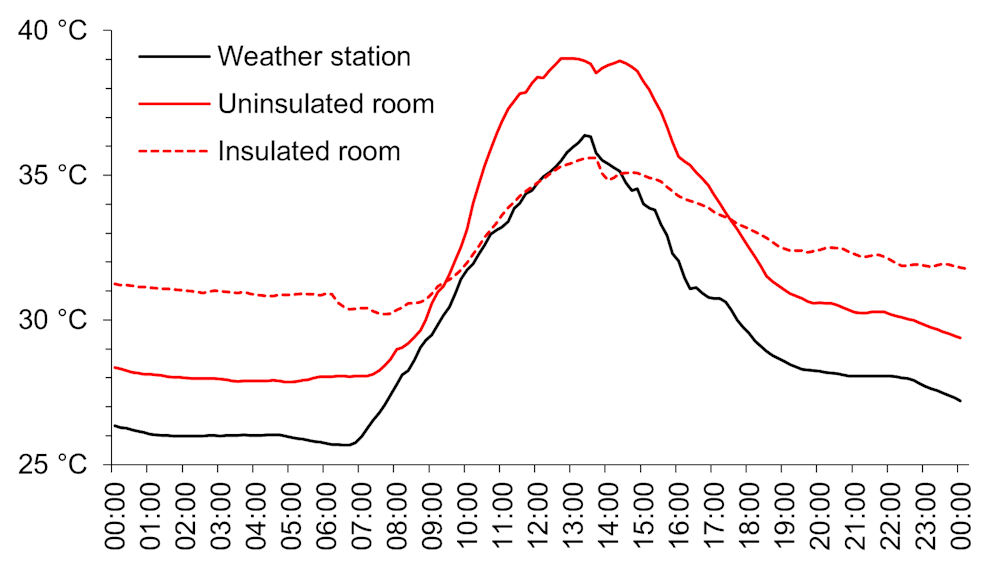
Our research showed that an insulated ceiling beneath a metal roof could hold peak indoor temperatures at their current levels even if it gets 4°C warmer outside. Unfortunately, this modification would raise night temperatures, because heat that builds up inside during the day is less able to escape at night. Already, indoor temperatures may not fall below 30°C during some nights in Accra. There’s a trade-off between lower indoor temperatures by day or by night, so affordable adaptations have to be tailored carefully to each home.
Without action, the number of unbearably hot homes is set to grow. By 2050, 68% of humanity may live in urban areas and populations in the tropics will be most exposed to extreme humid heat. We know surprisingly little about these front lines of climate change, especially within the streets and homes of low-income communities.
I will not forget that room in Accra, especially during the climate negotiations in Glasgow.
Robert Wilby, Professor of Hydroclimatic Modelling, Loughborough University
This article is republished from The Conversation under a Creative Commons license. Read the original article.