• Advertise
  • About us
  • Terms and Conditions
  • Contact us
Sunday, December 7, 2025
Australian Times News
  • News
    • Weather
    • Sport
    • Technology
    • Business & Finance
      • Currency Zone
    • Lotto Results
      • The Lott
  • Lifestyle
    • Entertainment
    • Horoscopes
    • Health & Wellness
    • Recipes
  • Travel
  • Expat Life
  • Move to Australia
No Result
View All Result
  • News
    • Weather
    • Sport
    • Technology
    • Business & Finance
      • Currency Zone
    • Lotto Results
      • The Lott
  • Lifestyle
    • Entertainment
    • Horoscopes
    • Health & Wellness
    • Recipes
  • Travel
  • Expat Life
  • Move to Australia
No Result
View All Result
Australian Times News
No Result
View All Result
Home News

Uganda election: Museveni social media ban caps violent campaign

Forty-eight hours before Ugandan voters went to the polls the country’s Communications Commission (UCC) imposed a social media blackout. It had been a bitter and violent election campaign pitting the 76-year-old veteran president, Yoweri Museveni against Robert Kyagulanyi – better known as Bobi Wine – a 38-year-old pop-star-turned-politician.

The Conversation by The Conversation
17-01-2021 18:05
in News
Heavy hand of internet regulation

Heavy hand of internet regulation Photo by Rami Al-zayat on Unsplash

Vincent Obia, Birmingham City University

Forty-eight hours before Ugandan voters went to the polls the country’s Communications Commission (UCC) imposed a social media blackout. It had been a bitter and violent election campaign pitting the 76-year-old veteran president, Yoweri Museveni against Robert Kyagulanyi – better known as Bobi Wine – a 38-year-old pop-star-turned-politician.

Museveni has been in power for 34 years and a victory in this election would be his seventh in a row in a tenure marked, say his critics, by a slide towards authoritarianism.

According to BBC reports, the shutdown affected not only popular social media sites such as Facebook, Twitter, WhatsApp, Signal and Viber, but more than 100 virtual private networks (VPN) which people were using to circumvent restrictions. The BBC also reported that the Uganda Communications Commission had ordered telecoms companies to suspend internet access altogether the evening before the January 14 election, although this information has yet to be officially verified.

It’s not the first time this has happened – a similar social media ban was ordered during the 2016 general election. Restrictions on social media were implemented in 2019 around elections or referenda in several African countries, including Togo, Burundi and Guinea.

Museveni, the self-styled liberator, led the National Resistance Movement to power in Uganda in 1986. He has ten opponents in this year’s election, but the consensus is that Wine is the most serious challenger. His National Unity Platform has led a vigorous campaign against the incumbent and Wine himself has been arrested several times in the run-up to the poll. His home was raided two days before election day.

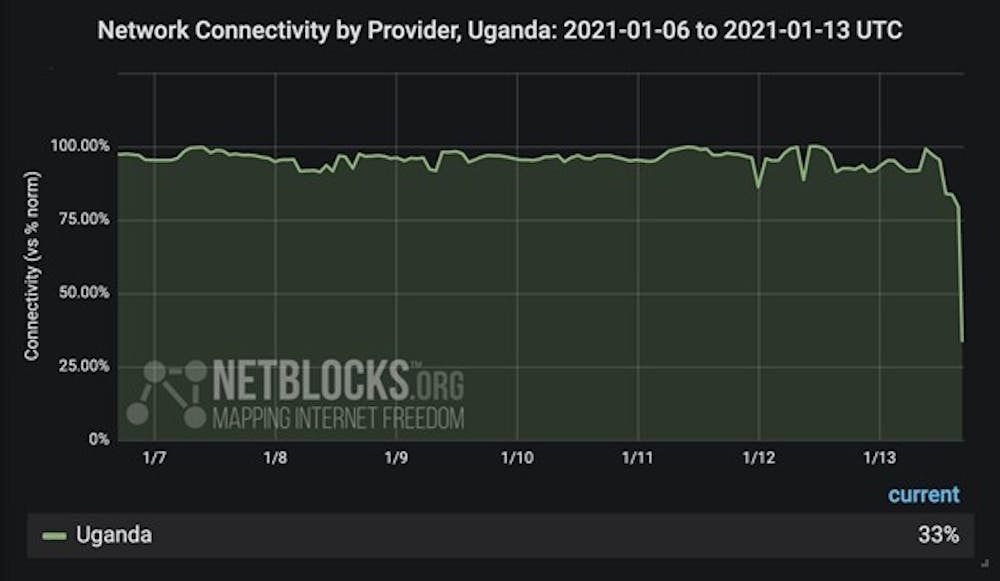
On January 13, the government ordered internet service providers to block all social media platforms and messaging apps and online activity plummeted to 33% of normal levels, according to the NetBlocks Internet Observatory.


AlsoRead...

Ryan: Building real freedom through e-commerce

Ryan: Building real freedom through e-commerce

27 November 2025
Design Australia Group: Redefining Drafting as the engine of housing growth

Design Australia Group: Redefining Drafting as the engine of housing growth

26 November 2025
Graph showing internet usage in Uganda falling sharply after social media ban.
Ugandan government’s social media ban prompted sharp fall in internet use. Netblocks, Author provided

Museveni’s press secretary, Don Wanyama, told reporters the move was made in retaliation after Facebook took down a number of pro-government accounts which it said were engaged in a coordinated campaign of misinformation.

Facebook released a statement alleging that government agencies had “used fake and duplicate accounts to manage posts, comment on other people’s content, impersonate users, re-share posts in groups to make them appear more popular than they were”.

DFRLab, a Washington-based internet watchdog, announced it had “uncovered a collection of Twitter accounts and Facebook pages engaging in suspicious online behaviour”.

Wanyama, whose own social media accounts had been suspended after the investigation, accused Facebook of bias: “It is simply a platform,” he told the BBC. “It should not morph into a political party. There must be regulation of these platforms and independent oversight bodies.”

Heavy hand of internet regulation

The latest shutdown suggests that, in trying to regulate social media, the Ugandan authorities want to manage online platforms in a similar way to broadcasters. In December 2020, the UCC wrote to Google, citing the Communications Act of 2013 as the basis for which 17 pro-opposition YouTube accounts should be suspended. Section 27 of the Act requires all broadcasters to be licensed and Section 2(c) says regulatory subjects include “any electronic representation of information”. This deliberately vague wording allows a very wide interpretation of what can be effectively controlled by the state.

It’s not the first time the UCC has used this 2013 legislation to restrict online publishers. In March 2018, the UCC cited Section 6(e) of the Act to require internet publishers and broadcasting platforms to be annually registered. In September 2020, this order was extended to “all persons currently offering or planning to commence the provision of online data communication”. Meanwhile, in July 2018, the government introduced a social media tax of 200 Shilling (US$0.05) per day on all users as a way of combatting “online gossip”.

In spite of the broad application of the act, big tech platforms such as Facebook and Twitter have not been directly targeted. Instead these recurring internet bans have targeted ISPs and telecoms providers. This is probably because these platforms are perceived as being beyond the reach of Uganda’s government control – for instance, Google pushed back against the UCC’s take-down demands, arguing that a court order would be needed before it would comply.

The Museveni government’s approach is different from efforts being made in developed countries to introduce some measure of online regulation. In the UK, the Online Harms White Paper which was published in December 2020, “sets out plans for new laws to make the UK a safer place to be online, while ensuring strong safeguards for freedom of expression”. This puts the onus on online publishers – including social media platforms – to moderate the content on their own platforms. The white paper itself was developed after a three-month consultation process in which responses from more than 2,400 stakeholders were considered.

It seems likely that, unless its approach changes with a new government, the UCC will be content to exert its influence on ordinary people and organisations within Uganda as it continues to view social media regulation through the same lens as it regards traditional media. How that will work remains to be seen.

Vincent Obia, PhD Researcher, Birmingham City University

This article is republished from The Conversation under a Creative Commons license. Read the original article.


Tags: SB001
DMCA.com Protection Status

SUBSCRIBE to our NEWSLETTER

[mc4wp_form id=”2384248″]

Don't Miss

The evolution of Aesthetic Surgery through the lens of Dr Kourosh Tavakoli

by Pauline Torongo
4 December 2025
The evolution of Aesthetic Surgery through the lens of Dr. Kourosh Tavakoli
Health & Wellness

As global interest in Australian cosmetic surgery continues to grow, the combination of regulation, research and emerging digital tools is...

Read moreDetails

Ryan: Building real freedom through e-commerce

by Pauline Torongo
27 November 2025
Ryan: Building real freedom through e-commerce
Business & Finance

Ryan’s greatest achievement isn’t any single business or revenue milestone — it’s the ecosystem he’s built through the Change community.

Read moreDetails

Design Australia Group: Redefining Drafting as the engine of housing growth

by Pauline Torongo
26 November 2025
Design Australia Group: Redefining Drafting as the engine of housing growth
Business & Finance

Australia is under pressure to build homes faster, but design bottlenecks slow progress. Design Australia Group is fixing this by...

Read moreDetails

Louis Guy Detata builds Global Trading Empires through autonomous systems and disciplined leadership

by Pauline Torongo
25 November 2025
Louis Guy Detata builds Global Trading Empires through autonomous systems and disciplined leadership
Business & Finance

The path from investment banking to leading a global trading platform has taught Louis Detata that sustainable success requires more...

Read moreDetails

Burning Eucalyptus Wood: Tips, Advantages, Disadvantages & Alternatives

by Fazila Olla-Logday
20 November 2025
Image Supplied
Enviroment

Learn about burning eucalyptus wood for stoves and fireplaces. Discover benefits, drawbacks, harvesting tips, and better alternative firewood options for...

Read moreDetails

Everything Parents Need to Know About Baby Soft Play and Why It’s a Game Changer

by Fazila Olla-Logday
11 November 2025
Everything Parents Need to Know About Baby Soft Play
Health & Wellness

Baby soft play is a fun, safe, and educational way for little ones to explore and grow. Discover the benefits...

Read moreDetails

WOMAD Sets Up a New Camp in Wiltshire – Australian festival fans take note!

by Kris Griffiths
11 November 2025
Kumbia Boruka brought their reggae and dancehall flavour to the Taste the World Stage at WOMAD 2024 - Credit - Mike Massaro
Entertainment

With its 2026 edition moving to Neston Park in England, WOMAD offers Aussie music lovers a chance to reconnect with global...

Read moreDetails
Load More

Copyright © Blue Sky Publications Ltd. All Rights Reserved.
australiantimes.co.uk is a division of Blue Sky Publications Ltd. Reproduction without permission prohibited. DMCA.com Protection Status

  • About us
  • Write for Us
  • Advertise
  • Contact us
  • T&Cs, Privacy and GDPR
No Result
View All Result
  • News
    • Weather
    • Sport
    • Technology
    • Business & Finance
      • Currency Zone
    • Lotto Results
      • The Lott
  • Lifestyle
    • Entertainment
    • Horoscopes
    • Health & Wellness
    • Recipes
  • Travel
  • Expat Life
  • Move to Australia

Copyright © Blue Sky Publications Ltd. All Rights Reserved.
australiantimes.co.uk is a division of Blue Sky Publications Ltd. Reproduction without permission prohibited. DMCA.com Protection Status

No Result
View All Result
  • News
    • Weather
    • Sport
    • Technology
    • Business & Finance
      • Currency Zone
    • Lotto Results
      • The Lott
  • Lifestyle
    • Entertainment
    • Horoscopes
    • Health & Wellness
    • Recipes
  • Travel
  • Expat Life
  • Move to Australia

Copyright © Blue Sky Publications Ltd. All Rights Reserved.
australiantimes.co.uk is a division of Blue Sky Publications Ltd. Reproduction without permission prohibited. DMCA.com Protection Status