


• Advertise
  • About us
  • Terms and Conditions
  • Contact us
Sunday, December 7, 2025
Australian Times News
  • News
    • Weather
    • Sport
    • Technology
    • Business & Finance
      • Currency Zone
    • Lotto Results
      • The Lott
  • Lifestyle
    • Entertainment
    • Horoscopes
    • Health & Wellness
    • Recipes
  • Travel
  • Expat Life
  • Move to Australia
No Result
View All Result
  • News
    • Weather
    • Sport
    • Technology
    • Business & Finance
      • Currency Zone
    • Lotto Results
      • The Lott
  • Lifestyle
    • Entertainment
    • Horoscopes
    • Health & Wellness
    • Recipes
  • Travel
  • Expat Life
  • Move to Australia
No Result
View All Result
Australian Times News
No Result
View All Result
Home News

A year of blursdays: how coronavirus distorted our sense of time in 2020

Objectively, time passes at a constant, linear rate. Subjectively, however, time waxes and wanes with our activities and emotions. Sometimes, it flies by, other times it drags so slowly that it almost stands still.

The Conversation by The Conversation
29-12-2020 18:09
in News
Coronavirus distorted our sense of time

Coronavirus distorted our sense of time Photo by Milad B. Fakurian on Unsplash

Ruth Ogden, Liverpool John Moores University

Does it feel like 2020 went on forever? Did lockdown drag, and can you even remember how you spent your time when you weren’t living under coronavirus restrictions? You are not alone. For many, 2020 has been the year in which the constancy of time was lost to the upheaval of coronavirus.

StunningArt/Shutterstock

Objectively, time passes at a constant, linear rate. Subjectively, however, time waxes and wanes with our activities and emotions. Sometimes, it flies by, other times it drags so slowly that it almost stands still.

This is backed up by research I conducted in April, which explored how the early months of the coronavirus pandemic had affected people’s experiences of the passage of time. Of particular interest was how quickly time felt like it was passing during lockdown in comparison to “normal” (that long-ago time before lockdown).

I surveyed 604 people about how quickly time felt it was passing that day and that week in comparison to before the lockdown. Participants also answered questions about their mood, family life and how busy they were to give context on the factors, which made time more likely to speed up or slow down for different people.

Tempus fugit?

My results showed that there was widespread distortion time during lockdown, with more than 80% of people reporting that time felt like it was passing differently. But lockdown did not distort time in the same way for everyone. Instead, time sped up during lockdown for 40% of people and slowed down for the remaining 40%.

Why was this? My analysis suggests that the perceived speed of time during the day was affected by a person’s age, how satisfied they were with their level of social interaction, how stressed they were and how busy they were. In general, the days passed more quickly for younger people who were socially satisfied, busy and experiencing low levels of stress. Conversely, the day passed more slowly for older people, particularly those over the age of 60, who were socially dissatisfied, stressed and lacking tasks to occupy them.


AlsoRead...

Ryan: Building real freedom through e-commerce

Ryan: Building real freedom through e-commerce

27 November 2025
Design Australia Group: Redefining Drafting as the engine of housing growth

Design Australia Group: Redefining Drafting as the engine of housing growth

26 November 2025

Similar patterns were observed for the subjective speed of the week. A fast week was associated with being younger and more socially satisfied, whereas a slow week was associated with being older and less socially satisfied.

In an illustration, hands gesture at a clock as the numbers fly off.
À la recherche du temps perdu … Alberto Andrei Rosu/Shutterstock

A second unpublished study I conducted during the November lockdown revealed that, of the 851 people surveyed, more than 75% experienced distortion to time and 55% reported that the start of the first lockdown felt longer than eight months ago. A slower second lockdown was associated with shielding, dissatisfaction with social interaction and greater depression and boredom.

The UK is not alone in its loss of time during lockdown. Studies conducted in France, Italy and Argentina also show widespread distortion to the passage of time during periods of strict COVID-19 restrictions.

Unlike in the UK, in France and Italy lockdown passed more slowly than normal for most people rather than being split 40/40 as in my April study. As in the UK, however, boredom was an important predictor of time slowing down in Italy and in France. In France, time also passed more slowly with increasing sadness.

Emotions and time

Why does being older, bored, stressed and socially dissatisfied make time pass more slowly? This question is difficult to answer.

Unlike other senses, we don’t have an obvious organ for time. Instead, time is experienced as part of other sensory inputs, such as sight and hearing, and this has made it difficult to identify precisely how the brain processes it.

One possibility is that when we are bored and socially dissatisfied we have lots of spare cognitive capacity and that we then use some of that capacity to increase our monitoring of time. This increased monitoring then results in time passing more slowly than normal, simply because we are more aware of time than normal. Another possibility is that the emotional consequence of lockdown altered the way the brain processes time.

In particular, the negative emotions associated with isolation, boredom, sadness and stress may have contributed to a slowing of time. However, inconsistent effects of depression and anxiety across studies suggests that the effect of emotion on time is complex.
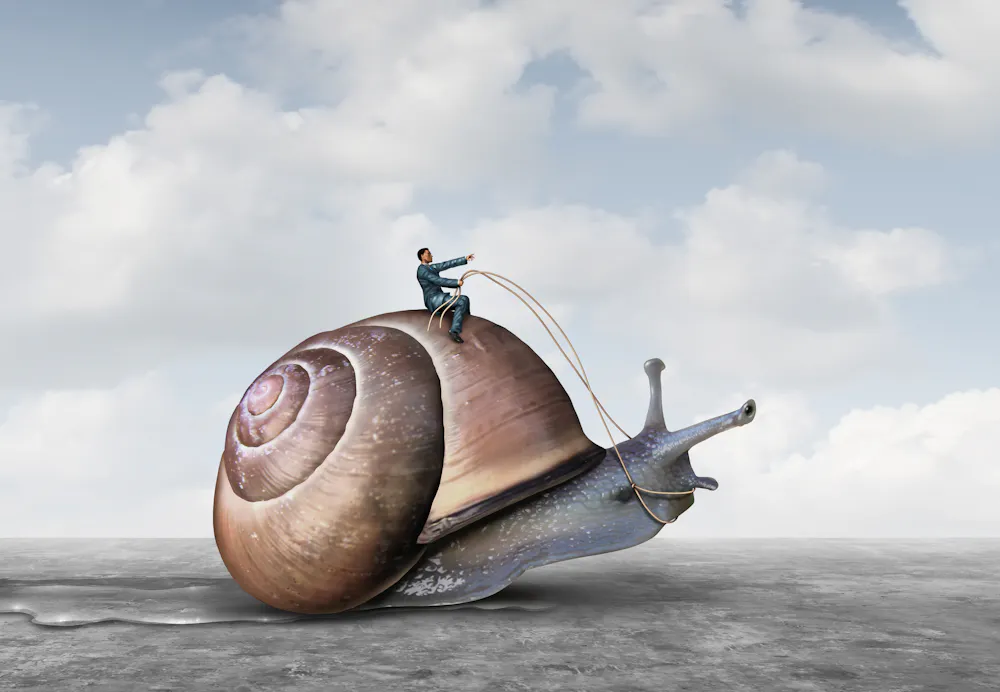
A computer generated image of a man riding a snail.
Vaccine ahoy. Lightspring/Shutterstock

So what of 2021? Will time regain its regular rhythm? It is difficult to say. With the first vaccines currently being deployed, we maybe more hopeful than ever that normality is just around the corner. The reality may be that normality is many months away.

Regardless, while we can’t change the actual time it takes for the vaccination programme to be completed, there are some things which we can do to speed up the wait. By keeping busy, minimising stress, engaging in as much face-to-face or online social interaction as we can and by reducing our stress levels, we can help the journey back to normality pass more quickly than normal.

Ruth Ogden, Senior Lecturer in Psychology, Liverpool John Moores University

This article is republished from The Conversation under a Creative Commons license. Read the original article.


Tags: SB001
DMCA.com Protection Status

SUBSCRIBE to our NEWSLETTER

[mc4wp_form id=”2384248″]

Don't Miss

The evolution of Aesthetic Surgery through the lens of Dr Kourosh Tavakoli

by Pauline Torongo
4 December 2025
The evolution of Aesthetic Surgery through the lens of Dr. Kourosh Tavakoli
Health & Wellness

As global interest in Australian cosmetic surgery continues to grow, the combination of regulation, research and emerging digital tools is...

Read moreDetails

Ryan: Building real freedom through e-commerce

by Pauline Torongo
27 November 2025
Ryan: Building real freedom through e-commerce
Business & Finance

Ryan’s greatest achievement isn’t any single business or revenue milestone — it’s the ecosystem he’s built through the Change community.

Read moreDetails

Design Australia Group: Redefining Drafting as the engine of housing growth

by Pauline Torongo
26 November 2025
Design Australia Group: Redefining Drafting as the engine of housing growth
Business & Finance

Australia is under pressure to build homes faster, but design bottlenecks slow progress. Design Australia Group is fixing this by...

Read moreDetails

Louis Guy Detata builds Global Trading Empires through autonomous systems and disciplined leadership

by Pauline Torongo
25 November 2025
Louis Guy Detata builds Global Trading Empires through autonomous systems and disciplined leadership
Business & Finance

The path from investment banking to leading a global trading platform has taught Louis Detata that sustainable success requires more...

Read moreDetails

Burning Eucalyptus Wood: Tips, Advantages, Disadvantages & Alternatives

by Fazila Olla-Logday
20 November 2025
Image Supplied
Enviroment

Learn about burning eucalyptus wood for stoves and fireplaces. Discover benefits, drawbacks, harvesting tips, and better alternative firewood options for...

Read moreDetails

Everything Parents Need to Know About Baby Soft Play and Why It’s a Game Changer

by Fazila Olla-Logday
11 November 2025
Everything Parents Need to Know About Baby Soft Play
Health & Wellness

Baby soft play is a fun, safe, and educational way for little ones to explore and grow. Discover the benefits...

Read moreDetails

WOMAD Sets Up a New Camp in Wiltshire – Australian festival fans take note!

by Kris Griffiths
11 November 2025
Kumbia Boruka brought their reggae and dancehall flavour to the Taste the World Stage at WOMAD 2024 - Credit - Mike Massaro
Entertainment

With its 2026 edition moving to Neston Park in England, WOMAD offers Aussie music lovers a chance to reconnect with global...

Read moreDetails
Load More

Copyright © Blue Sky Publications Ltd. All Rights Reserved.
australiantimes.co.uk is a division of Blue Sky Publications Ltd. Reproduction without permission prohibited. DMCA.com Protection Status

  • About us
  • Write for Us
  • Advertise
  • Contact us
  • T&Cs, Privacy and GDPR
No Result
View All Result
  • News
    • Weather
    • Sport
    • Technology
    • Business & Finance
      • Currency Zone
    • Lotto Results
      • The Lott
  • Lifestyle
    • Entertainment
    • Horoscopes
    • Health & Wellness
    • Recipes
  • Travel
  • Expat Life
  • Move to Australia

Copyright © Blue Sky Publications Ltd. All Rights Reserved.
australiantimes.co.uk is a division of Blue Sky Publications Ltd. Reproduction without permission prohibited. DMCA.com Protection Status

No Result
View All Result
  • News
    • Weather
    • Sport
    • Technology
    • Business & Finance
      • Currency Zone
    • Lotto Results
      • The Lott
  • Lifestyle
    • Entertainment
    • Horoscopes
    • Health & Wellness
    • Recipes
  • Travel
  • Expat Life
  • Move to Australia

Copyright © Blue Sky Publications Ltd. All Rights Reserved.
australiantimes.co.uk is a division of Blue Sky Publications Ltd. Reproduction without permission prohibited. DMCA.com Protection Status





