

• Advertise
  • About us
  • Terms and Conditions
  • Contact us
Wednesday, September 30, 2026
Australian Times News
  • News
    • Weather
    • Sport
    • Technology
    • Business & Finance
      • Currency Zone
    • Lotto Results
      • The Lott
  • Lifestyle
    • Entertainment
    • Horoscopes
    • Health & Wellness
    • Recipes
  • Travel
  • Expat Life
  • Move to Australia
No Result
View All Result
  • News
    • Weather
    • Sport
    • Technology
    • Business & Finance
      • Currency Zone
    • Lotto Results
      • The Lott
  • Lifestyle
    • Entertainment
    • Horoscopes
    • Health & Wellness
    • Recipes
  • Travel
  • Expat Life
  • Move to Australia
No Result
View All Result
Australian Times News
No Result
View All Result
Home News

Huge ‘battery warehouses’ could be the energy stores of the future

One of the world’s largest battery storage projects will be built on the banks of the River Thames in Essex, after the UK government recently granted permission. When it is completed in 2024, the battery will eventually store 1.3 gigawatt hours of electricity – enough to to supply more than 300 homes for a year.

The Conversation by The Conversation
24-12-2020 06:09
in News
Electrical energy storage systems

Electrical energy storage systems Photo by Danilo Alvesd on Unsplash

Andrew Cruden, University of Southampton

One of the world’s largest battery storage projects will be built on the banks of the River Thames in Essex, after the UK government recently granted permission. When it is completed in 2024, the battery will eventually store 1.3 gigawatt hours of electricity – enough to to supply more than 300 homes for a year. It may herald the beginning of an escalating race for ever bigger electrical energy storage systems.
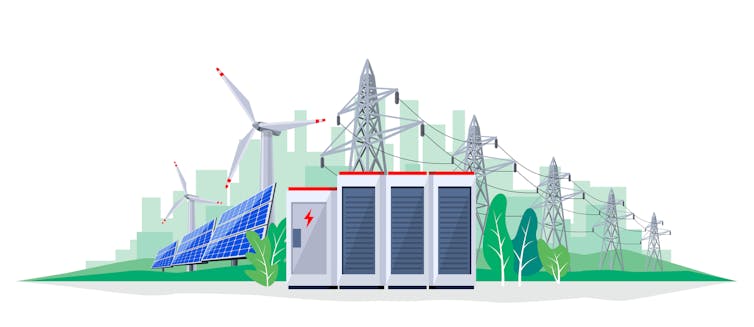
petovarga / shutterstock

This sort of storage will be needed more and more due to the rapid growth of solar and wind power which may be renewable but only generates electricity intermittently. If it can be stored, the energy produced by solar or wind farms can subsequently be used at night or when the wind doesn’t blow.

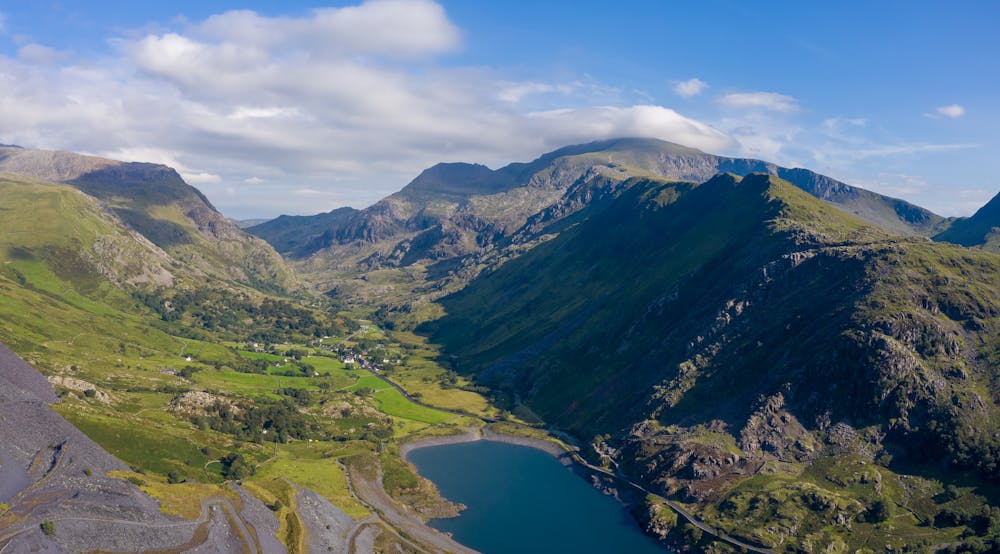
Currently, around three quarters of the UK’s energy storage is in the form of pumped hydro-electric: a reservoir’s-worth of water is pumped uphill at a time when power is cheap and demand is low, and is then released when demand surges, generating electricity as the water flows downhill through turbines. These can provide vast amounts of power for between six and 10 hours. The UK’s largest pumped-hydro power station, built in an abandoned quarry in Snowdonia national park, Wales, would be a key part of rebooting the national grid in the event of a total nationwide blackout, a so called “black start”.
A lake in between small mountains.
Sometimes called ‘electric mountain’, Dinorwig in Snowdonia is the UK’s largest pumped-hydro station. steved_np3 / shutterstock

However pumped-hydro is restricted by geography as there are only so many abandoned quarries and hillsides suitable for reservoir construction and operation. In contrast, batteries can essentially be installed wherever required.

A phone battery – but much, much larger

Large scale battery projects currently almost exclusively employ lithium-ion technology. That essentially means larger versions of the batteries you’d find in your mobile phone or laptop computer.

Typically these systems employ “pouch” cells, a vacuum packed lithium-ion cell in a plasticised aluminium sheet cover similar to vacuum packed coffee bags. These are then assembled into “modules”, typically a metal enclosure about the size of a large desktop computer, and then a large number of these modules are stored on shelving racks. It looks a bit like a large wholesale warehouse or containerised shipping system.


AlsoRead...

Mark Levin and Yael Eckstein: Celebrating 250 Years - The Bond Between America and Israel

Mark Levin and Yael Eckstein: Celebrating 250 Years – The Bond Between America and Israel

30 September 2026
How supporting Australia’s Care Workforce could strengthen care in the community

How supporting Australia’s Care Workforce could strengthen care in the community

10 September 2026

California has some of the largest lithium-ion batteries. The LS Power Gateway project in San Diego County is scheduled to store more than 1 gigawatt hour during 2021, and the huge Moss Landing system in Monterey is ultimately aiming to store 6 gigawatt hours.

When introducing new technologies like these we should consider the emissions generated through the whole life cycle of their production and use. In this regard batteries fare well: recent research looked at the overall global warming impact of eight different ways to store electricity, including as hydrogen, compressed air or in various types of batteries, and found that reused electric vehicle batteries had the lowest impact, followed by lithium-ion.

If large scale lithium-ion batteries are to be sustainable they will also need to be recycled effectively. Starter batteries in petrol cars are a nice example of what could be achieved: around 99% of the lead in these “waste” batteries can be reused to make new batteries.

Naturally lithium-ion has some competitor technologies. There are sodium sulphur batteries, which store energy in molten salt kept at high temperatures (around 300℃), or batteries based on the metal vanadium which offer a lengthy lifecycle and low flammability.

There is also developing vehicle-to-grid technology that aggregates many electric vehicles and enables bidirectional charging to essentially use them collectively as one huge battery. Currently a trial called Bus2Grid is underway in London. As the batteries are owned by whoever owns the vehicle, and so are “free” to the grid, this potentially offers the lowest cost storage. However it is yet to develop at a larger scale and will require lots more people to switch to electric vehicles.

Storing such large amounts of energy may be necessary to regulate the electricity grid, but it does come with inherent risks. A series of fires of both lithium-ion and sodium sulphur batteries highlight the dangers of this technology and the requirement for further safety improvements.

The need to transition to a clean, sustainable energy system will benefit from the regulation such large energy stores can provide. Caution and improved safety design is paramount, but surely the biggest risk is not taking any risk at all.

Andrew Cruden, Professor of Energy Technology, University of Southampton

This article is republished from The Conversation under a Creative Commons license. Read the original article.


Tags: SB001
DMCA.com Protection Status

SUBSCRIBE to our NEWSLETTER

[mc4wp_form id=”2384248″]

Don't Miss

Mark Levin and Yael Eckstein: Celebrating 250 Years – The Bond Between America and Israel

by Pauline Torongo
30 September 2026
Mark Levin and Yael Eckstein: Celebrating 250 Years - The Bond Between America and Israel
News

As America marks 250 years since the Declaration of Independence, Yael Eckstein and Mark Levin explore the biblical values and...

Read moreDetails

How supporting Australia’s Care Workforce could strengthen care in the community

by Pauline Torongo
10 September 2026
How supporting Australia’s Care Workforce could strengthen care in the community
News

Australian care funding faces growing scrutiny after a 2025 ANAO report found NDIS losses from fraud, non-compliance, and payment errors...

Read moreDetails

The Future of Work Is Changing: What HR must champion next, according to Energy Collective Co

by Pauline Torongo
28 August 2026
What HR Must Champion Next, According to Energy Collective Co
Business & Finance

Energy Collective Co examines the root causes of performance by considering how work is designed, how leadership is enacted and...

Read moreDetails

From Empathy Burnout to Body-Led Recovery: What Heidi Jane of Intuition Co. learned by living through what she teaches

by Pauline Torongo
25 August 2026
What Heidi Jane of Intuition Co. learned by living through what she teaches
Lifestyle

Recognising emotional exhaustion is only the first step. While supportive habits such as rest, time in nature, hydration, and reduced...

Read moreDetails

Why Smarter Fleet Management Is For All Modern Business Options

by Fazila Olla-Logday
29 July 2026
Smarter Fleet Management
Motoring

Operating a business that relies on vehicles is harder than ever.

Read moreDetails

Animal Communication Goes Beyond What Science Can Currently Measure: Zoologist and Spiritual teacher Artemis, the heart whisperer on what the textbooks don’t teach

by Australian Times
7 July 2026
Animal Communication Goes Beyond What Science Can Currently Measure
Lifestyle

Animal communication classes and formal training can be valuable, providing tools, structure, and guidance.

Read moreDetails

Managing Aussie Share Portfolios Abroad: Tips for Growth

by Fazila Olla-Logday
2 July 2026
Managing Aussie Share Portfolios Abroad: Tips for Growth
at

Unlock the secrets to optimizing your Aussie share portfolios abroad. Discover essential tips for growth and navigate the global market...

Read moreDetails
Load More

Copyright © Blue Sky Publications Ltd. All Rights Reserved.
australiantimes.co.uk is a division of Blue Sky Publications Ltd. Reproduction without permission prohibited. DMCA.com Protection Status

  • About us
  • Write for Us
  • Advertise
  • Contact us
  • T&Cs, Privacy and GDPR
No Result
View All Result
  • News
    • Weather
    • Sport
    • Technology
    • Business & Finance
      • Currency Zone
    • Lotto Results
      • The Lott
  • Lifestyle
    • Entertainment
    • Horoscopes
    • Health & Wellness
    • Recipes
  • Travel
  • Expat Life
  • Move to Australia

Copyright © Blue Sky Publications Ltd. All Rights Reserved.
australiantimes.co.uk is a division of Blue Sky Publications Ltd. Reproduction without permission prohibited. DMCA.com Protection Status

No Result
View All Result
  • News
    • Weather
    • Sport
    • Technology
    • Business & Finance
      • Currency Zone
    • Lotto Results
      • The Lott
  • Lifestyle
    • Entertainment
    • Horoscopes
    • Health & Wellness
    • Recipes
  • Travel
  • Expat Life
  • Move to Australia

Copyright © Blue Sky Publications Ltd. All Rights Reserved.
australiantimes.co.uk is a division of Blue Sky Publications Ltd. Reproduction without permission prohibited. DMCA.com Protection Status





