
Tim Breitbarth, Swinburne University of Technology; Adam Karg, Swinburne University of Technology, and Kasey Symons, Swinburne University of Technology
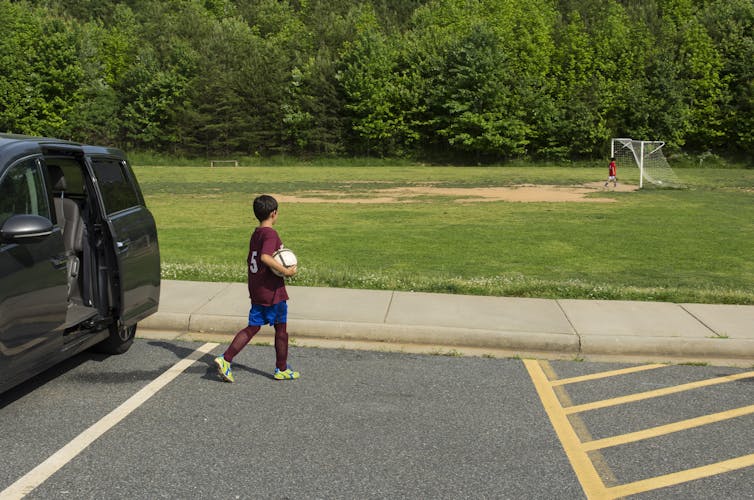
Few people would stop to consider if their sporting activities damage the environment. But our research shows Victorians use a huge chunk of their “personal carbon budget” driving to and from sport events each year – either to watch or participate, or to transport children.

To have any hope of limiting global warming to 2℃ this century – the upper limit of the Paris Agreement – each person in the developed world should only be emitting about two tonnes of CO₂ per year. We must start getting used to this lifestyle change now. But through sports-related travel alone – mostly driving – some Victorians are emitting almost one tonne of CO₂ a year.
These sport-related emissions equal the total CO₂ a person in Pakistan or Africa emits in a year.
Obviously, sport participation is to be encouraged. But Australian sport policy is usually all too quiet on its contribution to the climate emergency, and finding solutions.
Driving the climate problem
The data was gathered by our Swinburne University Sport Innovation Research Group. It is based on self-reported travel data in November 2019, from a sample of 300 people representing the Victorian population.
Travel for soccer, swimming, cricket, football, basketball and tennis featured most commonly, followed by gym, jogging, walking and golf.


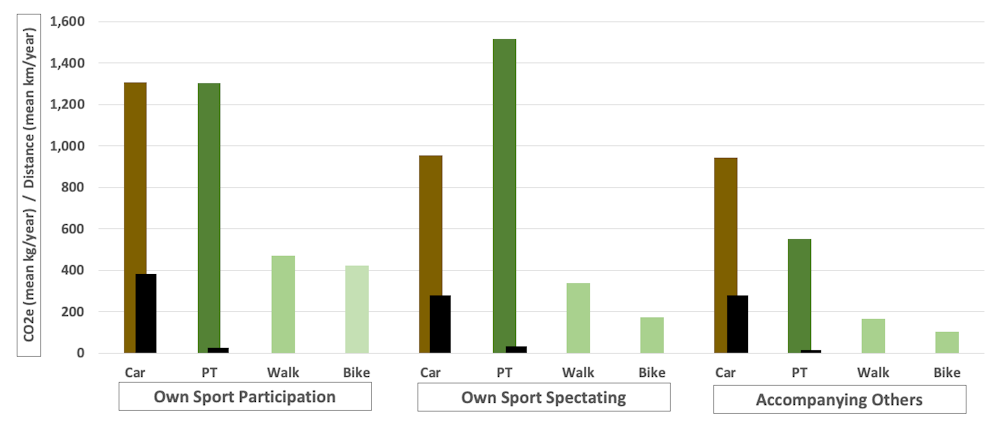
Our analysis assumed walking and biking to an activity emits no greenhouse gases. Public transport accounts for less than 0.02 kilograms per kilometre (kg/km). A combustion engine car produces an average 0.29 kg/km.
Among Victorians actively engaged in sport, 43% of mobility was related to their own participation, 36% to being a spectator and 21% to driving or accompanying others, such as children. Research into swimming clubs suggests children’s sport participation results in a bigger carbon footprint than that of adults, due to parent drop-offs and pickups.
Cars were used on 39% of all trips, and public transport on 41% of trips. This means just one of every five kilometres was walked or cycled.
Consider a person who exercises, attends sporting events as a spectator and takes their kids to the oval or swimming pool. On average, we found such a person creates 935kg (almost a tonne) of CO₂ per year if using their car. Unfortunately, COVID-19 has led to a renewed reliance on cars.
A tree, if planted today, would take more than 40 years to absorb that one tonne of carbon. Clearly, mitigating emissions should be given priority over carbon offsetting.
Such sport-related travel behaviour may be due to various factors, including:
- a long distance to sporting facilities
- sports facilities not served by public transport and not connected to safe cycle paths
- lifestyle choice and convenience
- persistent habits due to lack of awareness and role models.
Rare sporting leaders
Achieving climate action requires improving people’s “climate literacy” – their understanding of how humans are affecting the climate, and how the climate affects human systems and associated costs. Here, professional sport has a big role to play. The AFL and NFL, Swimming Australia, Cricket Australia, Football Australia, Motor Racing Australia and others can do more to promote climate literacy within and beyond their organisations.
Environmental sporting initiatives have been shown to foster loyalty and turn supporters into environmental ambassadors. And some organisations are real leaders.
For example, in 2012, German Bundesliga club VfL Wolfsburg became the first professional sports club to publish a sustainability report approved by the Global Reporting Initiative, a leading sustainability standards organisation.
Wolfsburg recently published its fifth report. It shows of the 9,500 tonnes of CO₂ produced during the 2019-20 season, fan travel was responsible for 60%, team and business travel for 6% and employee travel for 2%.
It plans to reduce emissions by 55% within the decade, while acknowledging remaining emissions must be negated through credible carbon offset schemes. Importantly, the club does not shy away from initiating discussions and positive environmental action within its industry, region and fan base.
Wolfsburg is not alone; the United Nations has declared English professional football team Forest Green Rovers the first carbon-neutral professional sports organisation. Its policies include offsetting all fan travel through certified sustainable development projects, such as a solar-powered rural electrification project.
At the time of writing, 174 sport organisations have signed the UN’s Sport for Climate Action framework. These include Tennis Australia, Bowls Australia, the Australia SailGP Team, Richmond Tigers and, most recently, the Australian Olympic Committee.
But most sport signatories – including all the Australian ones – are yet to craft “best on ground” sustainability strategies, or adopt environmental consciousness as a normal part of their business.

Turning climate literacy into innovation
Human-caused climate change and global warming will bring fundamental structural change to societies and economies.
Drastic measures could be taken to force sporting organisations to change. For example, public funding of sports could be contingent on meeting environmental targets.
Australian sports organisations should not need be dragged to taking climate and environmental action. They are known for their innovative and ambitious mindsets, which they’ve traditionally directed towards improving sporting and commercial performance.
Now it’s time sports organisations turned their collective minds to better understanding the costs and damage caused by CO₂ emissions – and finding solutions.
Tim Breitbarth, Senior Academic, Swinburne University of Technology; Adam Karg, Associate professor, Swinburne University of Technology, and Kasey Symons, Postdoctoral research fellow, Swinburne University of Technology
This article is republished from The Conversation under a Creative Commons license. Read the original article.