

• Advertise
  • About us
  • Terms and Conditions
  • Contact us
Saturday, December 6, 2025
Australian Times News
  • News
    • Weather
    • Sport
    • Technology
    • Business & Finance
      • Currency Zone
    • Lotto Results
      • The Lott
  • Lifestyle
    • Entertainment
    • Horoscopes
    • Health & Wellness
    • Recipes
  • Travel
  • Expat Life
  • Move to Australia
No Result
View All Result
  • News
    • Weather
    • Sport
    • Technology
    • Business & Finance
      • Currency Zone
    • Lotto Results
      • The Lott
  • Lifestyle
    • Entertainment
    • Horoscopes
    • Health & Wellness
    • Recipes
  • Travel
  • Expat Life
  • Move to Australia
No Result
View All Result
Australian Times News
No Result
View All Result
Home News

Coronavirus: thresholds for effective herd immunity could be lower than predicted – here’s why

Basic models for COVID-19 suggest herd immunity is achieved when 60% of people are immune. This is because in a population where everyone is susceptible to the coronavirus, an infected person is estimated to infect on average an additional 2.5 people.

The Conversation by The Conversation
05-10-2020 22:23
in News
Herd immunity could be lower than predicted

Herd immunity could be lower than predicted

Pieter Trapman, Stockholm University

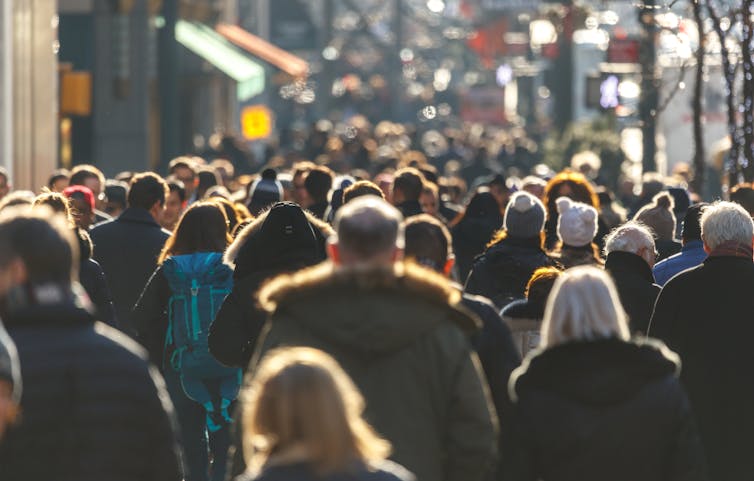
Basic models for COVID-19 suggest herd immunity is achieved when 60% of people are immune. This is because in a population where everyone is susceptible to the coronavirus, an infected person is estimated to infect on average an additional 2.5 people. Yet if 60% of those theoretical 2.5 people are immune, then only one new infection can take place, and the outbreak cannot grow.
blvdone/Shutterstock

This is based on a very simple model, though. It assumes that everyone in the population mixes to the same degree and at random. It’s unrealistic. In our research, we tried to reflect some of the diversity of behaviour found in human populations to show what effect it might have on reaching herd immunity.

We looked at two factors that influence the degree to which people mix with each other. The first was sociability.

Those who are more socially active are more likely to be infected in the early stages of an epidemic. This means that over time, naturally acquired immunity tends to be concentrated in those who make lots of social connections, while susceptibility to the disease – and the capability of spreading it – tends to be over-represented among people who make fewer connections.

As we demonstrated, this can affect when the herd immunity threshold is reached. We created an illustrative model in which 25% of people socialise half as much as the average, 50% socialise an average amount, and the remaining 25% socialise twice as much as average. When you have these different groups mixing at these different rates, the model predicts that the herd immunity threshold will be considerably lower: 46.3% instead of 60%.

If more differences between people are considered, the point at which herd immunity is reached through natural infection decreases even further. With this in mind, we considered the effect of age on social mixing.


AlsoRead...

Ryan: Building real freedom through e-commerce

Ryan: Building real freedom through e-commerce

27 November 2025
Design Australia Group: Redefining Drafting as the engine of housing growth

Design Australia Group: Redefining Drafting as the engine of housing growth

26 November 2025

People in one age group don’t mix equally with people across other age groups; across a population, socialisation follows certain trends. To roughly model this, we split the population into six age groups, and then estimated the amount of contact between them using data from a previous study on social contacts.

We found that accounting for age-specific mixing trends, together different sociability levels, lowered the herd immunity threshold a little further, to 43%.

What does this mean?

The first important thing to say is that our estimates should be interpreted only as a demonstration of how differences in behaviour can affect herd immunity. These figures aren’t exact values, or even best estimates. The activity levels and contact rates between age groups that we used in the model were simply illustrative.

The second thing to note is that we’ve only accounted for two types of variation across the population. More realistic models would be more complex, including many other factors. For example, large household sizes, school and work environments, and metropolitan living all create higher rates of person-to-person contact. In such places a greater proportion of people will get infected, and infection and immunity will be more concentrated among highly active and connected individuals.

Finally, for our model we’ve assumed that immunity doesn’t decrease over time and that it offers 100% protection. Neither of these things are necessarily true.

But what our work does seem to suggest is that most forms of variation across a population will decrease the point at which herd immunity is reached through natural infection. This means that it could be reached at a lower human cost than previously expected. In countries or areas that have already been heavily hit by the virus, herd immunity might already be close. In such places, stopping the spread of the disease might therefore only require getting people to adhere to relatively mild restrictions on social behaviour.

Some words of warning are needed though. Even if the threshold is lower, reaching herd immunity through natural infection will still require a lot of people to get infected. Though lower than initially thought, the human cost would still be very high. The city of Manaus in Brazil may be the first in the world to have reached herd immunity, but one in every 350 people infected with the virus there has died, amounting to around 2,500 deaths in total.

Finally, while variation across the population generally decreases the overall level of immunity needed, among the most active people, the fraction that needs to be infected to reach herd immunity will be more than 60%.

Pieter Trapman, Senior Lecturer in Mathematics, Stockholm University

This article is republished from The Conversation under a Creative Commons license. Read the original article.


Tags: SB001
DMCA.com Protection Status

SUBSCRIBE to our NEWSLETTER

[mc4wp_form id=”2384248″]

Don't Miss

The evolution of Aesthetic Surgery through the lens of Dr Kourosh Tavakoli

by Pauline Torongo
4 December 2025
The evolution of Aesthetic Surgery through the lens of Dr. Kourosh Tavakoli
Health & Wellness

As global interest in Australian cosmetic surgery continues to grow, the combination of regulation, research and emerging digital tools is...

Read moreDetails

Ryan: Building real freedom through e-commerce

by Pauline Torongo
27 November 2025
Ryan: Building real freedom through e-commerce
Business & Finance

Ryan’s greatest achievement isn’t any single business or revenue milestone — it’s the ecosystem he’s built through the Change community.

Read moreDetails

Design Australia Group: Redefining Drafting as the engine of housing growth

by Pauline Torongo
26 November 2025
Design Australia Group: Redefining Drafting as the engine of housing growth
Business & Finance

Australia is under pressure to build homes faster, but design bottlenecks slow progress. Design Australia Group is fixing this by...

Read moreDetails

Louis Guy Detata builds Global Trading Empires through autonomous systems and disciplined leadership

by Pauline Torongo
25 November 2025
Louis Guy Detata builds Global Trading Empires through autonomous systems and disciplined leadership
Business & Finance

The path from investment banking to leading a global trading platform has taught Louis Detata that sustainable success requires more...

Read moreDetails

Burning Eucalyptus Wood: Tips, Advantages, Disadvantages & Alternatives

by Fazila Olla-Logday
20 November 2025
Image Supplied
Enviroment

Learn about burning eucalyptus wood for stoves and fireplaces. Discover benefits, drawbacks, harvesting tips, and better alternative firewood options for...

Read moreDetails

Everything Parents Need to Know About Baby Soft Play and Why It’s a Game Changer

by Fazila Olla-Logday
11 November 2025
Everything Parents Need to Know About Baby Soft Play
Health & Wellness

Baby soft play is a fun, safe, and educational way for little ones to explore and grow. Discover the benefits...

Read moreDetails

WOMAD Sets Up a New Camp in Wiltshire – Australian festival fans take note!

by Kris Griffiths
11 November 2025
Kumbia Boruka brought their reggae and dancehall flavour to the Taste the World Stage at WOMAD 2024 - Credit - Mike Massaro
Entertainment

With its 2026 edition moving to Neston Park in England, WOMAD offers Aussie music lovers a chance to reconnect with global...

Read moreDetails
Load More

Copyright © Blue Sky Publications Ltd. All Rights Reserved.
australiantimes.co.uk is a division of Blue Sky Publications Ltd. Reproduction without permission prohibited. DMCA.com Protection Status

  • About us
  • Write for Us
  • Advertise
  • Contact us
  • T&Cs, Privacy and GDPR
No Result
View All Result
  • News
    • Weather
    • Sport
    • Technology
    • Business & Finance
      • Currency Zone
    • Lotto Results
      • The Lott
  • Lifestyle
    • Entertainment
    • Horoscopes
    • Health & Wellness
    • Recipes
  • Travel
  • Expat Life
  • Move to Australia

Copyright © Blue Sky Publications Ltd. All Rights Reserved.
australiantimes.co.uk is a division of Blue Sky Publications Ltd. Reproduction without permission prohibited. DMCA.com Protection Status

No Result
View All Result
  • News
    • Weather
    • Sport
    • Technology
    • Business & Finance
      • Currency Zone
    • Lotto Results
      • The Lott
  • Lifestyle
    • Entertainment
    • Horoscopes
    • Health & Wellness
    • Recipes
  • Travel
  • Expat Life
  • Move to Australia

Copyright © Blue Sky Publications Ltd. All Rights Reserved.
australiantimes.co.uk is a division of Blue Sky Publications Ltd. Reproduction without permission prohibited. DMCA.com Protection Status





