
• Advertise
  • About us
  • Terms and Conditions
  • Contact us
Thursday, February 5, 2026
Australian Times News
  • News
    • Weather
    • Sport
    • Technology
    • Business & Finance
      • Currency Zone
    • Lotto Results
      • The Lott
  • Lifestyle
    • Entertainment
    • Horoscopes
    • Health & Wellness
    • Recipes
  • Travel
  • Expat Life
  • Move to Australia
No Result
View All Result
  • News
    • Weather
    • Sport
    • Technology
    • Business & Finance
      • Currency Zone
    • Lotto Results
      • The Lott
  • Lifestyle
    • Entertainment
    • Horoscopes
    • Health & Wellness
    • Recipes
  • Travel
  • Expat Life
  • Move to Australia
No Result
View All Result
Australian Times News
No Result
View All Result
Home Lifestyle

Linking self-driving cars to traffic signals might help pedestrians give them the green light

Introducing autonomous vehicles might be one way to make roads safer

The Conversation by The Conversation
27-04-2020 08:32
in Lifestyle
Photo by Chris Barbalis on Unsplash

Photo by Chris Barbalis on Unsplash

Lionel Peter Robert Jr., University of Michigan

The Research Brief is a short take on interesting academic work.

The big idea

Automated vehicles don’t have human operators to communicate their driving intentions to pedestrians at intersections. My team’s research on pedestrians’ perceptions of safety shows their trust of traffic lights tends to override their fear of self-driving cars. This suggests one way to help pedestrians trust and safely interact with autonomous vehicles may be to link the cars’ driving behavior to traffic lights.

In a recent study by my team at the University of Michigan, we focused on communication via a vehicle’s driving behavior to study how people might react to self-driving cars in different situations. We set up a virtual-reality simulator that let people experience street intersections and make choices about whether to cross the street. In different simulations, self-driving cars acted either more or less like an aggressive driver. In some cases there was a traffic light controlling the intersection.

In the more aggressive mode, the car would stop abruptly at the last possible second to let the pedestrian cross. In the less aggressive mode, it would begin braking earlier, indicating to pedestrians that it would stop for them. Aggressive driving reduced pedestrians’ trust in the autonomous vehicle and made them less likely to cross the street.

However, this was true only when there was no traffic light. When there was a light, pedestrians focused on the traffic light and usually crossed the street regardless whether the car was driving aggressively. This indicates that pedestrians’ trust of traffic lights outweighs any concerns about how self-driving cars behave.

Why it matters

Introducing autonomous vehicles might be one way to make roads more safe. Drivers and pedestrians often use nonverbal communication to negotiate safe passage at crosswalks, though, and cars without drivers can’t communicate in the same way. This could in turn make pedestrians and other road users less safe, especially since autonomous vehicles aren’t yet designed to communicate with systems that make streets safer, such as traffic lights.


AlsoRead...

The evolution of Aesthetic Surgery through the lens of Dr. Kourosh Tavakoli

The evolution of Aesthetic Surgery through the lens of Dr Kourosh Tavakoli

4 December 2025
Design Australia Group: Redefining Drafting as the engine of housing growth

Design Australia Group: Redefining Drafting as the engine of housing growth

26 November 2025

Other research being done in the field

Some researchers have tried to find ways for self-driving cars to communicate with pedestrians. They have tried to use parts that cars already have, such as headlights, or add new ones, such as LED signs on the vehicle.

However, unless every car does it the same way, this strategy won’t work. For example, unless automakers agreed on how headlights should communicate certain messages or the government set rules, it would be impossible to make sure pedestrians understood the message. The same holds for new technology like LED message boards on cars. There would need to be a standard set of messages all pedestrians could understand without learning multiple systems.

Even if the vehicles communicated in the same way, several cars approaching an intersection and making independent decisions about stopping could cause confusion. Imagine three to five autonomous vehicles approaching a crosswalk, each displaying its own message. The pedestrian would need to read each of these messages, on moving cars, before deciding whether to cross.
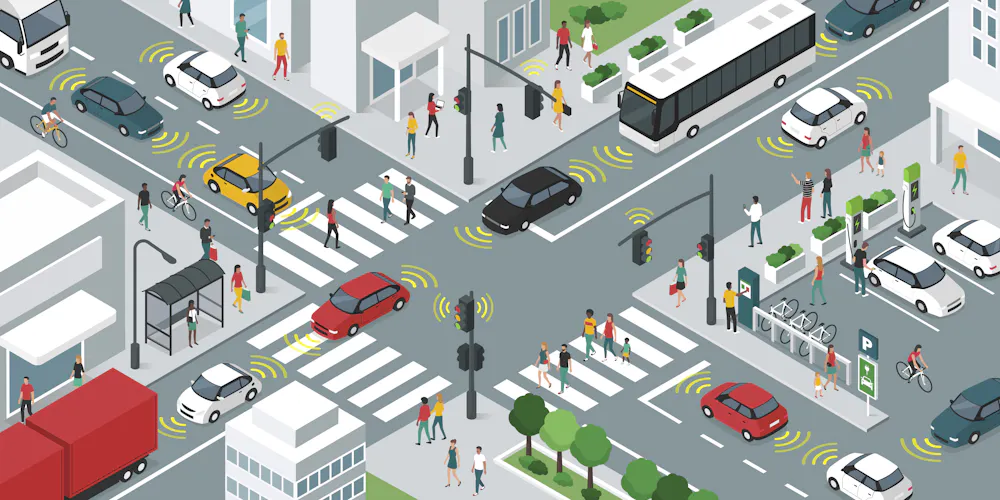
What if all vehicles were communicating with the traffic lights ahead, even before they’re visible? elenabs/iStock/Getty Images Plus

What’s next

Our results suggest a better approach would be to have the car communicate directly with the traffic signal, for two reasons.

First, pedestrians already look to and understand current traffic lights.

Second, a car can tell what a traffic light is doing much sooner by checking in over a wireless network than by waiting until its camera can see the light.

This technology is still being developed, and scholars at Michigan’s Mcity mobility research center and elsewhere are studying problems like how to send and prioritize messages between cars and signals. It might effectively put self-driving cars under traffic lights’ control, with ways to adapt to current conditions. For example, a traffic light might tell approaching cars that it was about to turn red, giving them more time to stop. On a slippery road, a car might ask the light to stay green a few seconds longer so an abrupt stop isn’t necessary.

To make this real, engineers and policymakers would need to work together on developing technologies and setting rules. Each would have to better understand what the other does. At the same time, they would need to understand that not every solution works in every region or society. For example, the best way for traffic lights and self-driving cars to communicate in Detroit might not work in Mumbai, where roads and driving practices are far different.

Lionel Peter Robert Jr., Associate Professor of Information, University of Michigan

This article is republished from The Conversation under a Creative Commons license. Read the original article.


Tags: SB001
DMCA.com Protection Status

SUBSCRIBE to our NEWSLETTER

[mc4wp_form id=”2384248″]

Don't Miss

Lyca Mobile Australia’s Customer-First Overhaul Pays Off with Finder Award Win

by Fazila Olla-Logday
2 February 2026
Lyca Mobile Australia's Customer-First Overhaul Pays Off with Finder Award Win
Technology

Lyca Mobile Australia’s customer-first overhaul has earned a Finder Award, recognising its improved value, service, and stronger focus on Australian...

Read moreDetails

From Driveway to Dream Court: The Rise of High-Performance Hoops at Home in 2026

by Fazila Olla-Logday
20 January 2026
The Rise of High-Performance Hoops at Home in 2026
Sport

High-performance home basketball hoops are gaining momentum in 2026, as more homeowners invest in durable, professional-grade systems that combine advanced...

Read moreDetails

Brandon Willington: The Marketing Entrepreneur Turning Heads Across Australia

by Pauline Torongo
8 January 2026
Brandon Willington: The Marketing Entrepreneur turning heads across Australia
Business & Finance

Brandon Willington, founder of “Where U?” is changing the narrative for Australian businesses tired of inconsistent leads and empty promises.

Read moreDetails

How Turnkey Building Group Is Restoring Trust In An Industry Known For Customer Disappointment

by Fazila Olla-Logday
17 December 2025
How Turnkey Building Group Is Restoring Trust In An Industry Known For Customer Disappointment
Business & Finance

Turnkey Building Group is changing the narrative in an industry often associated with missed deadlines and broken promises. By prioritizing...

Read moreDetails

Risk Awareness for International Travellers – What Australians Should Know Before Entering Multi-State Regions

by Fazila Olla-Logday
10 December 2025
Schengen
Travel

This guide helps Australian travellers understand cross-border requirements, assess political and environmental risks, manage health and safety considerations, and prepare...

Read moreDetails

The evolution of Aesthetic Surgery through the lens of Dr Kourosh Tavakoli

by Pauline Torongo
4 December 2025
The evolution of Aesthetic Surgery through the lens of Dr. Kourosh Tavakoli
Health & Wellness

As global interest in Australian cosmetic surgery continues to grow, the combination of regulation, research and emerging digital tools is...

Read moreDetails

Ryan: Building real freedom through e-commerce

by Pauline Torongo
27 November 2025
Ryan: Building real freedom through e-commerce
Business & Finance

Ryan’s greatest achievement isn’t any single business or revenue milestone — it’s the ecosystem he’s built through the Change community.

Read moreDetails
Load More

Copyright © Blue Sky Publications Ltd. All Rights Reserved.
australiantimes.co.uk is a division of Blue Sky Publications Ltd. Reproduction without permission prohibited. DMCA.com Protection Status

  • About us
  • Write for Us
  • Advertise
  • Contact us
  • T&Cs, Privacy and GDPR
No Result
View All Result
  • News
    • Weather
    • Sport
    • Technology
    • Business & Finance
      • Currency Zone
    • Lotto Results
      • The Lott
  • Lifestyle
    • Entertainment
    • Horoscopes
    • Health & Wellness
    • Recipes
  • Travel
  • Expat Life
  • Move to Australia

Copyright © Blue Sky Publications Ltd. All Rights Reserved.
australiantimes.co.uk is a division of Blue Sky Publications Ltd. Reproduction without permission prohibited. DMCA.com Protection Status

No Result
View All Result
  • News
    • Weather
    • Sport
    • Technology
    • Business & Finance
      • Currency Zone
    • Lotto Results
      • The Lott
  • Lifestyle
    • Entertainment
    • Horoscopes
    • Health & Wellness
    • Recipes
  • Travel
  • Expat Life
  • Move to Australia

Copyright © Blue Sky Publications Ltd. All Rights Reserved.
australiantimes.co.uk is a division of Blue Sky Publications Ltd. Reproduction without permission prohibited. DMCA.com Protection Status