
Amanda Webster, University of Wollongong
They may find it more difficult to independently complete tasks and struggle with managing their time. They are also more likely to have difficulty in writing tasks or ones involving high amounts of language and communication with others.
Children on the autism spectrum often associate specific tasks with locations. This might mean they resist doing schoolwork at home. Anxiety levels, which are often high in this group of students, may increase further due to changes in routine or uncertainty about what they should be learning.
General tips for schooling at home such as setting up a learning space, creating structure and routine, and becoming familiar with resources in the Australian Curriculum are good ideas. But parents of children on the autism spectrum may need additional strategies.
Studies of students on the autism spectrum in distance education (studying at school without being physically present) or experiencing homework difficulties suggest several helpful strategies for parents.
1. Put together a homework plan
Students learning at home will likely need to engage in independent learning tasks such as completing worksheets or writing assignments. This is somewhat similar to doing homework assigned by a teacher.


But students on the autism spectrum often do less homework than their peers. And they report finding homework too hard, frustrating and overwhelming.
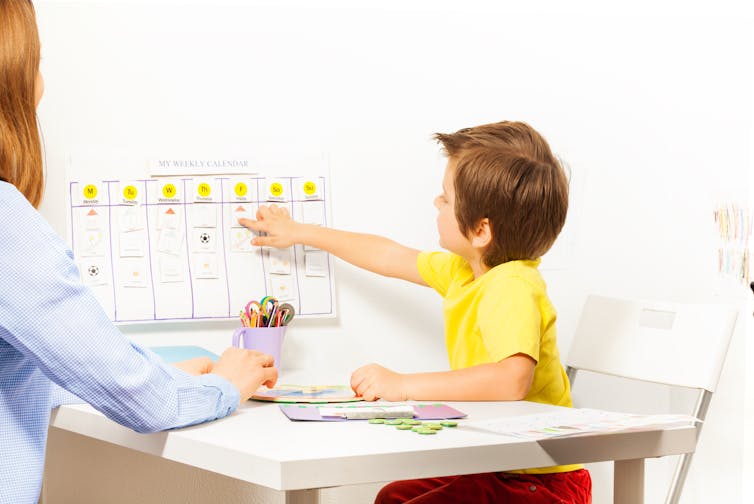
Parents helping their child may be confused about assignments from teachers if the communication is limited or unclear. Or they may find their child needs breaks and is unable to complete all their work.
These issues can increase children’s anxiety, lead to meltdowns and create tension between parents and children. Research shows creating a homework plan can help.
In a homework plan, a teacher clearly communicates to parents what the student needs to learn and which tasks can be prioritised over others.
Once parents know what specific knowledge and skills their child needs to learn, they can adjust the amount or nature of tasks to fit the needs of their child.
For example, a teacher sets out in a homework plan that at the end of the task, a student must be able to explain their knowledge about the early settlers. A parent may see their child is struggling to write a full essay.
In this case, the parent can adjust the task so their child can use puppets to tell and record the story instead.
Children on the autism spectrum may find it stressful to think about what may be going on in someone else’s mind. Using an outside tool, like a puppet, to tell another person’s story can take that pressure off.
2. Use your child’s special interests
Students on the autism spectrum often focus on special interests to calm themselves. Special interests can also be used to help them manage additional anxiety during the shutdown.
Research shows adapting teaching to incorporate students’ special interests can help students on the autism spectrum learn academic and social skills. For example, a teacher can use a student’s interest in Lego to help them learn maths skills such as fractions and measurements.

Special interests can also increase a student’s engagement in learning tasks, as they see them in the context of an activity that’s important to them.
A parent can help their child learn across the curriculum by using their special interest. For example, a student who is interested is space could work on a project in which they learn about early scientists who developed the solar system (history), write about the importance of space exploration (English, science) and design a new space station (maths, art).
3. Use technology
Technology-aided instruction can help students on the autism spectrum learn a range of skills. It can also help them understand task requirements, communicate their concerns and complete tasks.
Apps are an accessible and fairly inexpensive way to use technology. Apps may motivate students on the autism spectrum as they present information in ways that support their visual learning style.
Apps have been found to be effective in helping children on the autism spectrum learn language, literacy and numeracy skills. Apps can also be used to create schedules, checklists and language cards.
The Learning App Guide to Autism and Education provides parents with reviews for a number of apps grouped by skill areas and age groups. A parent can select the literacy group, for instance, and find apps for teaching spelling to children in lower primary grades.
4. Find ways to connect your child to others
Although students on the autism spectrum often experience difficulty in social situations, many say peer support can help make school a more positive experience. During the COVID-19 shutdown, classmates or friends can provide encouragement and information on learning tasks. This may decrease uncertainty and increase students’ confidence.
Connecting with peers on the internet is particularly well-suited to students on the autism spectrum as it reduces sensory distractions and the amount of language required.
Students can use programs such as Discord or Google Hangouts to talk to their classmates, play games and work together on assignments.
5. Seek help and don’t try to do everything
Accessing support can help parents cope with feelings of isolation and anxiety. Education departments in Tasmania and Western Australia provide parents of children on the autism spectrum with activities and curriculum information. And Queensland provides specific learning strategies.
Homeschooling Special Needs Australia helps parents connect and provides links to sites specifically set up to help them during the COVID-19 shutdown.
Parents should can also use these sites to connect with other parents. These networks can decrease parent’s stress and help them connect with their child.
Amanda Webster, Senior Lecturer, Autism and Inclusive Education, University of Wollongong
This article is republished from The Conversation under a Creative Commons license. Read the original article.