
• Advertise
  • About us
  • Terms and Conditions
  • Contact us
Wednesday, November 11, 2026
Australian Times News
  • News
    • Weather
    • Sport
    • Technology
    • Business & Finance
      • Currency Zone
    • Lotto Results
      • The Lott
  • Lifestyle
    • Entertainment
    • Horoscopes
    • Health & Wellness
    • Recipes
  • Travel
  • Expat Life
  • Move to Australia
No Result
View All Result
  • News
    • Weather
    • Sport
    • Technology
    • Business & Finance
      • Currency Zone
    • Lotto Results
      • The Lott
  • Lifestyle
    • Entertainment
    • Horoscopes
    • Health & Wellness
    • Recipes
  • Travel
  • Expat Life
  • Move to Australia
No Result
View All Result
Australian Times News
No Result
View All Result
Home News

Total solar eclipse will bring 2 minutes of darkness to Antarctica’s months of endless daylight

The Sun hasn’t set in Antarctica since October. Earth’s southernmost continent is currently experiencing a long summer’s day, one that stretches from mid-October until early April.

The Conversation by The Conversation
12-12-2021 11:53
in News

Tanya Hill, Museums Victoria

The Sun hasn’t set in Antarctica since October. Earth’s southernmost continent is currently experiencing a long summer’s day, one that stretches from mid-October until early April.

But on Saturday December 4, darkness will sweep across the ice of West Antarctica. The Moon will pass directly in front of the Sun, blocking its light and producing a total solar eclipse.

The path of totality crosses the Argentine, British and Chilean Antarctic Territories (which consist of overlapping regions), as well as the unclaimed territory known as Marie Byrd Land. Areas along the path will experience almost 2 minutes of darkness in the otherwise months-long stretch of daylight.

Meanwhile, the southern tips of South America, Africa, Australia and New Zealand will see a fairly minor partial eclipse. For South America and Africa, the eclipse will be in the early morning; for Australia and New Zealand it will happen as the Sun is setting.

The Moon’s goodnight kiss

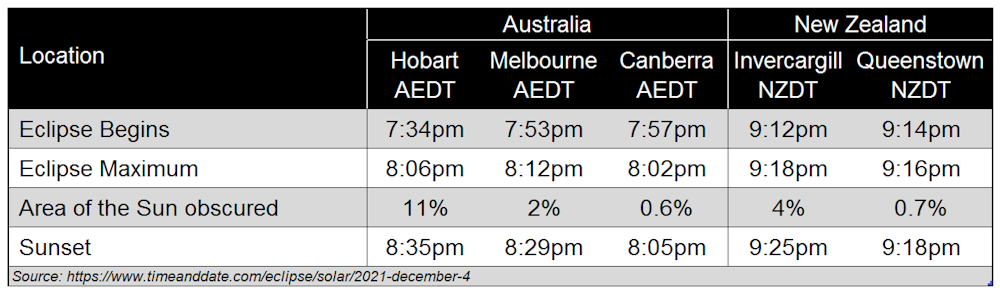
As the Sun sinks towards the horizon the Moon will appear to kiss the top-left of the Sun. Of all Australia’s capital cities, Hobart will see the largest eclipse, but even so only 11% of the Sun’s area will be covered. For Melbourne, this drops to just 2%, while in Canberra it’s hardly visible – the Sun is crossing the horizon as a tiny eclipse occurs.

It’s a similar situation in New Zealand. Invercargill will see 4% of the Sun obscured by the Moon, with the Moon passing by the Sun’s left side. But move further north to Queenstown and the eclipse is barely visible for the setting Sun.


AlsoRead...

How She Sells with Brooke helps thousands of women build new careers through high-ticket sales

How She Sells with Brooke helps thousands of women build new careers through high-ticket sales

6 October 2026
Mark Levin and Yael Eckstein: Celebrating 250 Years - The Bond Between America and Israel

Mark Levin and Yael Eckstein: Celebrating 250 Years – The Bond Between America and Israel

30 September 2026

In fact, if you weren’t aware of it, you wouldn’t even know the eclipse was happening. It’s not until about 80% or more of the Sun is obscured before we notice any change in daylight.

Star light, star bright

Solar eclipses are one astronomical event that require special care to observe. Most importantly, never look at the Sun directly – even when it’s low on the horizon.

Be sure to protect your eyes by using specially designed eclipse glasses. These glasses also allow you to see any sunspots that might be active. The Sun is currently moving from a quiet phase to an active one, as part of a cycle that repeats every 11 years. You can check websites such as Spaceweather to see what’s happening on the Sun’s surface right now.

Normally, the projection method is a great way to observe solar eclipses. This involves making a small hole in the bottom of a plastic cup or piece of cardboard. Then, with your back to the Sun, hold the cup so the sunlight passes through the hole onto a flat surface such as a piece of paper or a wall, projecting an image of the Sun on the surface.

But because this is such a minor eclipse and it will happen at sunset in eastern Australia, it may be hard to focus the Sun’s image in this way.

A great way to safely share a view of a solar eclipse. Sid/flickr

The rarity of totality

Solar eclipses are relatively rare experiences, because the Moon’s orbit is tilted by 5 degrees relative to Earth’s orbit around the Sun, so they don’t quite move in the same plane. However, roughly every six months the orbits align to produce a pair of eclipses – a lunar eclipse at Full Moon, followed by a solar eclipse at New Moon (as we are experiencing now), or vice versa.

Lunar eclipses are seen by more people because everyone on the night side of the Earth during a lunar eclipse will see the event. Solar eclipses happen just as often, but they are seen by far fewer people because the shadow created by the Moon passing in front of the Sun covers a much smaller fraction of the Earth.

Furthermore, partial solar eclipses are difficult to observe and they pale in comparison to the experience of a total solar eclipse. While total solar eclipses happen roughly every 18 months being able to see totality is rarer still.

The Moon’s shadow as it crosses the Earth is only 100-260km wide, and you have to be located within that narrow path to see the totally eclipsed Sun. This is why eclipse-chasers travel the world to be in the right place at the right time. But when totality occurs in a remote location like Antarctica it’ll be mainly the penguins who get to see it. https://www.youtube.com/embed/9Vp2jUQ4rNM?wmode=transparent&start=0

The next total solar eclipse visible from Australia will happen in April 2023. The band of totality will just clip Australia near Exmouth at the tip of the North West Cape in Western Australia.

But many more Aussies and New Zealanders will get to see a total solar eclipse on July 22 2028. Totality will stretch across Australia, from the top of WA down through New South Wales, passing directly over Sydney. It will also cross the South Island of New Zealand, passing through Queenstown and Dunedin.

Tanya Hill, Honorary Fellow of the University of Melbourne and Senior Curator (Astronomy), Museums Victoria

This article is republished from The Conversation under a Creative Commons license. Read the original article.


Tags: SB001
DMCA.com Protection Status

SUBSCRIBE to our NEWSLETTER

[mc4wp_form id=”2384248″]

Don't Miss

NRMA welcomes dogs at four NSW South Coast Holiday Parks

by Pauline Torongo
22 October 2026
NRMA welcomes dogs at four NSW South Coast Holiday Parks
Lifestyle

Pet-friendly stays and nearby beaches give families more coastal holiday options as Australian caravan and camping trips reach record levels.

Read moreDetails

How She Sells with Brooke helps thousands of women build new careers through high-ticket sales

by Pauline Torongo
6 October 2026
How She Sells with Brooke helps thousands of women build new careers through high-ticket sales
Business & Finance

More than 3,000 women have joined She Sells with Brooke Triplett to build careers in high-ticket sales. For many, the...

Read moreDetails

Qualities to look for in a Caribbean Luxury Cruise Experience

by Pauline Torongo
6 October 2026
Qualities to look for in a Caribbean Luxury Cruise Experience. Image: Supplied
Travel

Luxury Caribbean cruises are often associated with beaches, sunshine, and tropical ease, but they can be more than that with...

Read moreDetails

Mark Levin and Yael Eckstein: Celebrating 250 Years – The Bond Between America and Israel

by Pauline Torongo
30 September 2026
Mark Levin and Yael Eckstein: Celebrating 250 Years - The Bond Between America and Israel
News

As America marks 250 years since the Declaration of Independence, Yael Eckstein and Mark Levin explore the biblical values and...

Read moreDetails

How supporting Australia’s Care Workforce could strengthen care in the community

by Pauline Torongo
10 September 2026
How supporting Australia’s Care Workforce could strengthen care in the community
News

Australian care funding faces growing scrutiny after a 2025 ANAO report found NDIS losses from fraud, non-compliance, and payment errors...

Read moreDetails

The Future of Work Is Changing: What HR must champion next, according to Energy Collective Co

by Pauline Torongo
28 August 2026
What HR Must Champion Next, According to Energy Collective Co
Business & Finance

Energy Collective Co examines the root causes of performance by considering how work is designed, how leadership is enacted and...

Read moreDetails

From Empathy Burnout to Body-Led Recovery: What Heidi Jane of Intuition Co. learned by living through what she teaches

by Pauline Torongo
25 August 2026
What Heidi Jane of Intuition Co. learned by living through what she teaches
Lifestyle

Recognising emotional exhaustion is only the first step. While supportive habits such as rest, time in nature, hydration, and reduced...

Read moreDetails
Load More

Copyright © Blue Sky Publications Ltd. All Rights Reserved.
australiantimes.co.uk is a division of Blue Sky Publications Ltd. Reproduction without permission prohibited. DMCA.com Protection Status

  • About us
  • Write for Us
  • Advertise
  • Contact us
  • T&Cs, Privacy and GDPR
No Result
View All Result
  • News
    • Weather
    • Sport
    • Technology
    • Business & Finance
      • Currency Zone
    • Lotto Results
      • The Lott
  • Lifestyle
    • Entertainment
    • Horoscopes
    • Health & Wellness
    • Recipes
  • Travel
  • Expat Life
  • Move to Australia

Copyright © Blue Sky Publications Ltd. All Rights Reserved.
australiantimes.co.uk is a division of Blue Sky Publications Ltd. Reproduction without permission prohibited. DMCA.com Protection Status