Pierre Omaly, Centre national d’études spatiales (CNES)
On Monday 15 November, Russia destroyed one of its old satellites in an anti-satellite missile test.
The impact created a cloud of space debris in an area of space through which the International Space Station regularly passes, and members of the ISS were forced to seek safety in their spacecraft in the immediate aftermath of the test.
The US 18th Space Control Squadron confirmed the breakup of the COSMOS-1408 satellite on November 16. It estimates that there could be around 1,500 new pieces of debris floating through space as a result of the incident.
There is a vast amount of debris circulating in Earth’s orbit: it is one of the inherent consequences of human activity in space.
The first debris arrived in 1957 with the launch of Sputnik-1. More than 5,000 launches have taken place since then – generating 23,200 catalogued objects larger than 10 centimetres across, which represent 99% of the total mass in orbit, more than 8,000 tonnes.
The launches have also generated about 740,000 objects between 1 and 10 centimetres in size, as well as more than 160,000 objects between 0.1 and 1 centimetres.


In recent years, new satellite constellations launched by private companies have put more objects into orbit than the country of France has in its entire history.
The dangers of space debris
In Earth’s orbit, there are operational satellites, end-of-life satellites, abandoned launch vehicle stages and fragments of all sizes, mainly from accidental or deliberate explosions or the ageing of materials in space.
Objects in low orbit (an altitude of less than 2,000km) travel at very high velocity. At eight kilometres per second, a piece of debris can inflict significant damage on an operational satellite in the event of a collision.
Two major events have generated a significant amount of the space debris currently in orbit. In 2007, China deliberately destroyed one its own satellites in an anti-missile weapon test, with 3,527 pieces of identified debris still in orbit in March 2021. Then, in 2009, the the American satellite Iridium 33 and the Russian satellite Cosmos 2251 collided in orbit. This event alone doubled the amount of debris over 10 centimetres currently circulating.
Some of the pieces of unidentified debris (those smaller than 10 centimetres) came down and burned up on re-entering the atmosphere. Despite this, there are probably still a number that cannot be seen because they are too small but which nevertheless pose a danger to operational satellites.
Space debris can also pose a risk on the ground if large fragments fall back to Earth. Statistically, one large piece of debris falls to the Earth’s surface every week (mostly into the sea).
To date there have been no fatalities caused by falling space debris. One person was reportedly hit on the shoulder in the United States in 1997, and a piece of debris over 10 metres long from a Chinese rocket fell to Earth in Cote d’Ivoire in 2020.
Monitoring debris
In order to combat the proliferation of dangerous debris, a number of agencies voluntarily monitor Earth’s orbit.
The French National Centre for Space Studies, where I work, uses data from the 18th Space Control Squadron, to which we add data from the European GRAVES Space Surveillance System that detects debris in low orbit – between 400km and 1,000km in altitude. These observations are supplemented by military radars and data from the air force.
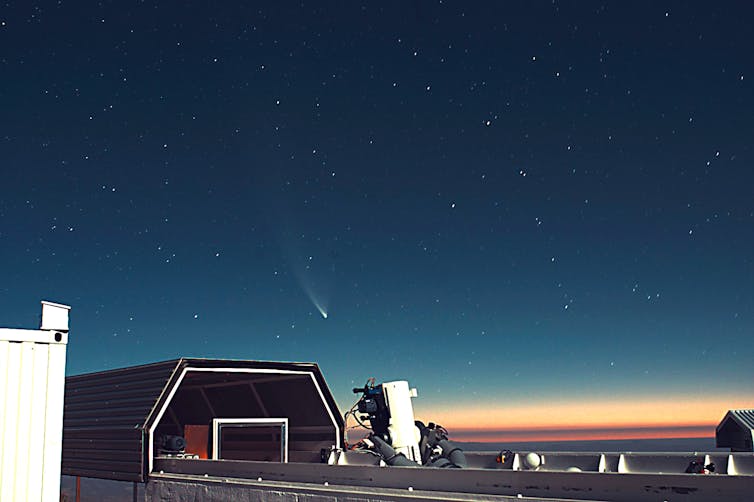
For geostationary orbit – the zone 36,000km from the equator – US military information is supplemented by observations from telescopes like those in the TAROT network. Image processing allows us to detect objects and calculate their trajectories. The accuracy of this trajectory is improved with each new observation, which makes it possible to assess the risk of collision.
Unfortunately, it is only possible to intervene on space objects that have their own propulsion system. Based on radar measurements, trajectories are propagated over time and the risk of collision is assessed.
The clean-up
As well as avoiding collisions, there is also work underway on a number of technologies that will eventually enable us to remove debris from space.
Last December, the European Space Agency signed a contract with the Swiss start-up Clear Space to carry out the first space debris removal mission. And in March, Astroscale, a private Singaporean company launched ELSA-d, a demonstration mission to clean up debris in orbit.
Still, prevention is the best approach to avoid large amounts of space debris accumulating. The United Nations has set out anti-proliferation rules, which are simple:
- Do not produce debris in orbit intentionally
- Remove all energy sources from satellites at the end of their life (by jettisoning the fuel that could generate other debris by exploding during a collision)
- Respect the “25-year rule” for satellites in low-earth orbit, which states that satellites must re-enter the atmosphere within 25 years of the end of their operational life
- Respect the “graveyard orbit” for geostationary satellites (an orbit path that avoids operational satellites).
These rules make it possible to begin to control the increase in debris, but they are applied progressively and with the diligence of each state. There are many satellites or launch vehicle stages of older generations in space that do not comply with these rules and remain a cause for concern.
As this latest incident shows, the need for regulation is becoming increasingly important. This is especially the case with the advent satellite megaconstellations and the proliferation of low-cost nanosatellites.
Pierre Omaly, Expert débris spatiaux et responsable de l’initiative Tech 4 Space Care, Centre national d’études spatiales (CNES)
This article is republished from The Conversation under a Creative Commons license. Read the original article.