

• Advertise
  • About us
  • Terms and Conditions
  • Contact us
Saturday, December 6, 2025
Australian Times News
  • News
    • Weather
    • Sport
    • Technology
    • Business & Finance
      • Currency Zone
    • Lotto Results
      • The Lott
  • Lifestyle
    • Entertainment
    • Horoscopes
    • Health & Wellness
    • Recipes
  • Travel
  • Expat Life
  • Move to Australia
No Result
View All Result
  • News
    • Weather
    • Sport
    • Technology
    • Business & Finance
      • Currency Zone
    • Lotto Results
      • The Lott
  • Lifestyle
    • Entertainment
    • Horoscopes
    • Health & Wellness
    • Recipes
  • Travel
  • Expat Life
  • Move to Australia
No Result
View All Result
Australian Times News
No Result
View All Result
Home News

COP26: meat eating is a big climate issue – but isn’t getting the attention it deserves

UK prime minister Boris Johnson launched the COP26 climate summit in Glasgow with the mantra of “coal, cars, cash and trees”. But thus far the summit has largely ignored the elephant in the room. Or rather, the cows, pigs, chickens and fish.

The Conversation by The Conversation
10-11-2021 09:17
in News
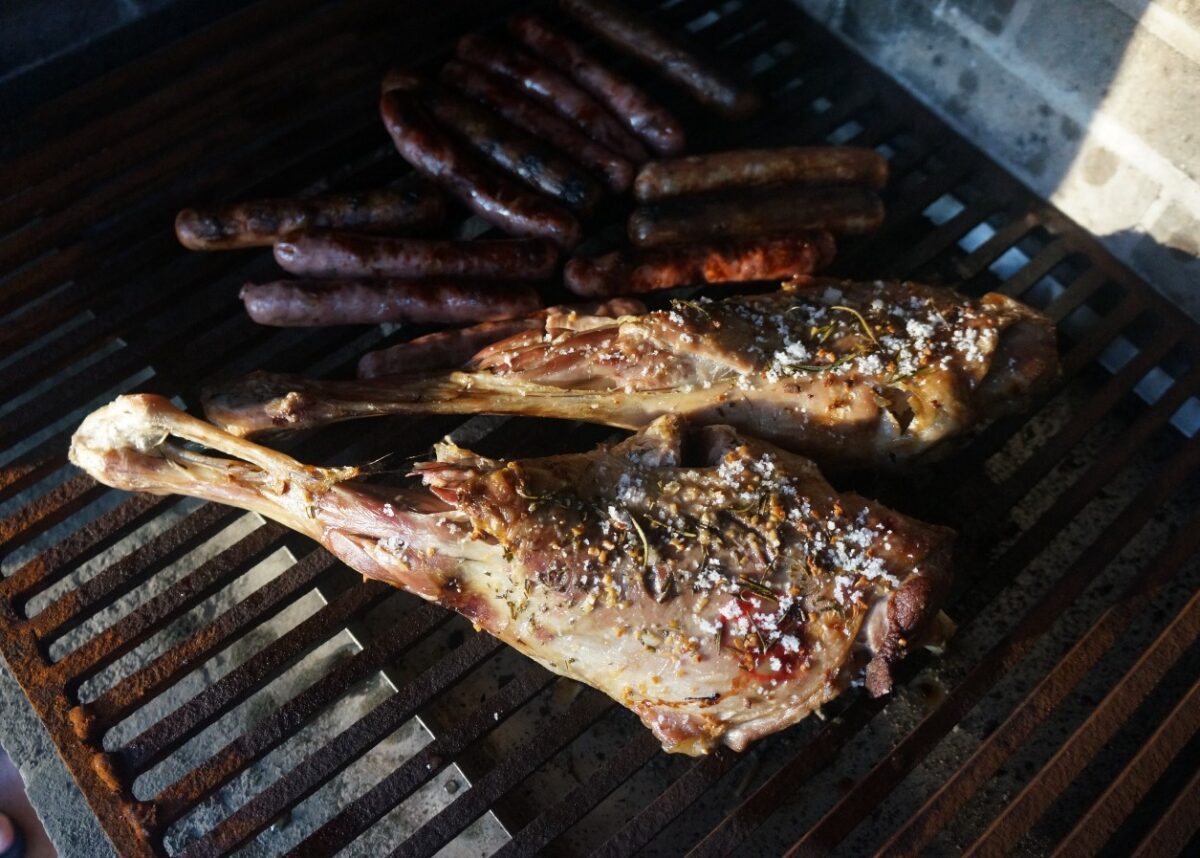
Photo by Keep Your Darlings on Unsplash

Photo by Keep Your Darlings on Unsplash

Emma Garnett, University of Cambridge

UK prime minister Boris Johnson launched the COP26 climate summit in Glasgow with the mantra of “coal, cars, cash and trees”. But thus far the summit has largely ignored the elephant in the room. Or rather, the cows, pigs, chickens and fish.

The global food system is currently responsible for about a quarter of all human made greenhouse gases, a figure that is projected to increase. The increase in food system emissions alone threatens warming above 1.5℃. There is no doubt we need to stop burning fossil fuels, but reducing livestock consumption in high- and middle-income countries is also vital to both protect the climate and restore nature.

Governments at COP26 have pledged to halt deforestation and cut methane emissions 30% by 2030. Eating lots of meat is a big driver of both, but so far no reduction targets have been announced. The pledge to protect nature signed by 45 governments didn’t mention meat consumption at all, while the US agriculture secretary claimed in an interview that Americans don’t need to produce or eat less meat at all.

Here are four reasons why less meat (and dairy) on our plates needs to be on the table at COP26.

1. Livestock have high carbon footprints

It is not very efficient to feed plants to livestock when we could eat the plants directly ourselves. Even though cows, sheep and goats can eat grass, unlike humans, they still need lots of land for grazing which could otherwise store more carbon dioxide as natural forests, grasslands or bogs, or in some cases be used to grow plant crops for human consumption. These animals also produce substantial amounts of methane in their digestive systems, which is a powerful greenhouse gas.

The carbon footprint of beef and lamb is roughly three times higher than that of pork, poultry or farmed fish per 100g of protein, and 24 times higher than pulses such as beans and lentils. Livestock produces just 18% of global calories and 37% of protein, but is responsible for more than half of food’s greenhouse gas emissions.


AlsoRead...

Ryan: Building real freedom through e-commerce

Ryan: Building real freedom through e-commerce

27 November 2025
Design Australia Group: Redefining Drafting as the engine of housing growth

Design Australia Group: Redefining Drafting as the engine of housing growth

26 November 2025

Small amounts of meat and dairy have a role in sustainable food systems, while some plants have quite high environmental impacts and some nuts use lots of water. But in general, even meat with the lowest carbon footprints still has higher emissions than the highest emitting plant-based foods which are high in protein.
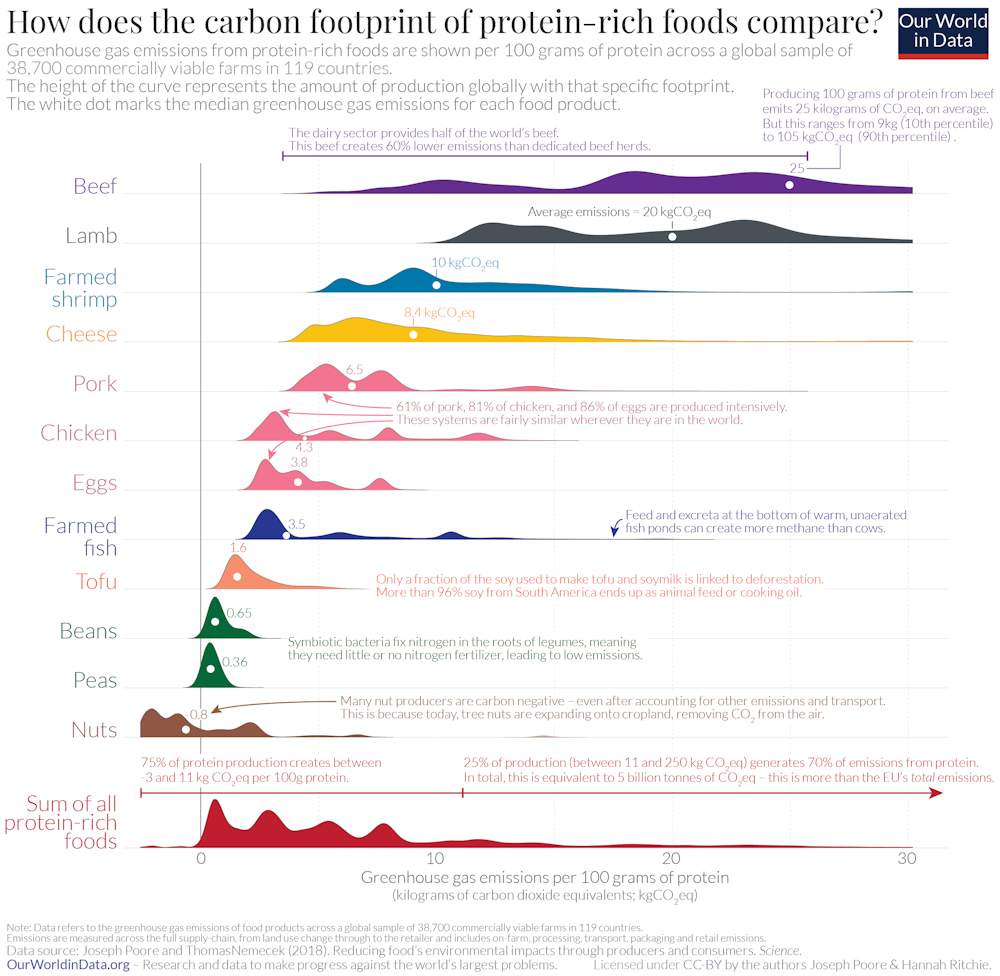
Graph showing carbon footprint of various protein foods
Beef and lamb are by far the most carbon-intensive sources of protein. Some nuts can even be carbon negative, if the nut trees are grown on former croplands. Data: Poore and Nemecek, Science; Chart: Our World in Data, CC BY-SA

2. Reducing livestock production would protect nature

Farmland takes up 50% of Earth’s habitable land, and the vast majority of that farmland is used for livestock and their feed. Farming is the leading cause of natural habitat loss, which is the biggest threat to wildlife. Beef production is the top driver of tropical forest loss.

Eating more meat means that more natural habitat needs to be cleared and deforested, and the diets of people in high- and middle-income countries can be key drivers of global deforestation. Conversely, reducing meat consumption would free up land which could be restored to benefit people and wildlife, and store carbon.
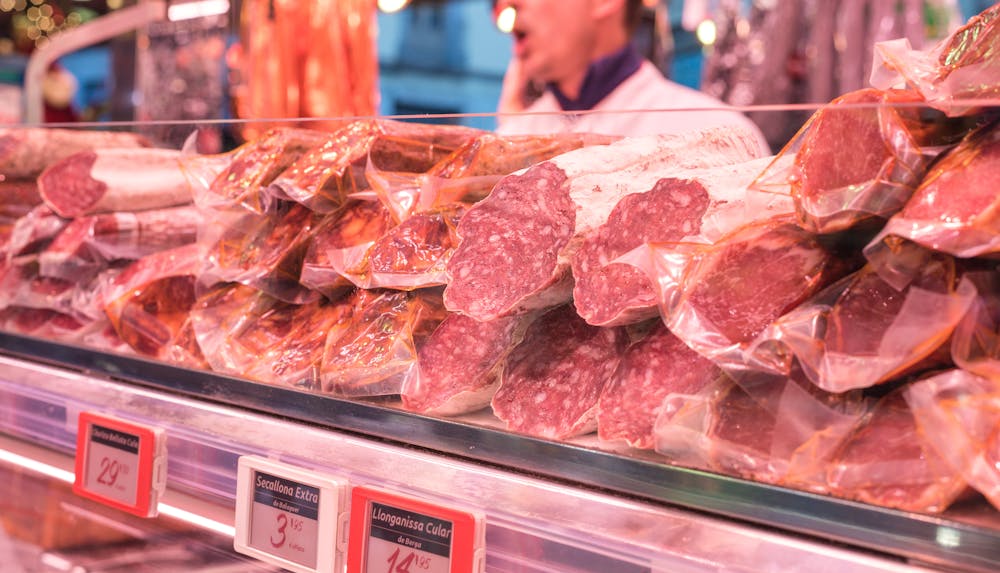
Meat on a shelf in a fridge
Meat production requires land, animal feed, water and other resources. Poberezhna / shutterstock

3. Meat production has quadrupled since the 1960s

Since 1961, meat production worldwide has quadrupled as meat supply per person has almost doubled (from 23kg to more than 43kg) and the human population has more than doubled (from 3 billion to 7 billion).

The number of animals slaughtered each year has consequently skyrocketed. The number of chickens killed each year has increased tenfold since the 1960s (from 6.6 billion to 68.8 billion), pigs have almost quadrupled (0.4 billion to 1.5 billion) and cows have increased from 0.2 billion to 0.3 billion.

Meat consumption is also very unevenly distributed. Just as richer countries tend to have higher greenhouse gas emissions, they also tend to eat more meat. For example, the average US citizen is supplied with 124kg of meat a year, whereas in China, Nigeria and India it’s 61kg, 7kg and 4kg respectively.
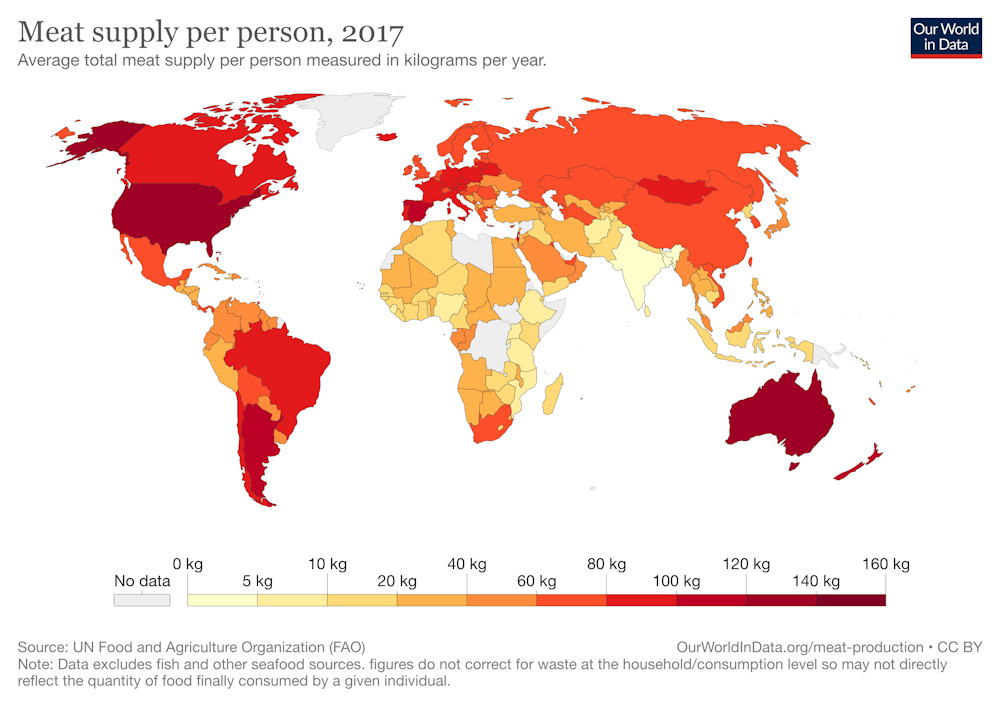
Map of meat supply by country.
A map of global meat supply looks similar to a map of carbon footprints or average incomes. FAO / Our World in Data, CC BY-SA

4. More sustainable means more healthy

Healthy and sustainable diets broadly overlap: diets with small amounts of red and processed meat, and high in vegetables, wholegrains and pulses. There are some important exceptions: oily fish benefits health but the fuel used by fishing boats means it generally has higher greenhouse gas emissions than plant-based proteins, while many fish populations are overfished. Sugar, on the other hand, has a relatively low environmental impact but doesn’t have any nutritional value besides calories.

The Planetary Health Diet – a healthy diet designed to minimise environmental damage – recommends on average three small portions of meat, two small portions of fish and seven glasses of milk a week. However, many of the poorest people in low-income countries eat less meat and fish than this or don’t have access to healthy alternative foods. They could benefit from increasing, not decreasing, the amount of animal products they eat. This makes it even more vital that people eating lots of meat, fish and dairy cut back.

There are many different policies that could make healthy and sustainable diets more accessible. These include removing subsidies for livestock farming, helping livestock farmers to transition to alternative farming systems, making menus mostly plant-based, and promoting behaviour changes through prominent positioning and cheaper prices for healthy and sustainable food. Education and public information – while important – won’t be enough by themselves. We need to step up to the plate: the planet depends on it.

COP26: the world's biggest climate talks

This story is part of The Conversation’s coverage on COP26, the Glasgow climate conference, by experts from around the world.
Amid a rising tide of climate news and stories, The Conversation is here to clear the air and make sure you get information you can trust. More.


Emma Garnett, Sustainability Research Fellow, University of Cambridge

This article is republished from The Conversation under a Creative Commons license. Read the original article.


Tags: SB001
DMCA.com Protection Status

SUBSCRIBE to our NEWSLETTER

[mc4wp_form id=”2384248″]

Don't Miss

The evolution of Aesthetic Surgery through the lens of Dr Kourosh Tavakoli

by Pauline Torongo
4 December 2025
The evolution of Aesthetic Surgery through the lens of Dr. Kourosh Tavakoli
Health & Wellness

As global interest in Australian cosmetic surgery continues to grow, the combination of regulation, research and emerging digital tools is...

Read moreDetails

Ryan: Building real freedom through e-commerce

by Pauline Torongo
27 November 2025
Ryan: Building real freedom through e-commerce
Business & Finance

Ryan’s greatest achievement isn’t any single business or revenue milestone — it’s the ecosystem he’s built through the Change community.

Read moreDetails

Design Australia Group: Redefining Drafting as the engine of housing growth

by Pauline Torongo
26 November 2025
Design Australia Group: Redefining Drafting as the engine of housing growth
Business & Finance

Australia is under pressure to build homes faster, but design bottlenecks slow progress. Design Australia Group is fixing this by...

Read moreDetails

Louis Guy Detata builds Global Trading Empires through autonomous systems and disciplined leadership

by Pauline Torongo
25 November 2025
Louis Guy Detata builds Global Trading Empires through autonomous systems and disciplined leadership
Business & Finance

The path from investment banking to leading a global trading platform has taught Louis Detata that sustainable success requires more...

Read moreDetails

Burning Eucalyptus Wood: Tips, Advantages, Disadvantages & Alternatives

by Fazila Olla-Logday
20 November 2025
Image Supplied
Enviroment

Learn about burning eucalyptus wood for stoves and fireplaces. Discover benefits, drawbacks, harvesting tips, and better alternative firewood options for...

Read moreDetails

Everything Parents Need to Know About Baby Soft Play and Why It’s a Game Changer

by Fazila Olla-Logday
11 November 2025
Everything Parents Need to Know About Baby Soft Play
Health & Wellness

Baby soft play is a fun, safe, and educational way for little ones to explore and grow. Discover the benefits...

Read moreDetails

WOMAD Sets Up a New Camp in Wiltshire – Australian festival fans take note!

by Kris Griffiths
11 November 2025
Kumbia Boruka brought their reggae and dancehall flavour to the Taste the World Stage at WOMAD 2024 - Credit - Mike Massaro
Entertainment

With its 2026 edition moving to Neston Park in England, WOMAD offers Aussie music lovers a chance to reconnect with global...

Read moreDetails
Load More

Copyright © Blue Sky Publications Ltd. All Rights Reserved.
australiantimes.co.uk is a division of Blue Sky Publications Ltd. Reproduction without permission prohibited. DMCA.com Protection Status

  • About us
  • Write for Us
  • Advertise
  • Contact us
  • T&Cs, Privacy and GDPR
No Result
View All Result
  • News
    • Weather
    • Sport
    • Technology
    • Business & Finance
      • Currency Zone
    • Lotto Results
      • The Lott
  • Lifestyle
    • Entertainment
    • Horoscopes
    • Health & Wellness
    • Recipes
  • Travel
  • Expat Life
  • Move to Australia

Copyright © Blue Sky Publications Ltd. All Rights Reserved.
australiantimes.co.uk is a division of Blue Sky Publications Ltd. Reproduction without permission prohibited. DMCA.com Protection Status

No Result
View All Result
  • News
    • Weather
    • Sport
    • Technology
    • Business & Finance
      • Currency Zone
    • Lotto Results
      • The Lott
  • Lifestyle
    • Entertainment
    • Horoscopes
    • Health & Wellness
    • Recipes
  • Travel
  • Expat Life
  • Move to Australia

Copyright © Blue Sky Publications Ltd. All Rights Reserved.
australiantimes.co.uk is a division of Blue Sky Publications Ltd. Reproduction without permission prohibited. DMCA.com Protection Status





