



Mark Howden, Australian National University
At the United Nations climate summit in Glasgow, more than 90 nations signed a global pledge led by the United States and United Kingdom to cut methane emissions. However, Australia was not among them.
China, Russia, India and Iran also declined to sign the pledge, which aims to slash methane emissions by 30% before 2030.
Methane is emitted in coal and gas production, from livestock and other agricultural activity, and when organic waste breaks down in landfill.
Almost half of Australia’s annual methane emissions come from the agriculture sector. Defending the federal government’s decision, Energy and Emissions Reduction Minister Angus Taylor said Australia had pledged net-zero greenhouse gas emissions by 2050 and would not set specific targets for each sector.
Days out from COP26, National Party leader Barnaby Joyce had claimed signing the pledge would be a disaster for coal mining and agriculture, saying “the only way you can get your 30% by 2030 reduction in methane on 2020 levels would be to grab a rifle and go out and start shooting your cattle”.
Australia’s position on the pledge is inconsistent with methane reductions the Intergovernmental Panel on Climate Change (IPCC) says are required to keep Earth below 1.5℃ warming this century.


The debate also highlights how the shorthand phrase “net-zero emissions” conceals and distorts the real challenges in avoiding dangerous climate change.
It focuses attention on the wrong time frame for action – the next decade is far more important for climate action than 2050. It also addresses the means of action – emissions reduction – rather than the desired goal, which is to avoid dangerous climate change.
And importantly, simply through delaying action, the world could feasibly reduce emissions to net-zero by 2050, but still fail to meet the goals of the Paris Agreement – keeping average global temperature rise below either 1.5℃ or 2℃ this century.
Net-zero is both too much, and not enough
The IPCC report released in August painted a clear picture of how different trajectories for various greenhouse gases translate to global temperature increases.
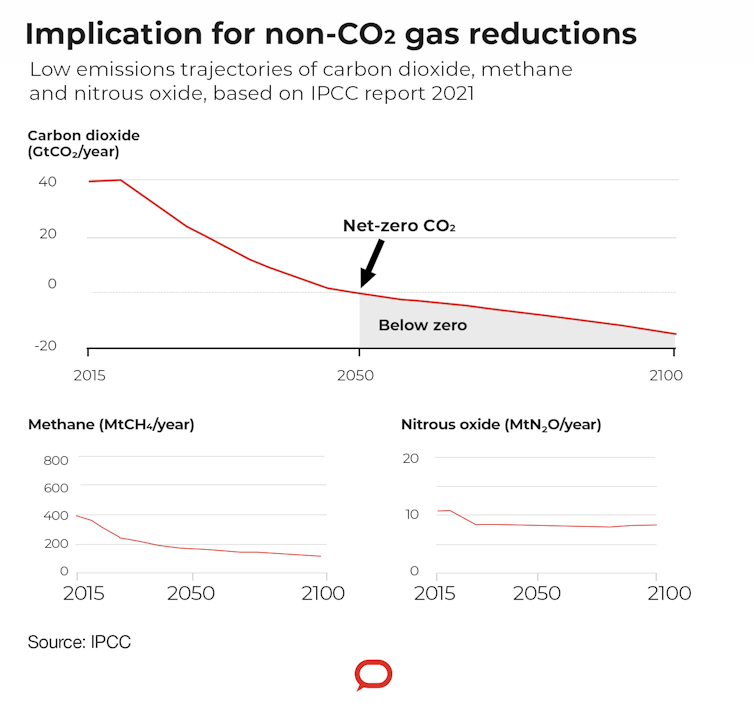
Carbon dioxide (CO₂) emissions last a very long time in the atmosphere so they accumulate. Consequently, net CO₂ emissions need to decline sharply as soon as possible if we’re to limit temperatures to 1.5℃ or 2℃ above pre-industrial levels.
However, CO₂ emissions not only need to reach net-zero – the IPCC says CO₂ emissions need to go “net-negative”. This will require a massive scaling up of methods and technologies to remove existing CO₂ in the atmosphere.
In other words, when it comes to CO₂, net-zero is not enough. It is a way point, not the end point.
So how do we remove CO₂ from the atmosphere? Some methods, such as mass tree planting, are already widely implemented. Some are difficult to implement at scale, such as substantial increases in soil carbon.
Others are in the exploratory stages including incorporating captured CO₂ into building products and high-value materials or in the ocean.
Each option has advantages, disadvantages and limits. The “net-zero by 2050” terminology obscures this complexity. It also conceals the need for crucial discussions about feasibility, governance and support for research and development that’s needed now.
Meanwhile, the situation is quite different for shorter-lived gases such as methane and nitrous oxide. In those cases, going all the way to net-zero is not needed to meet the Paris goals.
According to the IPCC report, an illustrative scenario consistent with 1.5℃ warming would involve methane emission reductions of about 30% by 2030, 50% by 2050 and just over 60% by 2100.
This is consistent with the global methane pledge signed at COP26 overnight. For nitrous oxide, the illustrative reductions would be about 30% by 2050.
So, for methane and nitrous oxide, net-zero is too much.
Targets based on science
It should be noted, to keep temperature rise to 1.5℃, there are many possible combinations of emission-reduction trajectories for various greenhouse gases. The extent to which CO₂, methane or nitrous oxide is reduced is interchangeable and the final mix will be a function of political decisions.
A clear and integrated assessment of the economic, environmental and social consequences of different emission-reduction pathways is needed to inform those decisions. Without that, inefficient and inequitable economic responses may result.
For example, methane (from livestock) and nitrous oxide (from fertiliser use) make up a high proportion of agriculture emissions. But options for completely stopping these emissions are limited.
Farmers could offset their emissions by planting trees or rehabilitating vegetation on their properties to increase carbon stores. But this would prevent them from selling those emissions reductions on carbon markets, thus removing a potential source of farm income.
So an economy-wide target of net-zero for all key greenhouse gases might mean agriculture must make far more effort in emissions reduction, at much greater cost, than other sectors which largely emit CO₂ and where decarbonisation options are more readily available.

New Zealand has recognised this, and treats agricultural emissions separately.
Carving agriculture out of national emissions-reduction goals would place a greater requirement to act onto other sectors. For example, emission reductions in the transport sector may have to be greater than otherwise, to compensate for the lack of progress in agriculture.
But is isolating agriculture from emission reductions necessary? A recent study assessed new emission reduction options for livestock, including several approaches that together may reduce emissions at the rate required by the methane pledge. They involve more efficient production, technological advances, changes in demand for livestock-related products and land-based carbon storage.
These are approaches already being adopted by industry groups and farmers.
Towards ‘Paris-aligned’
Targets for methane and nitrous oxide reductions should be set using the IPCC science – and don’t have to be set at net-zero. That would leave sectors emitting these gases with a feasible (but still challenging) pathway to reducing emissions in line with the Paris goals.
And where appropriate, we should start describing effective climate action as being “Paris-aligned”. Clearly, over-use of the term “net-zero emissions” misdirects attention from where it’s needed.
Mark Howden, Director, ANU Institute for Climate, Energy and Disaster Solutions, Australian National University
This article is republished from The Conversation under a Creative Commons license. Read the original article.







