



Fresh emissions targets from Saudi Arabia and Australia – two of the world’s largest fossil-fuel producers – are due to arrive just in time for global climate talks in Glasgow. These would commit the two countries to reducing domestic emissions to net zero by around mid-century – though both are expected to continue exporting fossil fuels for decades to come.
For the leaders of countries and governments that produce fossil fuels, UN climate summits are a public relations boon. They get to talk up their commitments to a green and clean future without being held to account for their disproportionate role in fuelling the problem. It’s hard for experts, let alone the average citizen, to tell fact from fiction.
Because it’s only domestic greenhouse gas emissions that are counted for the purpose of the UN climate negotiations, burning exported fossil fuels counts towards the emissions of the importing country. Accordingly, the role that major fossil fuel exporters like Saudi Arabia (oil and natural gas) and Australia (coal and natural gas) play in stoking global heating is not accurately reflected in the talks.
Unlike some areas of international cooperation, like limiting the spread of nuclear weapons, climate-change summits aim to control something which evades easy calculation. Nuclear weapons and their production facilities are tangible, chunky and relatively few in number. Greenhouse gases are everywhere, invisible and caused by lots of different processes – from cow digestion to steel production.
These gases are also in constant flux. Emissions are produced from ubiquitous sources, but there are also natural systems – especially forests and soil – that suck carbon dioxide (CO₂) from the atmosphere. These natural removals of carbon are known as sinks. That is why scientists and governments speak of net greenhouse gas emissions: emissions minus removals.
It’s relatively easy to monitor aggregate levels of CO₂ in the global atmosphere. This is why scientists have a clear picture of how badly off-track the world is with tackling the climate crisis. But all this complexity concerning sources and sinks makes it easy for governments and corporations to obfuscate their real contribution to climate change.


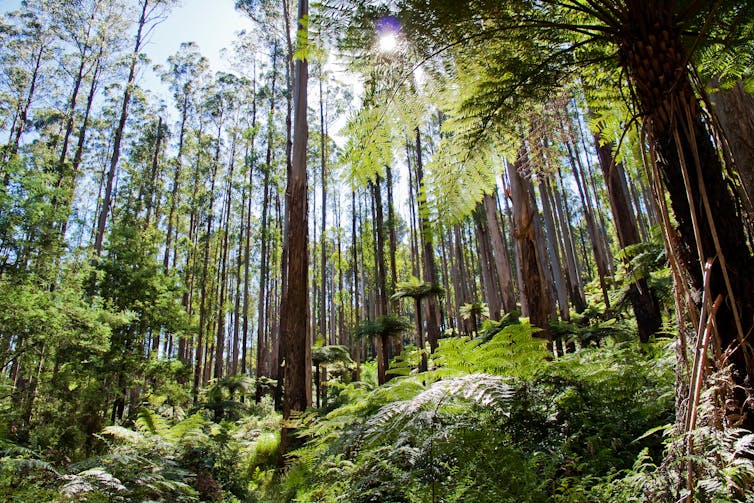
For example, countries with lots of uninhabited land, like Australia, have become especially adept at gaming the systems of accounting for net emissions of CO₂. Australia effectively gets credited for large amounts of carbon stored in forests, which make it look like overall emissions have been falling, even though emissions from burning fossil fuels have been growing for decades.
One sure-fire way of telling whether a government official is hoodwinking you when lauding their government’s climate credentials is to look upstream and see whether they’re producing the coal, oil or gas that ultimately causes about three-quarters of global emissions, and if so, what they’re doing about it.
Extracted fossil fuels are much easier to monitor and verify than greenhouse gas emissions. They come from a relatively small number of sources and are already measured by multiple parties for a range of purposes. Customers need proof that the shipments they receive reflect their contracts with suppliers. Governments collect production information to assess a company’s compliance with licensing requirements, tax liabilities and customs obligations.
Fossil-fuel infrastructure and projects are even easier to monitor. Oil rigs, gas pipelines and coal mines are large, making them easy to see both on the ground and via satellite. These features make it simpler to hold fossil fuel-producing countries to account for their contribution to global heating, compared with the more slippery measure of net emissions.
The fossil fuel production gap
In a new report, the UN Environment Programme and other research institutions found that governments plan to produce more than twice the amount of fossil fuels in 2030 than would be consistent with limiting warming to 1.5°C above pre-industrial levels – the goal of the Paris Agreement. Countries’ fossil-fuel production plans and projections in aggregate even exceed, by close to 10%, the levels of global fossil-fuel production implied by their own climate pledges.

Shockingly, governments are pouring fuel on the fire. G20 countries have directed more than US$300 billion (£218 billion) in new funds towards supporting fossil-fuel production, such as subsidies and tax breaks, since the beginning of the pandemic – about 10% more than they have invested in clean energy.
The report echoes recent calls for greater transparency around fossil-fuel production and the support – financial and otherwise – governments provide at home and abroad. Research by various organisations has provided a better understanding of this, but the information is incomplete, inconsistent and scattered.
Governments could help by disclosing plans, funding and projections for fossil-fuel production, and how they intend to manage a just transition away from coal, oil and gas. Fossil-fuel companies should disclose their spending and infrastructure plans, as well as all the greenhouse gas emissions their product is responsible for, and financial risks to their business from climate change.
Numerous environmental organisations are working to build a global picture of the sources and flows of fossil fuels. So even if governments fail to illuminate the activities of fossil-fuel companies and their role in it, they can still be named and shamed.
Talking only about a country’s net greenhouse gas emissions gives fossil fuel-producing companies and governments a free pass to bullshit their way through the climate negotiations. If we want to force the PR managers to really earn their money, we should turn the conversation to fossil-fuel production.
Fergus Green, Lecturer in Political Theory and Public Policy, UCL
This article is republished from The Conversation under a Creative Commons license. Read the original article.







