


• Advertise
  • About us
  • Terms and Conditions
  • Contact us
Wednesday, November 11, 2026
Australian Times News
  • News
    • Weather
    • Sport
    • Technology
    • Business & Finance
      • Currency Zone
    • Lotto Results
      • The Lott
  • Lifestyle
    • Entertainment
    • Horoscopes
    • Health & Wellness
    • Recipes
  • Travel
  • Expat Life
  • Move to Australia
No Result
View All Result
  • News
    • Weather
    • Sport
    • Technology
    • Business & Finance
      • Currency Zone
    • Lotto Results
      • The Lott
  • Lifestyle
    • Entertainment
    • Horoscopes
    • Health & Wellness
    • Recipes
  • Travel
  • Expat Life
  • Move to Australia
No Result
View All Result
Australian Times News
No Result
View All Result
Home News

Microplastics are in the air we breathe and in Earth’s atmosphere, and they affect the climate

Microplastics are found in the most remote places on land and in the ocean as well as in our food. Now several studies around the world have confirmed they are also present in the air we breathe.

The Conversation by The Conversation
21-10-2021 09:17
in News
Photo by Sören Funk on Unsplash

Photo by Sören Funk on Unsplash

Laura Revell, University of Canterbury

Microplastics are found in the most remote places on land and in the ocean as well as in our food. Now several studies around the world have confirmed they are also present in the air we breathe.

In our research, published today, we investigated for the first time how airborne microplastics behave in the atmosphere and whether they contribute to a warming or cooling of Earth’s climate system.

Other types of airborne particles (aerosols) such as dust, sea spray and soot either scatter or absorb sunlight, and as a consequence they cool or warm the climate system. We found microplastics do both.

In this first study to link airborne microplastics and climate change, we highlight just how widespread microplastic pollution is and the potential it has to influence climate on a global scale.

The current concentration of microplastics in the atmosphere is low and they have only a very small influence on global climate at this point. But given projections for a doubling of plastic waste over coming decades, we expect microplastics could have a larger impact on Earth’s climate system, unless we take action to address plastic pollution.


A plastic cycle

Microplastics are tiny fragments or fibres shed during the degradation of larger pieces of plastic. They are light enough to be transported by the wind over large distances.


AlsoRead...

How She Sells with Brooke helps thousands of women build new careers through high-ticket sales

How She Sells with Brooke helps thousands of women build new careers through high-ticket sales

6 October 2026
Mark Levin and Yael Eckstein: Celebrating 250 Years - The Bond Between America and Israel

Mark Levin and Yael Eckstein: Celebrating 250 Years – The Bond Between America and Israel

30 September 2026

Recently, researchers have confirmed microplastics in remote mountain catchments, in Arctic snow and in conservation areas. Earlier this year, we reported them in atmospheric fallout collected in New Zealand.
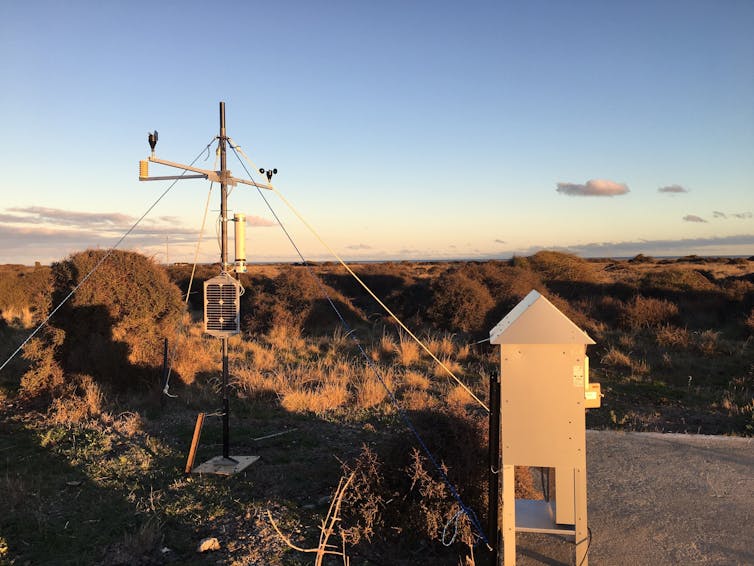
A sampling site to record microplastic fallout.
Microplastic sampling at Kaitorete Spit in Canterbury. Alex Aves, Author provided

Other studies have shown that once microplastic pollutants enter the ocean, they don’t necessarily remain there but can leave the sea with sea spray and, driven by wind currents, return to the atmosphere.

This has led us to think of a plastic cycle: microplastics don’t stay in soils, rivers, the ocean or air, but move between different parts of the Earth system.


Initially, we expected airborne microplastics would scatter sunlight like most aerosols, which act like tiny disco balls and reflect sunlight back to space. This has a cooling effect on Earth’s climate.

Most types of aerosols in Earth’s atmosphere scatter light – therefore in general, aerosols have partially offset greenhouse gas warming in recent decades. One exception is soot (or black carbon), which is good at absorbing sunlight and has a warming effect.

We found that, overall, airborne microplastics are efficient at scattering sunlight, which implies a cooling effect on climate. However, they can also absorb radiation emitted by the Earth, which means they contribute, in a very small way, to the greenhouse effect.

Microplastic impacts on climate

The highest reported concentrations of airborne microplastics (thousands of fragments per cubic metre of air) were measured at urban sampling sites in London and Beijing.

We don’t know yet how far up into the atmosphere microplastics have reached, but an aircraft-based study found them at altitudes of up to 3.5 kilometres.

This presents additional questions whether microplastics could alter atmospheric chemistry by providing surfaces for chemical reactions to occur on, and how they interact with clouds.
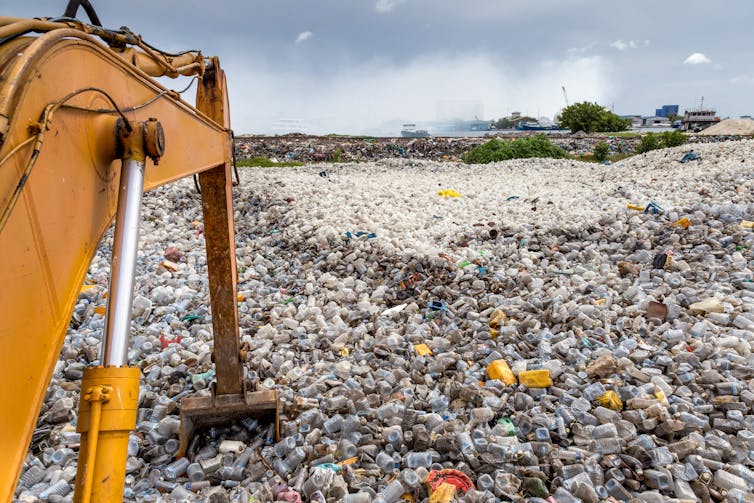
Piles of plastic waste in a landfill
Billions of tonnes of plastic waste are already in landfills and the environment, degrading into smaller fragments. Shutterstock/Mohamed Abdulraheem

The magnitude of microplastics’ influence on climate varies in our climate model simulations, depending on assumptions we made about how the plastic fragments are distributed throughout Earth’s atmosphere.

Because airborne microplastics research is so new, we had a limited number of studies to inform our research.

Our study shows the influence of microplastics on global climate is currently very small, and a cooling effect dominates. However, we expect it to increase in future, to the point that airborne microplastics exert a climate influence comparable to other types of aerosols.


An estimated 5 billion tonnes of plastic waste has already accumulated in landfills or the environment to date. This figure is projected to double over the next three decades. Without serious efforts to address microplastic pollution, mismanaged plastic waste will continue to increase the abundance of airborne microplastics, and their influence on the climate in the future.

Laura Revell, Senior Lecturer in Environmental Physics, University of Canterbury

This article is republished from The Conversation under a Creative Commons license. Read the original article.


Tags: SB001
DMCA.com Protection Status

SUBSCRIBE to our NEWSLETTER

[mc4wp_form id=”2384248″]

Don't Miss

NRMA welcomes dogs at four NSW South Coast Holiday Parks

by Pauline Torongo
22 October 2026
NRMA welcomes dogs at four NSW South Coast Holiday Parks
Lifestyle

Pet-friendly stays and nearby beaches give families more coastal holiday options as Australian caravan and camping trips reach record levels.

Read moreDetails

How She Sells with Brooke helps thousands of women build new careers through high-ticket sales

by Pauline Torongo
6 October 2026
How She Sells with Brooke helps thousands of women build new careers through high-ticket sales
Business & Finance

More than 3,000 women have joined She Sells with Brooke Triplett to build careers in high-ticket sales. For many, the...

Read moreDetails

Qualities to look for in a Caribbean Luxury Cruise Experience

by Pauline Torongo
6 October 2026
Qualities to look for in a Caribbean Luxury Cruise Experience. Image: Supplied
Travel

Luxury Caribbean cruises are often associated with beaches, sunshine, and tropical ease, but they can be more than that with...

Read moreDetails

Mark Levin and Yael Eckstein: Celebrating 250 Years – The Bond Between America and Israel

by Pauline Torongo
30 September 2026
Mark Levin and Yael Eckstein: Celebrating 250 Years - The Bond Between America and Israel
News

As America marks 250 years since the Declaration of Independence, Yael Eckstein and Mark Levin explore the biblical values and...

Read moreDetails

How supporting Australia’s Care Workforce could strengthen care in the community

by Pauline Torongo
10 September 2026
How supporting Australia’s Care Workforce could strengthen care in the community
News

Australian care funding faces growing scrutiny after a 2025 ANAO report found NDIS losses from fraud, non-compliance, and payment errors...

Read moreDetails

The Future of Work Is Changing: What HR must champion next, according to Energy Collective Co

by Pauline Torongo
28 August 2026
What HR Must Champion Next, According to Energy Collective Co
Business & Finance

Energy Collective Co examines the root causes of performance by considering how work is designed, how leadership is enacted and...

Read moreDetails

From Empathy Burnout to Body-Led Recovery: What Heidi Jane of Intuition Co. learned by living through what she teaches

by Pauline Torongo
25 August 2026
What Heidi Jane of Intuition Co. learned by living through what she teaches
Lifestyle

Recognising emotional exhaustion is only the first step. While supportive habits such as rest, time in nature, hydration, and reduced...

Read moreDetails
Load More

Copyright © Blue Sky Publications Ltd. All Rights Reserved.
australiantimes.co.uk is a division of Blue Sky Publications Ltd. Reproduction without permission prohibited. DMCA.com Protection Status

  • About us
  • Write for Us
  • Advertise
  • Contact us
  • T&Cs, Privacy and GDPR
No Result
View All Result
  • News
    • Weather
    • Sport
    • Technology
    • Business & Finance
      • Currency Zone
    • Lotto Results
      • The Lott
  • Lifestyle
    • Entertainment
    • Horoscopes
    • Health & Wellness
    • Recipes
  • Travel
  • Expat Life
  • Move to Australia

Copyright © Blue Sky Publications Ltd. All Rights Reserved.
australiantimes.co.uk is a division of Blue Sky Publications Ltd. Reproduction without permission prohibited. DMCA.com Protection Status