

• Advertise
  • About us
  • Terms and Conditions
  • Contact us
Saturday, December 6, 2025
Australian Times News
  • News
    • Weather
    • Sport
    • Technology
    • Business & Finance
      • Currency Zone
    • Lotto Results
      • The Lott
  • Lifestyle
    • Entertainment
    • Horoscopes
    • Health & Wellness
    • Recipes
  • Travel
  • Expat Life
  • Move to Australia
No Result
View All Result
  • News
    • Weather
    • Sport
    • Technology
    • Business & Finance
      • Currency Zone
    • Lotto Results
      • The Lott
  • Lifestyle
    • Entertainment
    • Horoscopes
    • Health & Wellness
    • Recipes
  • Travel
  • Expat Life
  • Move to Australia
No Result
View All Result
Australian Times News
No Result
View All Result
Home News

We are ignoring the true cost of water-guzzling data centres

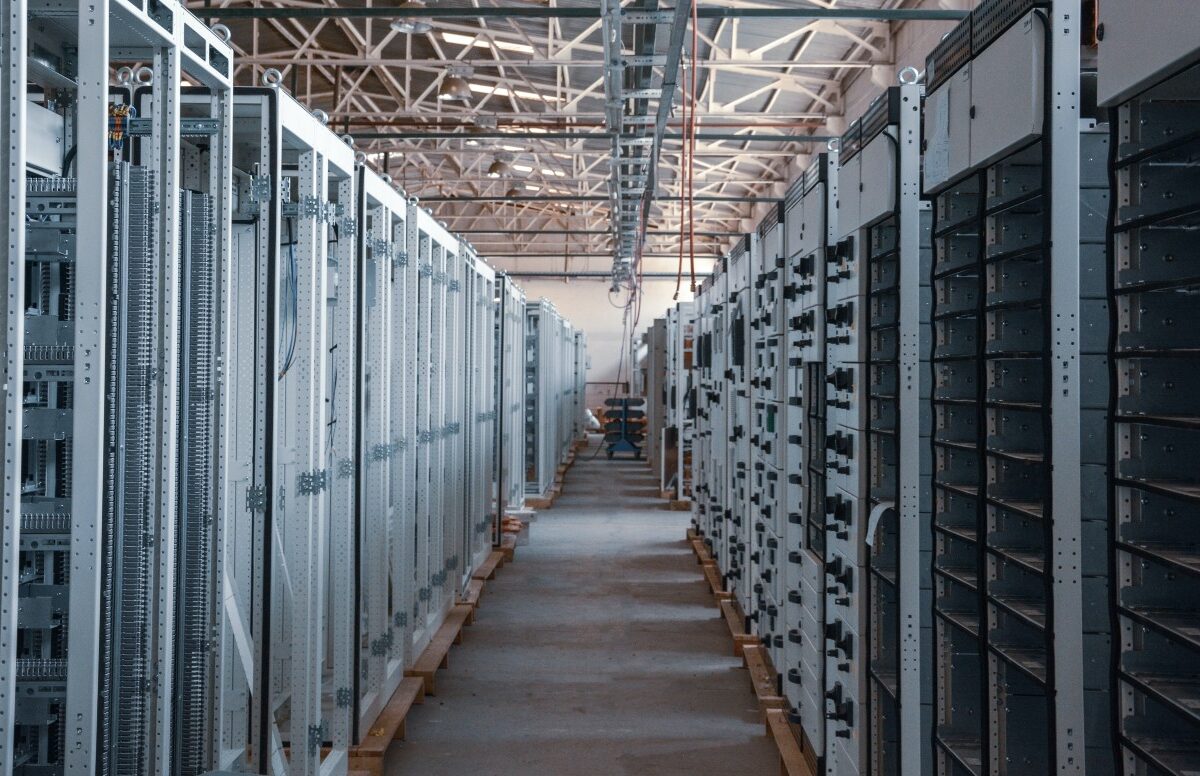
Data centres can range in size from small cabinets through to vast “hyperscale” warehouses the size of stadiums. Inside, are computers called servers which support the software, apps and websites we use every day.

The Conversation by The Conversation
20-10-2021 09:17
in News
Photo by İsmail Enes Ayhan on Unsplash

Photo by İsmail Enes Ayhan on Unsplash

Masaō Ashtine, University of Oxford and David Mytton, Imperial College London

The 1960s ushered in a new age of processing digital information, driven by the intelligence needs of the cold war. Moore’s law meant microchips doubled in speed every two years, shrinking costs and miniaturising machines that once filled entire rooms. Today, the smartphone probably being used to read this article is millions of times more powerful than the computer that landed the Apollo missions on the moon.

While those huge supercomputers have disappeared, the proliferation of the cloud and the internet of things, with everything down to our socks being able to connect to the internet, means more and more computer processors that need to communicate with data centres around the world. Even something as simple as scrolling down on this article triggers communications that may eventually pass through a distant data centre.

Data centres can range in size from small cabinets through to vast “hyperscale” warehouses the size of stadiums. Inside, are computers called servers which support the software, apps and websites we use every day.

As of the end of 2020, 597 hyperscale data centres were in operation (39% in the US, 10% in China, 6% Japan), up by almost 50% since 2015. Amazon, Google and Microsoft account for more than half of these and a further 219 are in various stages of planning.
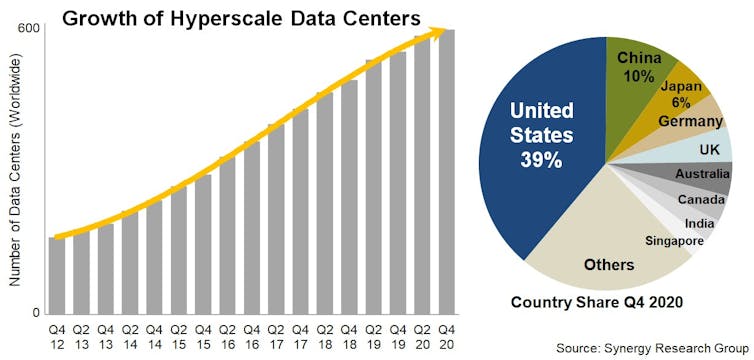
Graph of the growth of hyperscale data centers
Growth of hyperscale data centers. Synergy Research Group

Energy eaters

Data centres accounted for around 1% or 2% of global electricity demand in 2020. All that processing power generates lots of heat, so data centres must keep cool to prevent damage. While some companies are using cool air on mountain sites and Microsoft has used the cold waters of Scotland to experiment with underwater data centres, up to 43% of data centre electricity in the US is used for cooling.

This energy goes into cooling water which is either sprayed into air flowing past the servers, or evaporated to transfer heat away from the servers. Not only is energy required to cool the water (unless the system is specifically designed as a closed loop) but that water is lost as it evaporates. In a relatively small 1 megawatt data centre (that uses enough electricity to power 1,000 houses), these traditional types of cooling would use 26 million litres of water per year.


AlsoRead...

Ryan: Building real freedom through e-commerce

Ryan: Building real freedom through e-commerce

27 November 2025
Design Australia Group: Redefining Drafting as the engine of housing growth

Design Australia Group: Redefining Drafting as the engine of housing growth

26 November 2025

Water directly used for cooling is what most data centre operators focus on, but the largest source of water usage is actually electricity generation. This comes from how water is heated to generate steam which turns a turbine and generates electricity. Fossil fuels and nuclear power all consume water in this way, and even hydroelectric power involves some water loss from reservoirs.

The transition to renewables is therefore important to reduce both water and carbon footprints. By 2030, wind and solar energy could reduce water withdrawals related to power generation by 50% in the UK, 25% in the US, Germany and Australia, and 10% in India.

More than the daily water recommendation?

Data centre water demand is more complicated than the carbon footprint. Reaching zero carbon is a reasonable goal, but zero-water is not necessarily the right choice. Consumption goals need more context.
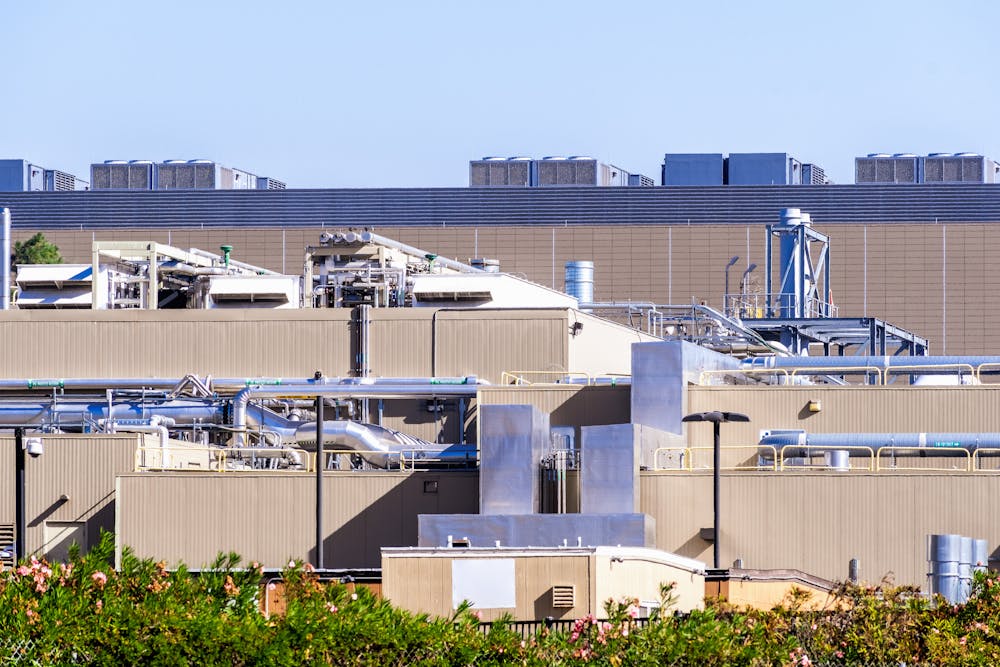
Warehouse building with external fans and pipes
A data centre in California’s Silicon Valley. Sundry Photography / shutterstock

Some data centres are in regions with abundant water, easily accessible without competing with other potential users. However, others may be built in areas of drought with degrading infrastructure.

Regional water stress must be considered for each data centre, not just in relation to the water used for on-site cooling, but also linked to the power plants that generate the electricity that power the centre.

For example, a recent US study showed that the western US has more water stress compared to the eastern US, and that electricity generated in the south west is more water intensive due to the use of more hydropower. Despite this, the west and south west have more data centres.
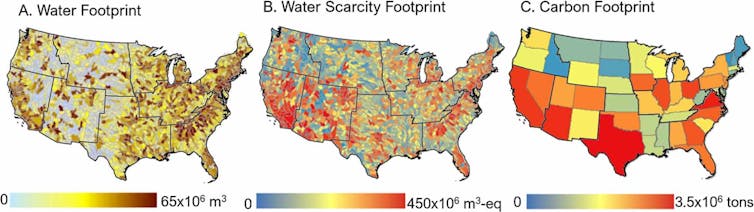
Map of data centre water footprint in the USA.
The subbasin or state of direct and indirect environmental impact associated with data centre operation. (A) Water footprint (m3). (B) WSF (m3 US-eq water). (C) Carbon footprint (tons CO2-eq/y). Md Abu Bakar Siddik et al 2021 Environ. Res. Lett. 16 064017

Opposition is starting to grow even as new projects are being approved. The US has seen local communities protest against new data centres, which may be why in the past Google has considered its usage of water to be a trade secret. Similar concerns led to a temporary ban on new data centres in The Netherlands, and France is in the process of passing new laws to require more transparency.

We do not give water enough value

Companies are not pricing water risk into their calculations when picking locations for data centres. A lower price does not necessarily mean lower risk. When Microsoft assessed its water footprint at a data centre in San Antonio, Texas, it found the true cost of water was 11 times more than it was paying.

This is similar to carbon footprints. We undervalue or ignore abatement costs associated with greenhouse emissions, and the impacts are hardly marginal. Carbon dioxide and water are inextricably linked, and climate change is already stressing drought-prone areas around the world.

The first step is transparency. Some companies like Microsoft and Facebook already publish aggregated water data, but others need to do the same. Every operator needs to publish their water efficiency plan and back it up with the relevant regional numbers.

Most data centre owners have received the message about reducing their carbon footprint and the transition to renewable energy. We regularly see new projects announced with net-zero carbon goals. They now need to do something similar for water.

Masaō Ashtine, Posdoctoral Researcher in Local Energy Systems, University of Oxford and David Mytton, Researcher, Centre for Environmental Policy, Imperial College London

This article is republished from The Conversation under a Creative Commons license. Read the original article.


Tags: SB001
DMCA.com Protection Status

SUBSCRIBE to our NEWSLETTER

[mc4wp_form id=”2384248″]

Don't Miss

The evolution of Aesthetic Surgery through the lens of Dr Kourosh Tavakoli

by Pauline Torongo
4 December 2025
The evolution of Aesthetic Surgery through the lens of Dr. Kourosh Tavakoli
Health & Wellness

As global interest in Australian cosmetic surgery continues to grow, the combination of regulation, research and emerging digital tools is...

Read moreDetails

Ryan: Building real freedom through e-commerce

by Pauline Torongo
27 November 2025
Ryan: Building real freedom through e-commerce
Business & Finance

Ryan’s greatest achievement isn’t any single business or revenue milestone — it’s the ecosystem he’s built through the Change community.

Read moreDetails

Design Australia Group: Redefining Drafting as the engine of housing growth

by Pauline Torongo
26 November 2025
Design Australia Group: Redefining Drafting as the engine of housing growth
Business & Finance

Australia is under pressure to build homes faster, but design bottlenecks slow progress. Design Australia Group is fixing this by...

Read moreDetails

Louis Guy Detata builds Global Trading Empires through autonomous systems and disciplined leadership

by Pauline Torongo
25 November 2025
Louis Guy Detata builds Global Trading Empires through autonomous systems and disciplined leadership
Business & Finance

The path from investment banking to leading a global trading platform has taught Louis Detata that sustainable success requires more...

Read moreDetails

Burning Eucalyptus Wood: Tips, Advantages, Disadvantages & Alternatives

by Fazila Olla-Logday
20 November 2025
Image Supplied
Enviroment

Learn about burning eucalyptus wood for stoves and fireplaces. Discover benefits, drawbacks, harvesting tips, and better alternative firewood options for...

Read moreDetails

Everything Parents Need to Know About Baby Soft Play and Why It’s a Game Changer

by Fazila Olla-Logday
11 November 2025
Everything Parents Need to Know About Baby Soft Play
Health & Wellness

Baby soft play is a fun, safe, and educational way for little ones to explore and grow. Discover the benefits...

Read moreDetails

WOMAD Sets Up a New Camp in Wiltshire – Australian festival fans take note!

by Kris Griffiths
11 November 2025
Kumbia Boruka brought their reggae and dancehall flavour to the Taste the World Stage at WOMAD 2024 - Credit - Mike Massaro
Entertainment

With its 2026 edition moving to Neston Park in England, WOMAD offers Aussie music lovers a chance to reconnect with global...

Read moreDetails
Load More

Copyright © Blue Sky Publications Ltd. All Rights Reserved.
australiantimes.co.uk is a division of Blue Sky Publications Ltd. Reproduction without permission prohibited. DMCA.com Protection Status

  • About us
  • Write for Us
  • Advertise
  • Contact us
  • T&Cs, Privacy and GDPR
No Result
View All Result
  • News
    • Weather
    • Sport
    • Technology
    • Business & Finance
      • Currency Zone
    • Lotto Results
      • The Lott
  • Lifestyle
    • Entertainment
    • Horoscopes
    • Health & Wellness
    • Recipes
  • Travel
  • Expat Life
  • Move to Australia

Copyright © Blue Sky Publications Ltd. All Rights Reserved.
australiantimes.co.uk is a division of Blue Sky Publications Ltd. Reproduction without permission prohibited. DMCA.com Protection Status

No Result
View All Result
  • News
    • Weather
    • Sport
    • Technology
    • Business & Finance
      • Currency Zone
    • Lotto Results
      • The Lott
  • Lifestyle
    • Entertainment
    • Horoscopes
    • Health & Wellness
    • Recipes
  • Travel
  • Expat Life
  • Move to Australia

Copyright © Blue Sky Publications Ltd. All Rights Reserved.
australiantimes.co.uk is a division of Blue Sky Publications Ltd. Reproduction without permission prohibited. DMCA.com Protection Status





