


• Advertise
  • About us
  • Terms and Conditions
  • Contact us
Wednesday, May 13, 2026
Australian Times News
  • News
    • Weather
    • Sport
    • Technology
    • Business & Finance
      • Currency Zone
    • Lotto Results
      • The Lott
  • Lifestyle
    • Entertainment
    • Horoscopes
    • Health & Wellness
    • Recipes
  • Travel
  • Expat Life
  • Move to Australia
No Result
View All Result
  • News
    • Weather
    • Sport
    • Technology
    • Business & Finance
      • Currency Zone
    • Lotto Results
      • The Lott
  • Lifestyle
    • Entertainment
    • Horoscopes
    • Health & Wellness
    • Recipes
  • Travel
  • Expat Life
  • Move to Australia
No Result
View All Result
Australian Times News
No Result
View All Result
Home News

The plastic recycling system is broken – here’s how we can fix it

COVID-19 exposed the plastics recycling sector’s vulnerability to oil-price changes. Economic shutdown driven by the pandemic led to reduced global oil demand, which in turn caused oil prices to plunge.

The Conversation by The Conversation
15-10-2021 09:17
in News
Photo by Layne Harris on Unsplash

Photo by Layne Harris on Unsplash

Eleni Iacovidou, Brunel University London and Norman Ebner, University of Oxford

The investor Warren Buffett once remarked that “only when the tide goes out do you discover who’s been swimming naked”. For the plastics recycling industry, the pandemic was a bit like the tide going out, exposing its deep-rooted structural problems.

Specifically, COVID-19 exposed the plastics recycling sector’s vulnerability to oil-price changes. Economic shutdown driven by the pandemic led to reduced global oil demand, which in turn caused oil prices to plunge. This shifted manufacturers’ preference towards making new plastic, increasing the cost of recycling plastics in the first place.

Changes like this are leading to increasing pollution from new plastic production, with negative consequences for the health of our planet. In the short term, it could also threaten the livelihoods of those working in plastic waste management across the world. And in the long term, it could result in lower investment in the recycling sector, as companies may be wary of risking financial loss.

Since before the pandemic, governments worldwide have shown a tendency to seek quick-fix solutions to plastic pollution in order to signal a decisive stance on sustainability. For example, a move that commonly receives high levels of political support is a ban on single-use plastic plates and cutlery.

But while this ban has its benefits, it only provides a partial solution to the much larger problem of excessive consumption, influenced by our modern culture of convenience.

Such actions seem to smooth over the problem of generating plastic waste, when in reality, the resulting proliferation of other single-use items can lead to even worse environmental consequences. A far better plan would be to first tackle the problems with plastic production at their source.


AlsoRead...

Svitla Systems

Svitla Systems acquires Australia’s Kiandra IT to expand Global Engineering Footprint and Accelerate AI-Driven delivery

11 May 2026
How Clevero is helping Australian Service Businesses compete with Enterprises on a Fraction of the Budget

How Clevero is helping Australian Service Businesses compete with Enterprises on a Fraction of the Budget

28 April 2026

Improvements

To begin with, it’s time to improve transparency in the plastic production system.

There is not enough data on which types and amounts of plastics are imported and exported between countries, as well as on how those plastics are used, meaning we don’t always know precisely where most waste is generated. A monitoring system that can properly track how plastics flow across different countries will help us to better understand where regulations may be needed.
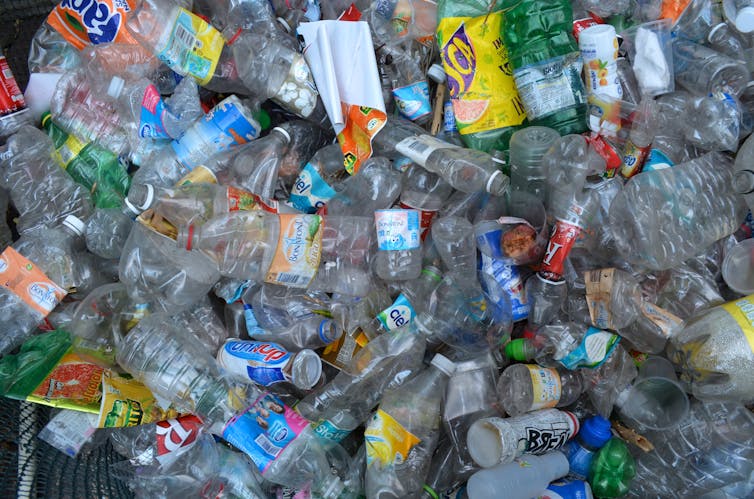
Plastic bottles gathered for recycling
Tracking plastic items can help us better understand where they end up and why their recycling rates are often low. Wikimedia

For example, blind spots in plastic data collection can be illuminated using track-and-trace technology able to follow a piece of plastic from its origin, along many trade routes, to the end of its journey as refuse or recycling.

Analysing hundreds of thousands of these journeys will help us develop a deeper understanding of the complex political and economic power dynamics that influence plastic supply chains across the planet.

What’s more, we must promote sustainable plastic waste management within countries by making it economically achievable to recycle plastics, even in places with little recycling infrastructure.

To do this, there needs to be significant changes in regulations to ensure that companies make the effort to recycle where possible, as well as incentives to achieve recycling targets and establish plants.

In the UK, the plastic packaging tax, due to be introduced in April 2022, aims to increase demand for recycled plastic. By taxing plastic packaging that contains less than 30% recycled material at £0.20 per kilogram, the government is creating a clear incentive for businesses to take advantage of recycled plastic when planning their products’ packages.

Similarly, in the EU, the plastic packaging levy introduced in January 2021 mandates member states to pay a tax of £0.68 per kilogram on non-recycled plastic packaging.
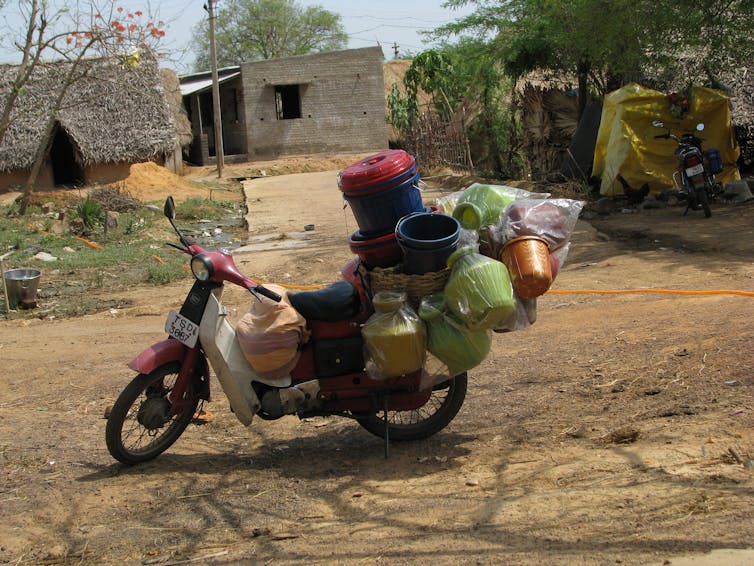
A motorbike with plastic containers and packaging attached
Social and cultural treatment of plastic waste, and of those who handle it, can differ widely from place to place. Wikimedia

Although it may be a few years before the effects of these taxes become clear, both are likely to spur improvements in plastic recycling rates while attracting investment into better recycling facilities. But if measures like these are to be successful, monitoring systems need to be put in place to make sure companies aren’t finding ways to dodge the laws.

Finally, the role plastic waste plays in different local cultures shouldn’t be overlooked. Conventions on how plastic waste should be treated, as well as attitudes towards informal waste pickers, ranging from acceptance to stigma, affect the way plastic waste management systems operate. These factors will need to be addressed by those familiar with each community’s customs if these systems are to be improved.

If we want to rid our natural spaces of plastic, we need to promote an inclusive, transparent approach to how plastic waste is treated.

Eleni Iacovidou, Lecturer in Environmental Management, Brunel University London and Norman Ebner, Postdoctoral Research Associate in Circular Plastics-Techno-Economics, University of Oxford

This article is republished from The Conversation under a Creative Commons license. Read the original article.


Tags: SB001
DMCA.com Protection Status

SUBSCRIBE to our NEWSLETTER

[mc4wp_form id=”2384248″]

Don't Miss

Svitla Systems acquires Australia’s Kiandra IT to expand Global Engineering Footprint and Accelerate AI-Driven delivery

by Pauline Torongo
11 May 2026
Svitla Systems
Business & Finance

Acquisition marks Svitla’s entry into the Australian market and strengthens capabilities in low-code, Microsoft technologies, and enterprise software engineering.

Read moreDetails

Residential Healthcare Practices: Revolution or Evolution?

by Pauline Torongo
11 May 2026
Residential Healthcare Practices: Revolution or Evolution?
Lifestyle

President Bill Lutz’s "revolution" was born from his background in fine dining, which instilled a disciplined, customer-focused approach.

Read moreDetails

Medicana Health Group launches HPV vaccination campaign to support cervical cancer prevention

by Pauline Torongo
28 April 2026
Medicana Health Group launches HPV vaccination campaign to support cervical cancer prevention
Health & Wellness

The Türkiye-based healthcare group has introduced a new awareness campaign focused on HPV vaccination, regular check-ups and early detection, with...

Read moreDetails

How Clevero is helping Australian Service Businesses compete with Enterprises on a Fraction of the Budget

by Pauline Torongo
28 April 2026
How Clevero is helping Australian Service Businesses compete with Enterprises on a Fraction of the Budget
Business & Finance

By consolidating CRM, scheduling, workflow automation, invoicing, reporting, and client communications into a single platform, Clevero gives smaller operators the...

Read moreDetails

How CJAM Group is building 1,100 homes across Southeast Queensland

by Pauline Torongo
24 March 2026
How CJAM Group is building 1,100 homes across Southeast Queensland
Lifestyle

The CJAM Group founder is quietly building a 1,100+ home pipeline, with projects in Hervey Bay and Toowoomba, using a...

Read moreDetails

Design Without Compromise: Where Gutter Protection Meets Modern Architecture

by Fazila Olla-Logday
20 March 2026
Design Without Compromise: Where Gutter Protection Meets Modern Architecture
Business & Finance

Design without compromise by integrating gutter protection seamlessly into modern architecture. Discover how innovative gutter systems enhance your home’s aesthetics...

Read moreDetails

How WageSafe Secured Australia’s Most Reputable Retail Business Among Its Premium Clients

by Fazila Olla-Logday
12 March 2026
How WageSafe Secured Australia’s Most Reputable Retail Business Among Its Premium Clients
at

Learn how WageSafe helps businesses stay compliant with payroll and wage regulations through reliable monitoring, risk management, and expert support—protecting...

Read moreDetails
Load More

Copyright © Blue Sky Publications Ltd. All Rights Reserved.
australiantimes.co.uk is a division of Blue Sky Publications Ltd. Reproduction without permission prohibited. DMCA.com Protection Status

  • About us
  • Write for Us
  • Advertise
  • Contact us
  • T&Cs, Privacy and GDPR
No Result
View All Result
  • News
    • Weather
    • Sport
    • Technology
    • Business & Finance
      • Currency Zone
    • Lotto Results
      • The Lott
  • Lifestyle
    • Entertainment
    • Horoscopes
    • Health & Wellness
    • Recipes
  • Travel
  • Expat Life
  • Move to Australia

Copyright © Blue Sky Publications Ltd. All Rights Reserved.
australiantimes.co.uk is a division of Blue Sky Publications Ltd. Reproduction without permission prohibited. DMCA.com Protection Status

No Result
View All Result
  • News
    • Weather
    • Sport
    • Technology
    • Business & Finance
      • Currency Zone
    • Lotto Results
      • The Lott
  • Lifestyle
    • Entertainment
    • Horoscopes
    • Health & Wellness
    • Recipes
  • Travel
  • Expat Life
  • Move to Australia

Copyright © Blue Sky Publications Ltd. All Rights Reserved.
australiantimes.co.uk is a division of Blue Sky Publications Ltd. Reproduction without permission prohibited. DMCA.com Protection Status





