



Paul Chinowsky, University of Colorado Boulder
Rising temperatures due to climate change are causing more than just uncomfortably hot days across the United States. These high temperatures are placing serious stress on critical infrastructure such as water supplies, airports, roads and bridges.
One category of critical infrastructure being severely affected is the nation’s K-12 schools.
Ideally, the nation’s more than 90,000 public K-12 schools, which serve over 50 million students, should protect children from the sometimes dangerous elements of the outdoors such as severe storms or extreme temperatures.
But since so many of America’s schools are old and dilapidated, it’s the school buildings themselves that need protection – or at least to be updated for the 21st century.
Twenty-eight percent of the nation’s public schools were built from 1950 through 1969, federal data shows, while just 10% were built in 1985 or later.
As a researcher who studies the impact of climate change, I have measured its effects on infrastructure and health for over a decade. During that time, I’ve seen little attention focused on the effects of climate change on public schools.


Since 2019, climate scientist Sverre LeRoy, at the Center for Climate Integrity, and I have worked to determine if the nation’s schools are prepared for the heat waves on the approaching horizon.
Comparing the climate conditions under which U.S. schools were built with the projected conditions over the next two decades, we looked at the vulnerability of all K-12 schools to increasing temperatures. We determined whether current schools have air conditioning or not and whether they would be required to add air conditioning in the future.
The results of our study, “Hotter Days, Higher Costs: The Cooling Crisis in America’s Classrooms,” show that by 2025, more than 13,700 schools will need to install air conditioning, and another 13,500 will need to upgrade their existing systems.
Hot classrooms
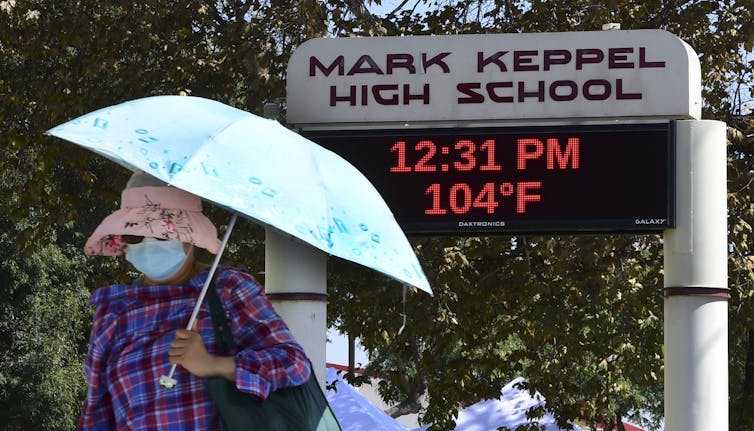
Research has shown that high classroom temperatures can make it harder to learn. Hot school days cause difficulty in concentrating, sleepiness, a decrease in energy and even reduced memory capacity.
Local school districts have policies for extreme heat events. However, rising temperatures mean these guidelines are no longer limited to rare occurrences.
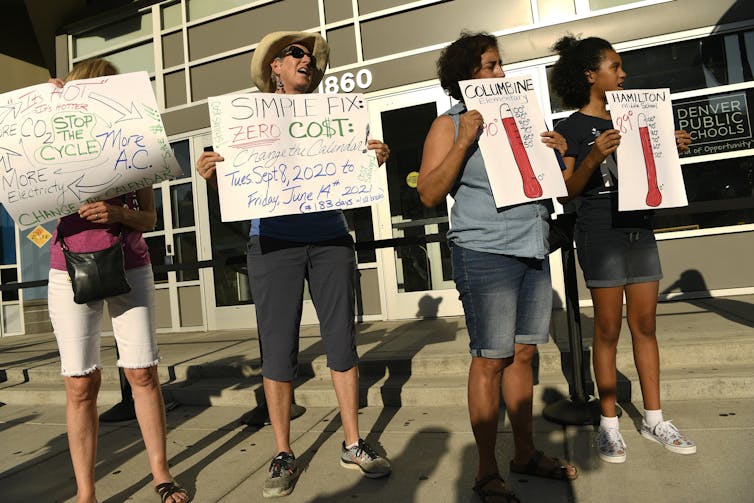
Over the past several years, schools across the U.S. are increasingly forced to take “heat days,” cutting school days short because of classrooms that are too hot for students to effectively learn.
This is happening in places that range from Denver to Baltimore and Cleveland.
Compounding the increase in temperatures is the national trend that seasonal temperatures are rising in both the spring and the fall. For example, both Rhode Island and New Jersey have seen average spring and fall temperatures rise over 3 degrees Fahrenheit (1.7 Celsius). Rather than high temperatures only occurring when students are on summer break, these heat events now occur regularly during the school year too. Students today in a greater number of cities are beginning and ending the school year in classrooms that often exceed 80 F (27 C).
Expensive upgrades
The problem of more hot days is due to average temperatures increasing over the past 40 years. The number of days with high temperatures has risen across the country, with notable increases in large northern cities. For example, Chicago has seen the number of days over 80 degrees during the school year increase from 27 in 1970 to 32 in 2020 and a projected 38 by 2025. These increases affect schools in two distinct ways.
Schools in the traditionally cooler north – especially older schools – will need to be retrofitted with new air conditioning systems at an accumulated cost of US$40 billion by 2025. For schools in the traditionally warmer South and West, many existing systems will need to be upgraded at a projected cost exceeding $400 million.
Temperature increases are especially costly in large cities such as Philadelphia, Chicago and Los Angeles, where existing efforts and continued needs will result in outlays exceeding $500 million, $1.5 billion and $600 million, respectively. These large districts have a greater number of older buildings that require upgrades in electrical and structural systems to support new air conditioning systems.
For all schools – even ones that don’t require system upgrades – the additional costs of operating air conditioning systems to meet the new demands will exceed $1.4 billion per year.
An equity issue
Since school districts are dependent on local taxes or bond measures to finance the school system, districts in affluent areas have a greater opportunity to obtain funds through tax increases or voter-approved bond measures.
In contrast, districts located in less affluent counties – including Bell County, Kentucky; Scott County, Tennessee; and DeKalb County, Alabama – face the challenge of creating safe learning environments without a financial safety net. With household incomes for the entire district in the bottom 20% of national averages, or less than $43,000 per year, these districts are unable to absorb significant tax increases.
In this regard, classroom environments become an equity issue. While the increase in temperature may affect all children, the relative impact of the increase and the ability to adapt is not equal.
Unsustainable solutions
Increasingly, school districts are turning to individual window units to address classroom overheating. However, window units do not cool interior offices, cannot circulate and exchange air within the classrooms, and will not meet expected lifespans due to extensive use. Furthermore, they create uneven cooling patterns and classroom disturbance due to noise. While these solutions are popular from an initial budget perspective, they ultimately fail to solve the hot classroom crisis.
Where mechanical systems are not an option due to budgetary constraints, school districts are looking at altering the school year to start later or end earlier. However, there are limits to this approach because there are minimum requirements for the number of days that are in the school year. Some schools are even experimenting with remote learning as a response when extreme temperatures are an issue.
The bottom line for schools and their surrounding communities is that rising temperatures from climate change are a growing threat to school infrastructure. Schools will need additional funding to install or upgrade air conditioning systems, pay for increased energy usage or redesign school buildings to enhance natural cooling. Various cities and states argue that fossil fuel companies have a duty to pay these infrastructure costs associated with climate change.
The only other choice is for America’s students to continue to endure classrooms where it’s simply too hot to learn.
[Like what you’ve read? Want more? Sign up for The Conversation’s daily newsletter.]
Paul Chinowsky, Professor of Environmental Design, University of Colorado Boulder
This article is republished from The Conversation under a Creative Commons license. Read the original article.







