


Mike Reddy, University of South Wales
Sir Clive Sinclair, inventor of the UK’s first mass-market home computer, has died at the age of 81. Pioneer of tiny portable devices, truly affordable computers and novel, electric forms of transportation, he leaves behind what some see as a checkered history of hit-and-miss inventions.
But Sir Clive’s contribution to British technology, and by extension the British economy, is beyond dispute. An icon of home computing, he created devices that were enjoyed by millions, the majority of whom would have been unable, in the 1980s when his computers were launched, to purchase the expensive models on the market.
Even Sinclair’s so-called failures reveal an inventor who sought to solve everyday problems rather than amass a personal fortune. And many were prescient. Anticipating electrified personal transportation, Sinclair developed an electric car, then an electric bike – long before the vogue they both enjoy today.
These later inventions may have been a business failure, but they were a triumph of the will and the imagination. Sinclair long ago secured his legacy as the “father of the home computer”, but time is only now vindicating his other creations. Now, at least, we have the chance to catch up.
Early successes
Sinclair’s earliest contribution to consumer electronics was the Sinclair Executive, the world’s first pocket calculator, which went on sale in 1972. No match for today’s calculators, the Executive nevertheless established Sinclair as a technological pioneer.
He subsequently shifted his attention to develop a string of genuinely affordable home computers, beginning with the launch of the Spectrum ZX80 in 1980. At a time when computers were still regarded as an exclusive technology affordable only to businesses and the wealthy, Sinclair’s targeted the mass market, with a price tag less than £100 – £440 in today’s money.


This period of innovation gave rise to the ZX Spectrum, the iconic home computer on which many people of a certain age shot their first pixelated aliens. That device, with its trademark rainbow sash, is still fondly remembered by millions of early computer users, whose parents may have hoped they’d pursue more explicitly educational experiences on the novel device.
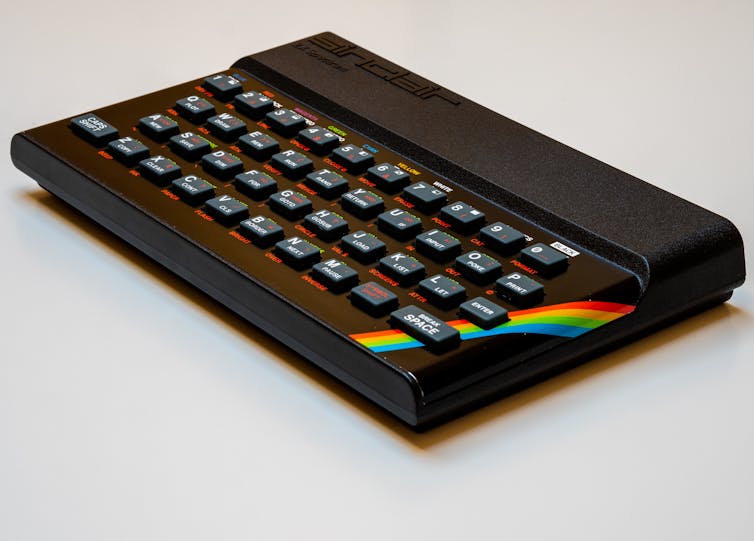
For Sinclair, the Spectrum’s resounding place in history as primarily a games machine must have rankled, given his well-known ambition to get computers to the masses as a means to expose them to technology he knew would come to define the future.
Still, placed in the general public’s hands, the ZX Spectrum did inspire a generation of software designers, including some of the leading lights in today’s UK games and tech industries. The beauty of these computers was in their ability to support all kinds of creativity – including those who wanted to build games.
So-called failures
Later in his career, Sinclair was regarded by many to have gone off the boil. He launched an unsuccessful bid to make the ZX81 the official BBC computer (not the Spectrum, as many believe). It ended up becoming much more successful than the BBC’s choice, the BBC Micro.
The BBC contract was awarded to Acorn, founded by former Sinclair Research employee Chris Curry. The rivalry between Sinclair and Curry was wonderfully – if apocryphally – retold in BBC 4’s Micro Men. The show was described as “mostly true” by those present at the time, though Sinclair himself stated that “it was a travesty of the truth. It just had no bearing on the truth. It was terrible.”
The “mockumentary” style made tongue-in-cheek references to Sinclair’s C5 electric car, launched in 1985 with the promise of delivering a “new power in personal transport”. The C5 recorded abysmal sales, with road users understandably nervy navigating mixed traffic from a seat inches above the road. The show also references Quantum Leap, Sinclair’s abortive attempt to get into business computing, including a parody of Sir Clive’s exaggerated jumping in the QL computer’s TV advert. https://www.youtube.com/embed/as6hSAqJ_g4?wmode=transparent&start=0
Micro Men reflects how some in the media turned on Sinclair after his early computing triumphs, focusing on his subsequent inventions, which they quickly deemed to be failures. But that perspective fails to recognise the hidden influence Sinclair’s work continued to have in the latter part of his career.
The company that won the BBC contact, Acorn Computers Ltd, was itself an offshoot of Sinclair’s vision and innovation. It went on, under the new name Advanced RISC Machines, or ARM, to create the central processing units (CPUs) that drive most of the devices we use today.
Sinclair also possessed startling prescience. Electric vehicles are set to take over our roads in the next decade or two, but Sinclair’s C5, manufactured in Merthyr Tydfil in the mid-1980s, could have started the push towards electric cars decades ago. It wasn’t to be.
Sinclair was soon at it again, this time with the Zike, first released in 1992. An electric bike with a top speed of 12mph, the Zike also failed to excite consumers. Yet this invention also appears to have anticipated future trends in personal transportation, given the proliferation of electric bicycles and scooters on our streets today.
Sinclair’s drive was not necessarily to be the best, but to be the most affordable. That’s a business model that many technology companies still emulate. All his inventions bear the hallmarks of products designed to solve everyday problems. Many sought to place cutting-edge technology into ordinary people’s hands.
Sir Clive’s true legacy is the lasting impact of those central motivations. Millions of people fondly remember Sinclair’s early computers with more then retro nostalgia. They were many people’s first chance to experience computer power, delivered by an inventor who valued access over exclusivity.
Despite criticism and even derision in the media, Sinclair was never disheartened, following instead his own often-quoted, endearingly simple advice: “Don’t give up. Stick at it.”
Mike Reddy, Senior Lecturer, Faculty of Computing, Engineering and Science, University of South Wales
This article is republished from The Conversation under a Creative Commons license. Read the original article.







